Introduction
The introduction of the Goods and Services Tax (GST) marked a major shift in India’s taxation system, aiming to simplify compliance and improve transparency through digitization. At the heart of this transformation lies the GST portal—a centralized online platform designed to handle registrations, return filings, tax payments, and refunds.
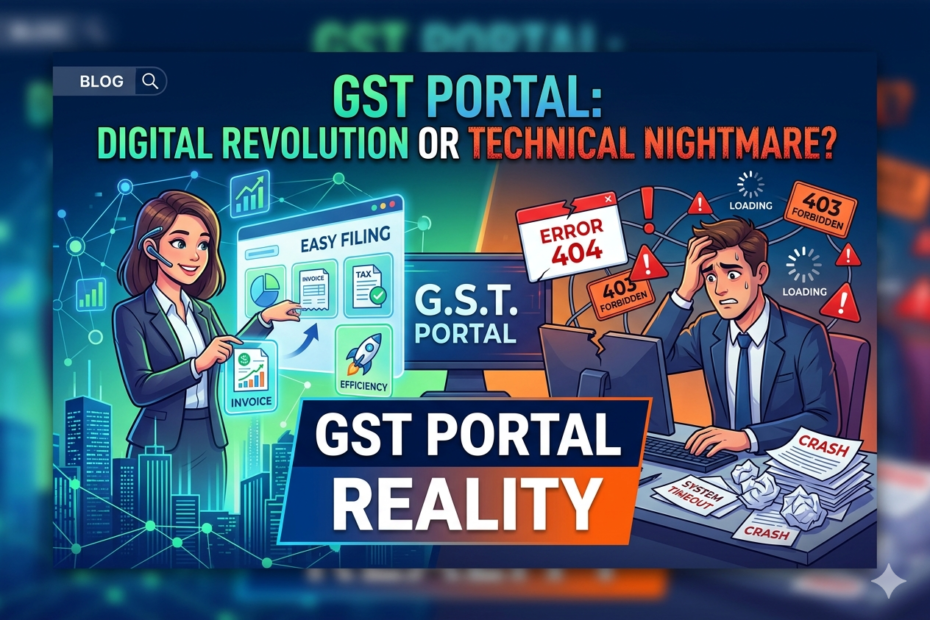
While the portal represents a significant technological advancement, the GST Portal Reality presents a mixed picture. For some, it is a revolutionary step toward digital governance. For others, it is a source of frustration due to technical glitches and compliance challenges.
So, is the GST portal truly a digital revolution, or has it become a technical nightmare for businesses?
Let’s explore the GST Portal Reality in detail.
What is the GST Portal?
The GST portal is the official online platform that enables taxpayers to:
Register under GST
File returns (GSTR-1, GSTR-3B, etc.)
Make tax payments
Claim refunds
Respond to notices
It was introduced to eliminate manual processes and bring efficiency, transparency, and accountability into the tax system.
The Vision: A Digital Revolution
The GST portal was envisioned as a game-changer for India’s tax ecosystem.
1. Simplification of Tax Processes
The portal aimed to replace complex offline procedures with a single, unified digital platform.
2. Transparency and Accountability
Digital records reduce human intervention, ensuring:
Less corruption
Better tracking
Improved compliance
3. Real-Time Data Access
Businesses can:
Track filings
Monitor tax liabilities
Access historical data
4. Ease of Doing Business
A streamlined system was expected to:
Reduce compliance burden
Save time and cost
From this perspective, the GST Portal Reality appears progressive and forward-looking.
The Ground Reality: Technical Nightmare?
Despite its ambitious vision, many taxpayers face practical issues that define the GST Portal Reality.
1. Frequent Technical Glitches
Users often encounter:
Portal downtime during peak periods
Slow loading speeds
Errors while filing returns
These issues can delay compliance and increase stress.
2. Filing Errors and System Bugs
Common problems include:
Incorrect data reflection
Failed submissions
Duplicate entries
Such errors can lead to mismatches and notices.
3. Complex User Interface
For many small business owners, the portal is:
Difficult to navigate
Not user-friendly
Confusing for first-time users
4. Last-Minute Pressure
Due to portal slowdowns near deadlines, taxpayers face:
Filing delays
Late fees
Panic situations
5. Integration Issues
Mismatch between:
GSTR-1
GSTR-3B
GSTR-2B
creates complications in compliance and ITC claims.
GST Portal Reality: Impact on Businesses
1. Increased Compliance Burden
Instead of simplifying processes, technical issues often:
Increase workload
Require repeated attempts
2. Financial Consequences
Errors and delays can result in:
Penalties
Interest charges
Loss of ITC
3. Time Consumption
Businesses spend significant time resolving portal issues rather than focusing on growth.
4. Dependence on Professionals
Due to complexity, many businesses rely heavily on:
Accountants
Tax consultants
Common Issues Faced on GST Portal
Understanding these issues helps highlight the GST Portal Reality:
Login and OTP problems
Server downtime
Data mismatch errors
Return filing failures
Refund processing delays
Difficulty in downloading reports
Government Initiatives to Improve the Portal
The government has taken several steps to address these concerns:
1. System Upgrades
Regular updates to improve speed and functionality.
2. Introduction of E-Invoicing
Enhances data accuracy and reduces manual errors.
3. Helpdesk Support
Dedicated support for resolving taxpayer issues.
4. Simplified Return Filing
Efforts to make return formats more user-friendly.
Despite these efforts, the GST Portal Reality still reflects a gap between expectation and experience.
Digital Revolution: The Positive Side
1. Paperless Compliance
No need for physical documentation, saving time and cost.
2. Better Data Management
Centralized system ensures easy access to records.
3. Improved Tax Monitoring
Authorities can track transactions efficiently.
4. Increased Transparency
Reduces scope for tax evasion and fraud.
Technical Nightmare: The Negative Side
1. System Dependency
Any technical issue directly impacts compliance.
2. Lack of Flexibility
Strict system rules leave little room for correction.
3. Frequent Updates
Constant changes create confusion among taxpayers.
4. Limited User Awareness
Many small businesses struggle to adapt to digital systems.
How to Manage GST Portal Challenges
To handle the GST Portal Reality, businesses should adopt smart strategies:
1. Avoid Last-Minute Filing
File returns early to avoid portal congestion.
2. Maintain Accurate Data
Ensure error-free data entry to prevent mismatches.
3. Regular Reconciliation
Match returns monthly to identify issues early.
4. Keep Backup Records
Maintain offline records for safety.
5. Use Professional Support
Experts can help navigate complex processes efficiently.
Future of GST Portal in India
The future of the GST portal looks promising with:
1. AI-Based Automation
Reducing errors and improving efficiency.
2. Better User Interface
Simplified design for ease of use.
3. Real-Time Data Integration
Minimizing mismatches and delays.
4. Enhanced Security
Protecting taxpayer data and transactions.
These improvements can transform the GST Portal Reality into a truly seamless digital experience.
Digital Revolution or Technical Nightmare?
The answer lies somewhere in between.
Revolution When:
System works smoothly
Data is accurate
Processes are automated
Nightmare When:
Technical glitches occur
Deadlines are missed
Errors lead to penalties
The GST Portal Reality is a combination of both—innovation and imperfection.
Conclusion
The GST Portal Reality reflects the challenges of implementing a large-scale digital system in a diverse economy like India. While the portal has significantly improved transparency and efficiency, technical issues and usability challenges continue to impact businesses.
For the GST system to achieve its full potential, continuous improvements in technology, user experience, and support systems are essential.
Businesses, on the other hand, must adapt to this digital ecosystem by staying compliant, proactive, and informed.
Ultimately, the GST portal is not just a system—it is the backbone of India’s modern tax framework. With the right balance of technology and user support, it can truly become the digital revolution it was meant to be.
SEO Keywords (For Ranking Boost)
GST Portal Reality, GST portal issues, GST portal errors, GST filing problems, GST system India, GST compliance challenges, GST portal glitches, GST return filing issues, GST digital system India.


