Introduction
The Goods and Services Tax (GST) has transformed India’s indirect tax system by replacing multiple taxes with a unified structure. While GST aims to simplify taxation, many businesses and individuals still struggle to understand its components.
This Essential Guide to GST Types will help you clearly understand the three main types of GST—CGST, SGST, and IGST—in the simplest way possible. Whether you are a business owner, student, or professional, this guide will give you practical clarity on how GST actually works in real life.
What is GST?
GST (Goods and Services Tax) is a destination-based tax levied on the consumption of goods and services. It is applied at every stage of value addition but allows credit for taxes paid at earlier stages.
The key objective of GST is to:
Eliminate cascading tax (tax on tax)
Simplify tax compliance
Create a unified national market
Why Are There Different Types of GST?
A common question is—if GST is “One Nation, One Tax,” why are there multiple types?
The answer lies in India’s federal structure, where both the Central and State Governments have the power to levy taxes.
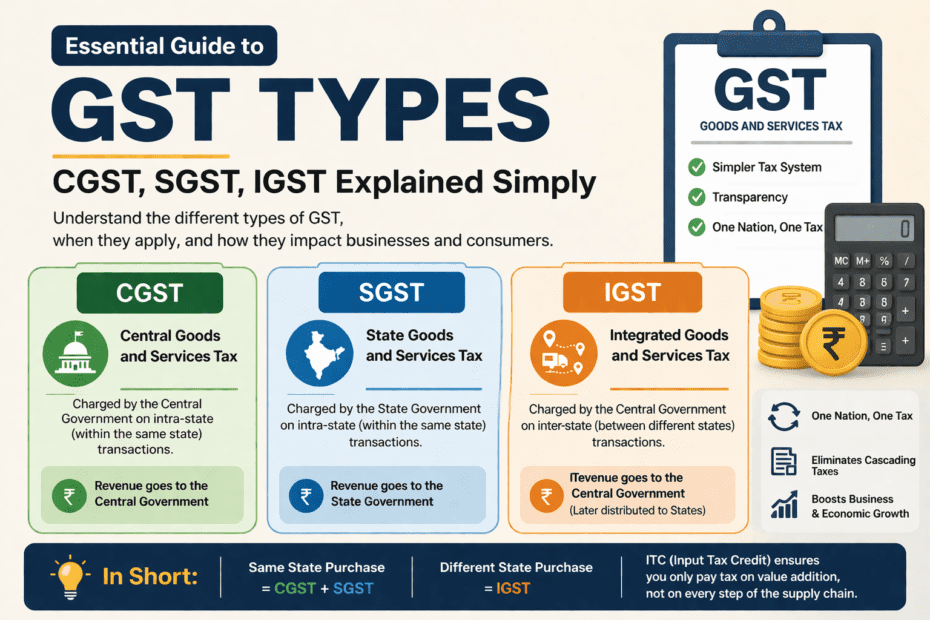
To ensure fair distribution of tax revenue, GST is divided into three types:
CGST (Central GST)
SGST (State GST)
IGST (Integrated GST)
This structure forms the foundation of this Essential Guide to GST Types.
1. CGST (Central Goods and Services Tax)
What is CGST?
CGST is the tax collected by the Central Government on intra-state transactions (within the same state).
Example:
If a business sells goods within West Bengal:
CGST is charged by the Central Government
SGST is charged by the State Government
Key Points:
Applicable on intra-state supply
Collected by Central Government
Equal share with SGST
2. SGST (State Goods and Services Tax)
What is SGST?
SGST is the tax collected by the State Government on intra-state transactions.
Example:
If a product is sold within the same state:
CGST + SGST are applied
Both are charged equally
Key Points:
Applicable on intra-state supply
Collected by State Government
Works alongside CGST
3. IGST (Integrated Goods and Services Tax)
What is IGST?
IGST is charged on inter-state transactions (between different states) and on imports.
Example:
If a business in West Bengal sells goods to Maharashtra:
IGST is applied instead of CGST + SGST
Key Points:
Applicable on inter-state supply
Collected by Central Government
Later distributed between states
Difference Between CGST, SGST, and IGST
| Feature | CGST | SGST | IGST |
|---|---|---|---|
| Applicable On | Intra-state | Intra-state | Inter-state |
| Collected By | Central Govt | State Govt | Central Govt |
| Tax Sharing | Shared with SGST | Shared with CGST | Distributed later |
This comparison is crucial in understanding the Essential Guide to GST Types.
How GST Types Work in Real Life
Intra-State Transaction Example
Suppose a product costs ₹1,000 and GST rate is 18%.
CGST = 9% → ₹90
SGST = 9% → ₹90
Total GST = ₹180
Inter-State Transaction Example
Same product sold to another state:
IGST = 18% → ₹180
This shows how GST types function differently depending on the nature of the transaction.
Input Tax Credit (ITC) Across GST Types
One of the most important aspects of this Essential Guide to GST Types is understanding how ITC works.
Rules for ITC Utilization:
CGST credit → used for CGST & IGST
SGST credit → used for SGST & IGST
IGST credit → used for IGST, CGST, SGST
Important Rule:
CGST credit cannot be used to pay SGST directly and vice versa.
Why Understanding GST Types is Important
1. Accurate Tax Filing
Correct classification helps avoid errors and penalties.
2. Proper ITC Claim
Understanding GST types ensures correct input tax credit utilization.
3. Avoiding Notices
Incorrect tax application can lead to GST notices.
4. Better Business Decisions
Helps in pricing, invoicing, and compliance.
Common Mistakes Businesses Make
Even after reading this Essential Guide to GST Types, many businesses make mistakes such as:
Applying CGST/SGST instead of IGST
Incorrect place of supply determination
Wrong ITC utilization
Filing incorrect returns
These errors can result in penalties and compliance issues.
GST Types and Place of Supply
The place of supply determines whether a transaction is intra-state or inter-state.
Key Rule:
Same state → CGST + SGST
Different states → IGST
Incorrect determination of place of supply is a major cause of GST errors.
Advantages of GST Structure
1. Eliminates Multiple Taxes
Replaces VAT, Service Tax, Excise Duty, etc.
2. Uniform Tax System
Creates consistency across states.
3. Better Tax Compliance
Digital system improves tracking and transparency.
4. Boosts Economy
Encourages ease of doing business.
Challenges in GST Types
Despite its benefits, the Essential Guide to GST Types also highlights challenges:
1. Complexity for Beginners
Understanding multiple components can be confusing.
2. Compliance Burden
Frequent filings and reconciliation required.
3. System Errors
GST portal issues can create confusion in tax classification.
How to Avoid GST Errors
1. Understand Place of Supply
Always determine the correct nature of transaction.
2. Use Accounting Software
Automates tax calculation and reduces errors.
3. Regular Reconciliation
Match returns to avoid mismatches.
4. Consult Experts
Professional guidance can prevent costly mistakes.
Future of GST Structure in India
The GST system is continuously evolving. Possible future changes include:
Simplification of tax structure
Reduction in tax slabs
Improved digital infrastructure
Better compliance systems
These changes aim to make GST easier and more efficient.
Conclusion
This Essential Guide to GST Types clearly shows that while GST aims to simplify taxation, understanding its structure is crucial for compliance.
CGST, SGST, and IGST are not just technical terms—they directly impact how businesses calculate tax, claim credits, and file returns.
By understanding these concepts, businesses can:
Avoid errors
Reduce tax burden
Improve compliance
Ultimately, GST types are not complicated once you understand the logic behind them. With the right knowledge and approach, GST can truly become a simplified and efficient tax system.
SEO Keywords (For Ranking Boost)
Essential Guide to GST Types, GST types India, CGST SGST IGST explained, GST structure India, GST basics, GST for beginners, GST components explained, GST tax system India.


