Introduction
The introduction of the Goods and Services Tax (GST) in India was hailed as a landmark reform aimed at simplifying the indirect tax system, improving transparency, and ensuring seamless flow of credit across the value chain. One of the most critical features of GST is its refund mechanism, which ensures that businesses—especially exporters and those with accumulated input tax credit—are not burdened with excess taxes.
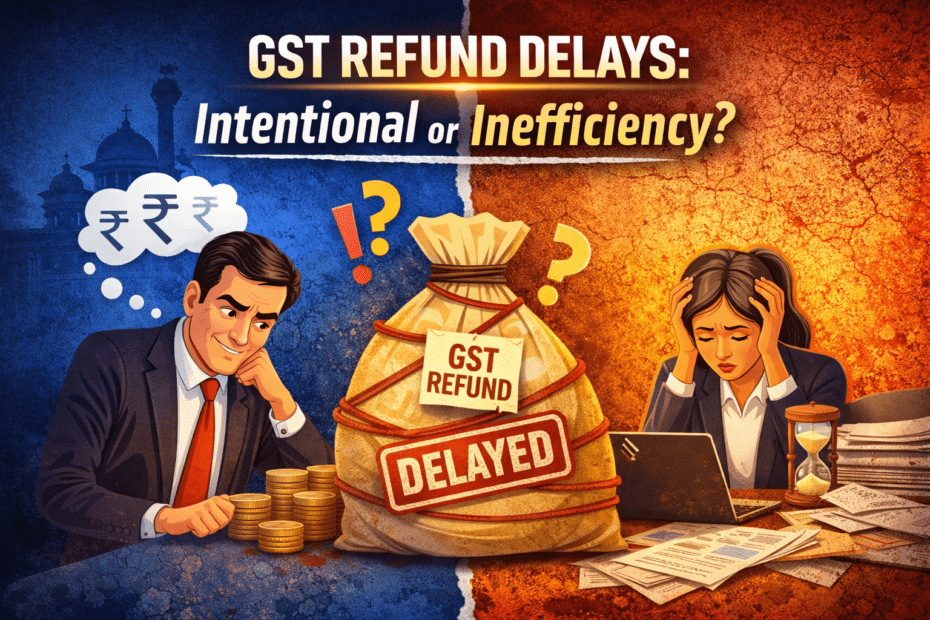
However, despite the promise of efficiency, many businesses continue to face prolonged delays in receiving their refunds. This has given rise to an important and controversial debate around the GST Refund Delay Reality—are these delays a deliberate strategy to manage government cash flow, or are they simply the result of systemic inefficiencies?
In this blog, we take a deep dive into the GST Refund Delay Reality, analyzing both sides of the argument, its impact on businesses, and what lies ahead.
Understanding GST Refunds
A GST refund arises when a taxpayer has paid more tax than required or is eligible to claim back taxes under specific conditions. Some common situations include:
Export of goods or services (zero-rated supplies)
Accumulated Input Tax Credit (ITC) due to an inverted duty structure
Excess tax payment
Refunds arising from assessment or appeal orders
The refund mechanism is designed to ensure liquidity and prevent tax cascading. Ideally, refunds should be processed smoothly and within prescribed timelines.
What the Law Says About Refund Timelines
As per GST provisions:
Refunds should be granted within 60 days from the date of application
In case of delay, interest is payable to the taxpayer
Despite these provisions, the GST Refund Delay Reality often reflects significant deviations from the expected timelines, raising concerns among businesses across sectors.
The Positive Perspective: Are Delays a Necessary Safeguard?
Before labeling refund delays as inefficiency or intentional pressure, it is important to consider the rationale behind strict verification processes.
1. Combating GST Fraud
India has witnessed several cases of fake invoicing and fraudulent ITC claims. Refund delays often occur due to:
Detailed verification of transactions
Cross-checking supplier compliance
Risk-based scrutiny
From this perspective, delays are seen as a protective mechanism rather than a flaw.
2. Ensuring Accuracy and Compliance
GST is a self-assessment-based system. Authorities must ensure that:
Refund claims are genuine
Data reported matches across returns
No excess or wrongful claims are processed
This adds layers of verification, contributing to delays.
3. Data-Driven Governance
Modern GST systems rely heavily on data analytics, including:
GSTR-1 vs GSTR-3B reconciliation
ITC matching through GSTR-2B
E-invoicing data
While this improves transparency, it also increases processing time in many cases.
The Negative Perspective: Administrative Inefficiency
While safeguards are important, the ground-level GST Refund Delay Reality often points toward inefficiencies.
1. GST Portal Challenges
Despite being a digital tax system, the GST portal frequently faces:
Technical glitches
Downtime during peak filing periods
Errors in refund application processing
These issues significantly delay refund approvals.
2. Complex Filing and Documentation
The refund process requires extensive documentation, such as:
Tax invoices
Shipping bills
Bank realization certificates
Reconciliation statements
Even minor discrepancies can result in rejection or repeated queries.
3. Human Intervention and Delays
Although GST aims to be automated, many processes still depend on manual verification, leading to:
Inconsistent decisions
Delayed approvals
Lack of accountability
4. Frequent Legal Changes
Constant amendments and circulars create confusion. Both taxpayers and officers may interpret rules differently, causing:
Disputes
Reprocessing of applications
Further delays
GST Refund Delay Reality: Impact on Businesses
The consequences of refund delays go beyond inconvenience—they directly affect business sustainability.
1. Working Capital Blockage
Refund delays lock up funds that could otherwise be used for:
Purchasing raw materials
Paying salaries
Expanding operations
2. Increased Financial Burden
Businesses often rely on loans or credit lines to maintain liquidity, increasing:
Interest costs
Financial stress
3. Export Competitiveness
For exporters, timely refunds are critical. Delays can:
Increase product cost
Reduce global competitiveness
4. Compliance Stress
Frequent follow-ups, notices, and documentation requirements create:
Mental stress
Reduced focus on core business activities
This is a key part of the GST Refund Delay Reality that policymakers must address.
Major Causes Behind GST Refund Delays
To truly understand the GST Refund Delay Reality, we must identify the root causes:
Mismatch between GSTR-1 and GSTR-3B
Supplier non-compliance affecting ITC eligibility
Incorrect or incomplete refund applications
High volume of refund claims
Departmental backlog and slow processing
Each of these factors contributes to delays in different ways.
Government Measures to Address Refund Delays
Recognizing the issue, the government has introduced several reforms:
1. Automation of Refund Processing
System-driven approvals aim to reduce manual intervention and speed up processing.
2. Faster Processing for Exporters
Special focus on exporters ensures quicker refund disbursement in many cases.
3. Introduction of E-Invoicing
Improves data accuracy and reduces mismatches.
4. Simplified Procedures
Efforts are being made to reduce documentation and streamline filing.
While these initiatives are promising, the GST Refund Delay Reality suggests that implementation gaps still exist.
Practical Tips to Handle GST Refund Delays
Businesses can take proactive steps to minimize delays:
1. Accurate and Timely Filing
Ensure consistency between all GST returns to avoid mismatches.
2. Maintain Complete Documentation
Organize all required documents in advance to prevent last-minute issues.
3. Vendor Compliance Check
Work only with compliant suppliers to avoid ITC-related complications.
4. Regular Monitoring
Track refund applications and respond quickly to queries.
5. Professional Assistance
Consult GST experts to ensure error-free filings and faster processing.
Intentional or Inefficiency: A Balanced View
So, what does the GST Refund Delay Reality truly indicate?
Intentional Elements
Strong verification to prevent fraud
Revenue protection measures
Risk-based scrutiny systems
Inefficiency Elements
Technical issues
Complex procedures
Administrative delays
In reality, refund delays are a mix of both—intentional safeguards and systemic inefficiencies.
The Future of GST Refunds in India
The GST ecosystem is continuously evolving. The future may bring:
1. AI-Based Processing
Faster verification and reduced human intervention.
2. Real-Time Data Integration
Elimination of mismatches and quicker approvals.
3. Policy Stability
Fewer changes will lead to better clarity and consistency.
4. Improved Accountability
Defined timelines and stricter monitoring of officers.
If implemented effectively, these changes can significantly improve the GST Refund Delay Reality.
Conclusion
The GST Refund Delay Reality reflects both the strengths and weaknesses of India’s GST system. While delays may sometimes be justified to prevent fraud and ensure compliance, they often create significant challenges for businesses, particularly in terms of liquidity and operational efficiency.
A balanced and efficient refund mechanism is essential for building trust in the GST system. Policymakers must focus on reducing inefficiencies while maintaining necessary safeguards.
For businesses, the key lies in staying compliant, maintaining proper documentation, and proactively managing refund processes. Only then can GST refunds truly serve their purpose—as a facilitator of growth rather than a barrier.
SEO Keywords (For Ranking Boost)
GST Refund Delay Reality, GST refund delay India, GST refund issues, GST refund problems, GST compliance challenges, GST refund process India, GST refund inefficiency, GST refund system India.


