Introduction
Since its implementation, the Goods and Services Tax (GST) has transformed India’s indirect tax structure into a more transparent and technology-driven system. However, with digitization comes a new set of challenges—one of the most common and controversial being data mismatches.
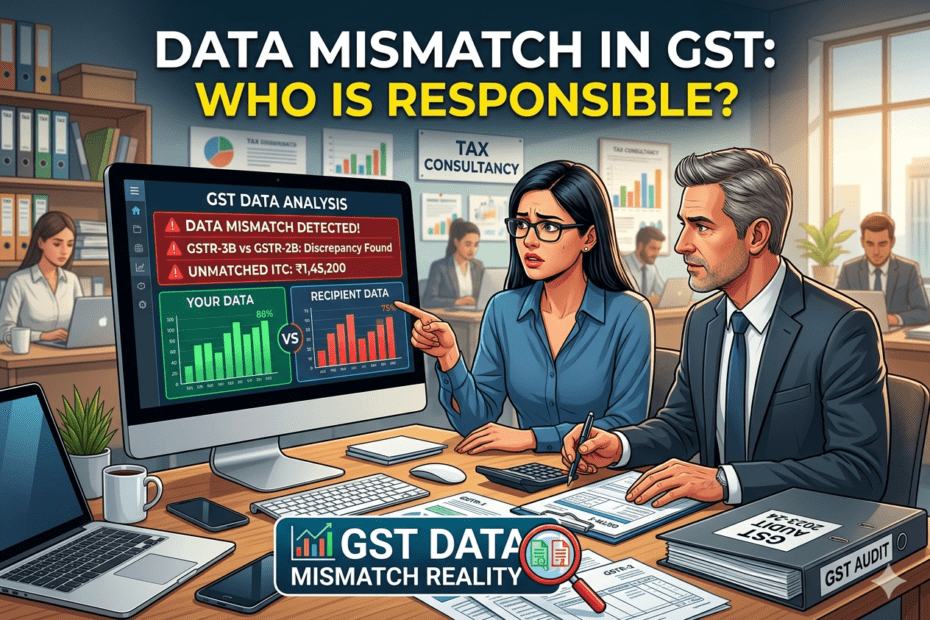
The growing concern around discrepancies between returns, invoices, and Input Tax Credit (ITC) claims has given rise to what professionals now call the GST Data Mismatch Reality. Businesses across India are increasingly facing notices, ITC denials, and compliance pressure due to mismatched data.
But the real question remains—who is actually responsible for these mismatches? Is it the taxpayer, the supplier, or flaws within the system itself?
In this blog, we break down the GST Data Mismatch Reality, explore its causes, impact, and provide practical solutions.
What is Data Mismatch in GST?
A data mismatch in GST occurs when the information reported in different returns or systems does not match. Common examples include:
Difference between GSTR-1 and GSTR-3B
ITC mismatch between GSTR-2B and purchase records
Supplier’s data not reflecting in recipient’s returns
Errors in invoice details
These mismatches often trigger notices from the department and may lead to penalties or ITC reversals.
Understanding the GST Data Matching System
GST relies heavily on automated data matching across multiple returns:
GSTR-1 → Outward supplies declared by supplier
GSTR-3B → Summary return with tax liability
GSTR-2B → Auto-generated ITC statement
The system compares these datasets to identify discrepancies. While this automation improves transparency, it also exposes even minor errors—leading to the rising GST Data Mismatch Reality.
The Big Question: Who Is Responsible?
The answer is not straightforward. The GST Data Mismatch Reality shows that responsibility is often shared.
1. Taxpayer Responsibility
a. Filing Errors
Many mismatches occur due to simple mistakes such as:
Incorrect invoice numbers
Wrong GSTIN entries
Data entry errors
b. Improper Reconciliation
Failure to regularly reconcile returns leads to unnoticed discrepancies.
c. Claiming Excess ITC
Claiming ITC without verifying GSTR-2B can result in mismatches and notices.
👉 In such cases, the taxpayer plays a significant role in the mismatch.
2. Supplier Responsibility
One of the most debated aspects of the GST Data Mismatch Reality is supplier non-compliance.
a. Non-Filing or Late Filing of Returns
If a supplier does not file GSTR-1 on time, the buyer’s ITC will not reflect in GSTR-2B.
b. Incorrect Reporting
Errors made by suppliers directly impact recipients, even if the buyer has complied correctly.
c. Fake or Bogus Invoicing
Fraudulent practices create major mismatches and lead to strict scrutiny.
👉 This raises an important concern—is it fair to penalize buyers for supplier mistakes?
3. System and Technical Issues
The GST Data Mismatch Reality is not limited to human errors—it also includes system-related problems.
a. Portal Glitches
Data not updating in real-time
Missing invoices in GSTR-2B
Technical errors during filing
b. Frequent Updates and Changes
Constant changes in GST rules and return formats create confusion and increase chances of mismatches.
c. Lack of Integration
Incomplete synchronization between systems can lead to discrepancies.
👉 These issues highlight that the system itself shares part of the responsibility.
4. Government Policies and Compliance Framework
a. Strict ITC Rules
GST laws require strict matching of ITC with supplier data. Even minor mismatches can lead to:
ITC denial
Notices
Penalties
b. Automated Notices
System-generated notices are often issued without detailed explanations, increasing confusion.
c. Reverse Burden on Taxpayer
In many cases, the burden of proof lies on the taxpayer—even when the error is not theirs.
👉 This policy framework contributes significantly to the GST Data Mismatch Reality.
Impact of GST Data Mismatch on Businesses
1. ITC Loss
One of the biggest consequences is denial or reversal of Input Tax Credit.
2. Cash Flow Problems
Blocked ITC leads to increased tax liability and reduced liquidity.
3. Increased Compliance Burden
Businesses must spend additional time and resources on reconciliation and corrections.
4. Legal and Litigation Risks
Frequent mismatches often lead to disputes, appeals, and legal proceedings.
Common Causes Behind GST Data Mismatch
Understanding the root causes helps in addressing the GST Data Mismatch Reality:
Mismatch between GSTR-1 and GSTR-3B
Supplier non-compliance
Data entry errors
Timing differences in reporting
Amendments in returns
Technical glitches
How to Avoid GST Data Mismatch
Businesses can reduce mismatches by adopting proactive strategies:
1. Regular Reconciliation
Compare GSTR-1, GSTR-3B, and GSTR-2B monthly
Identify and rectify discrepancies early
2. Vendor Compliance Check
Work with reliable and compliant suppliers
Monitor supplier filing status
3. Accurate Data Entry
Double-check invoices and GSTIN details
Use automated accounting software
4. Timely Filing of Returns
Avoid last-minute filing to reduce errors.
5. Use Technology
Adopt tools that integrate accounting and GST systems for real-time tracking.
Is the System Too Harsh? A Critical View
The GST Data Mismatch Reality has sparked criticism regarding fairness.
Challenges Faced by Businesses
Penalized for supplier mistakes
Complex compliance requirements
Lack of clear communication in notices
Need for Reform
Experts suggest:
Relaxation in ITC rules
Better system integration
Clear guidelines for handling mismatches
Future of GST Data Matching
The future may bring improvements such as:
1. AI-Based Reconciliation
Advanced tools to detect and resolve mismatches automatically.
2. Real-Time Data Updates
Reducing delays and discrepancies in reporting.
3. Simplified Compliance
Easier return filing and reduced documentation.
4. Better Accountability
Clear responsibility framework for taxpayers, suppliers, and authorities.
Conclusion
The GST Data Mismatch Reality reflects the growing pains of a complex, technology-driven tax system. While data matching improves transparency and accountability, it also creates significant challenges for businesses.
Responsibility for mismatches is shared among:
Taxpayers
Suppliers
System limitations
Policy framework
To navigate this landscape, businesses must adopt strong compliance practices, leverage technology, and stay updated with GST regulations.
Ultimately, the goal should be to create a system that balances strict compliance with practical ease, ensuring that GST serves as a growth enabler rather than a compliance burden.
SEO Keywords (Bonus)
GST Data Mismatch Reality, GST mismatch issues, GSTR-1 vs GSTR-3B mismatch, GST ITC mismatch, GST compliance errors, GST notices India, GST return mismatch problems, GST system issues India.


