Introduction
The Goods and Services Tax (GST) system has brought transparency and structure to India’s indirect taxation. However, with increased compliance requirements comes the need for proper verification—and that’s where GST audits play a crucial role.
For many businesses, audits can feel stressful and complicated. This GST Audit Guide is designed to simplify the process, helping you understand how GST audits work, why they happen, and how you can prepare effectively.
Whether you are a small business owner or a large enterprise, understanding this GST Audit Guide can help you avoid penalties, reduce risks, and stay compliant.
What is a GST Audit?
A GST audit is an examination of a taxpayer’s records, returns, and documents to ensure that:
Taxes are correctly calculated and paid
Input Tax Credit (ITC) is properly claimed
Returns are filed accurately
Compliance with GST laws is maintained
The objective of a GST audit is to verify the correctness of financial records and ensure there is no tax evasion or error.
Types of GST Audits
Understanding the types of audits is essential in this GST Audit Guide.
1. Departmental Audit
Conducted by GST authorities to verify compliance and identify discrepancies.
2. Special Audit
Ordered in complex cases where authorities believe additional scrutiny is required.
3. Turnover-Based Audit (Earlier Requirement)
Earlier, businesses crossing a certain turnover threshold required audit by a Chartered Accountant. This has been largely removed but still relevant in certain cases.
Who Can Be Audited Under GST?
Any registered taxpayer can be selected for audit based on:
Risk parameters
Data mismatches
High-value transactions
Suspicious activities
This means that even compliant businesses must be prepared, making this GST Audit Guide highly relevant for everyone.
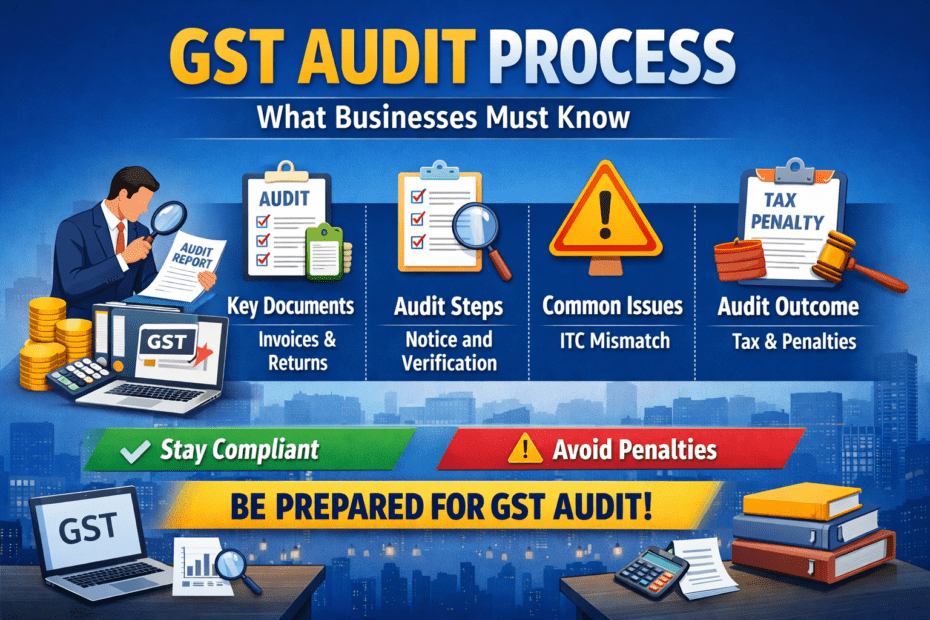
GST Audit Process Explained
Let’s break down the GST audit process step-by-step.
Step 1: Notice for Audit
Authorities issue a notice informing the taxpayer about the audit. This includes:
Date of audit
Documents required
Scope of verification
Step 2: Submission of Documents
Businesses must provide records such as:
GST returns (GSTR-1, GSTR-3B)
Invoices and purchase records
ITC details
Financial statements
Step 3: Verification by Authorities
Officials examine:
Tax payments
ITC claims
Compliance with GST rules
Step 4: Audit Findings
After verification, authorities may:
Accept records
Raise queries
Identify discrepancies
Step 5: Final Report
A final audit report is issued, which may include:
Tax demand
Penalty
Recommendations
Key Documents Required for GST Audit
As per this GST Audit Guide, businesses should keep the following documents ready:
Sales and purchase invoices
GST returns filed
ITC reconciliation statements
E-way bills
Bank statements
Financial reports
Proper documentation is the backbone of a smooth audit process.
Common Issues Found During GST Audits
Understanding common errors can help you avoid problems.
1. ITC Mismatch
Mismatch between GSTR-2B and claimed ITC is a major issue.
2. Incorrect Tax Classification
Wrong GST rates applied to products/services.
3. Mismatch in Returns
Differences between GSTR-1 and GSTR-3B.
4. Non-Compliance
Late filing or missing returns.
5. Documentation Errors
Missing or incorrect invoices.
GST Audit Guide: Impact on Businesses
1. Financial Impact
Audit findings may result in:
Tax demands
Interest charges
Penalties
2. Operational Disruption
Audits require time and resources, affecting daily operations.
3. Legal Risk
Serious discrepancies can lead to litigation.
4. Reputation Impact
Non-compliance can affect business credibility.
How to Prepare for GST Audit
Preparation is key to handling audits smoothly.
1. Maintain Accurate Records
Ensure all invoices and returns are properly recorded.
2. Regular Reconciliation
Match:
GSTR-1
GSTR-3B
GSTR-2B
3. Verify ITC Claims
Ensure all credits are valid and supported by documents.
4. Stay Updated
GST laws change frequently—stay informed.
5. Conduct Internal Audit
Regular internal checks can prevent major issues.
GST Audit Guide: Best Practices
1. Avoid Last-Minute Filing
Timely compliance reduces audit risks.
2. Use Technology
Accounting software can reduce errors.
3. Work with Experts
Professional guidance ensures accuracy.
4. Keep Backup Records
Maintain digital and physical copies.
Government Perspective on GST Audits
From the government’s point of view:
Audits ensure tax compliance
Prevent revenue leakage
Strengthen the GST system
However, balancing enforcement with ease of doing business remains important.
Challenges in GST Audits
Despite their importance, audits present challenges:
1. Complex Regulations
GST rules can be difficult to interpret.
2. Frequent Changes
Constant updates create confusion.
3. Compliance Burden
Small businesses face resource constraints.
4. Risk of Disputes
Different interpretations can lead to litigation.
Future of GST Audits
The future of GST audits is moving towards:
1. Automation
Use of AI and data analytics for faster audits.
2. Risk-Based Selection
Targeted audits instead of random checks.
3. Reduced Human Intervention
Minimizing subjectivity and bias.
4. Improved Transparency
Clear guidelines and processes.
Why This GST Audit Guide is Important
This GST Audit Guide helps businesses:
Understand audit procedures
Avoid common mistakes
Prepare effectively
Reduce financial and legal risks
Knowledge is the best defense against audit-related stress.
Conclusion
The GST audit process is an essential part of maintaining a transparent and compliant tax system. While audits may seem intimidating, proper preparation and understanding can make the process much smoother.
This GST Audit Guide highlights that audits are not just about enforcement—they are also an opportunity for businesses to identify gaps and improve compliance.
By maintaining accurate records, staying updated with GST laws, and seeking professional help when needed, businesses can confidently navigate GST audits and focus on growth.
SEO Keywords (For Ranking Boost)
GST Audit Guide, GST audit process India, GST audit rules, GST compliance audit, GST audit checklist, GST audit preparation, GST audit issues, GST audit documents, GST audit steps India


