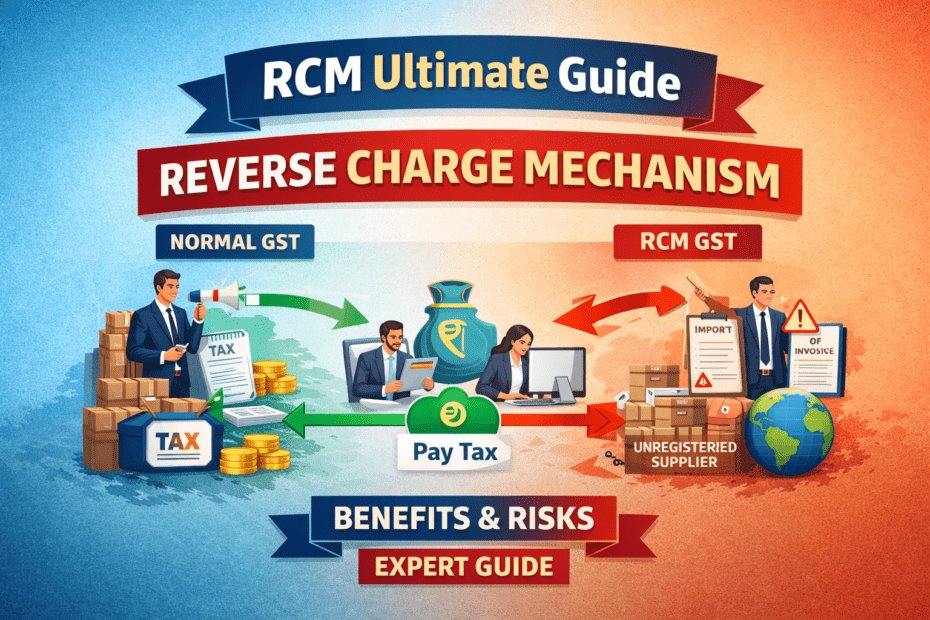
The RCM Ultimate Guide is essential for every business owner, accountant, and taxpayer who wants to understand how the Reverse Charge Mechanism (RCM) works under GST. While GST usually requires the supplier to pay tax, RCM shifts this responsibility to the recipient, making it a critical concept in compliance.
In this RCM Ultimate Guide, we will break down everything you need to know—meaning, applicability, rules, advantages, disadvantages, and practical examples.
📌 What is Reverse Charge Mechanism (RCM)?
Under GST, the Reverse Charge Mechanism (RCM) means the recipient of goods or services is liable to pay GST instead of the supplier.
This is different from the normal tax system where the seller collects and deposits GST with the government.
👉 In simple terms:
Normal GST → Supplier pays tax
RCM → Buyer pays tax
The RCM Ultimate Guide helps you understand why the government introduced this system—to bring unorganized sectors under tax compliance and reduce tax evasion.
📊 Why is RCM Important?
The Reverse Charge Mechanism plays a key role in:
Increasing tax compliance
Tracking unregistered suppliers
Reducing tax leakage
Expanding the tax base
For businesses, understanding RCM is crucial because non-compliance can lead to penalties.
✅ When Does RCM Apply?
In this RCM Ultimate Guide, here are the major scenarios where RCM is applicable:
1. Purchase from Unregistered Dealer
If a registered business purchases goods/services from an unregistered supplier (in certain notified cases), RCM may apply.
2. Notified Goods & Services
The government has specified certain goods and services where RCM is mandatory, such as:
Legal services
Goods transport agency (GTA) services
Sponsorship services
3. E-commerce Transactions
In some cases, e-commerce operators are liable to pay GST under RCM.
📋 List of Common RCM Services
Some commonly applicable RCM categories include:
Services provided by advocates or law firms
GTA (Goods Transport Agency) services
Services by directors to a company
Import of services
Security services (in certain cases)
Understanding these categories is a must in this RCM Ultimate Guide to avoid mistakes.
👍 Advantages of Reverse Charge Mechanism
1. Better Tax Compliance
RCM ensures that taxes are paid even when the supplier is unregistered.
2. Increased Government Revenue
It reduces tax evasion and increases transparency.
3. Organized Business Environment
Encourages businesses to deal with registered vendors.
4. Simplified Tracking
The government can easily track transactions under RCM.
❌ Disadvantages of Reverse Charge Mechanism
1. Increased Compliance Burden
Businesses need to identify RCM transactions and pay tax accordingly.
2. Cash Flow Impact
Tax must be paid in cash (not through ITC), affecting working capital.
3. Complex Accounting
Proper documentation and accounting entries are required.
4. Risk of Errors
Misinterpretation of RCM rules can lead to penalties.
⚖️ RCM: Pros vs Cons
| Pros | Cons |
|---|---|
| Ensures tax compliance | Increases compliance burden |
| Reduces tax evasion | Affects cash flow |
| Expands tax base | Complex rules |
| Promotes transparency | Higher risk of mistakes |
📊 Example of RCM
Let’s understand this with a simple example from the RCM Ultimate Guide:
A company hires a lawyer for legal services worth ₹50,000.
Under normal GST → Lawyer charges GST
Under RCM → Company pays GST directly to the government
This means the company must:
Pay GST
Report it in returns
Claim ITC (if eligible)
🧾 Compliance Requirements Under RCM
In this RCM Ultimate Guide, here are key compliance rules:
Issue self-invoice for purchases under RCM
Pay GST in cash (not through ITC)
Maintain proper records
File GST returns correctly
Important Returns:
GSTR-3B → Report RCM liability
GSTR-1 → Not required for RCM purchases
ITC can be claimed after payment
🔄 Input Tax Credit (ITC) Under RCM
One important concept in the RCM Ultimate Guide is ITC:
You must first pay GST under RCM
Then you can claim Input Tax Credit
👉 This creates a temporary cash flow blockage.
🚫 Common Mistakes to Avoid
Many businesses make errors while dealing with RCM. This RCM Ultimate Guide highlights common mistakes:
Ignoring RCM applicability
Not issuing self-invoices
Delayed tax payment
Incorrect ITC claims
Poor record keeping
Avoiding these mistakes can save you from penalties.
📈 Latest Updates on RCM
GST rules are constantly evolving. Some key updates include:
Changes in notified services
Clarifications on applicability
Updates in compliance requirements
Stay updated with this RCM Ultimate Guide to ensure smooth compliance.
💡 Who Should Be Careful About RCM?
RCM is especially important for:
Businesses receiving legal services
Companies dealing with transport services
Importers of services
Corporates receiving director services
If your business falls into these categories, you must understand this RCM Ultimate Guide thoroughly.
📊 Key Differences: Normal GST vs RCM
| Basis | Normal GST | RCM |
|---|---|---|
| Tax payer | Supplier | Recipient |
| ITC usage | Allowed | Pay first, claim later |
| Compliance | Simple | Slightly complex |
| Cash flow | Neutral | Temporary impact |
📣 Final Verdict: Is RCM Complicated?
The RCM Ultimate Guide shows that while the Reverse Charge Mechanism may seem complex, it is manageable with proper understanding and compliance.
👉 It is beneficial for the government as it improves tax collection
👉 It can be challenging for businesses due to compliance burden
However, with proper planning and expert guidance, RCM can be handled efficiently.
📞 Need Help with RCM Compliance?
Handling RCM can be tricky, especially for growing businesses.
👉 Taxamicus can help you with:
GST Registration
RCM Compliance
GST Return Filing
Tax Planning
🔎 SEO Keywords Included
RCM Ultimate Guide
Reverse Charge Mechanism under GST
RCM applicability India
GST RCM rules
RCM compliance
🚀 Conclusion
The RCM Ultimate Guide is essential for every business operating under GST. Understanding when and how RCM applies can help you stay compliant, avoid penalties, and manage your taxes effectively.
If used correctly, RCM is not just a compliance requirement—it’s a tool for building a transparent and organized business environment.


