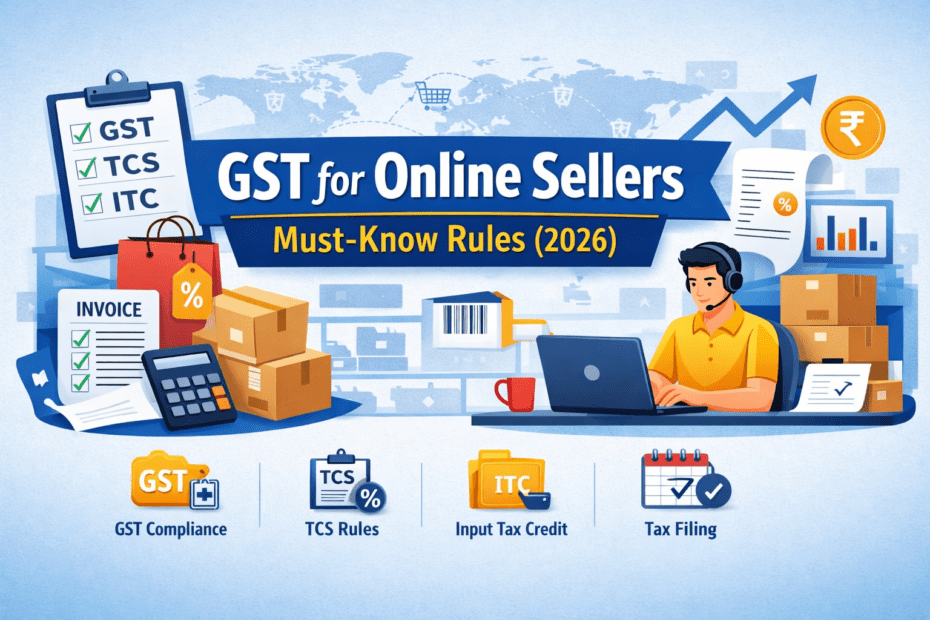
The rise of platforms like Amazon, Flipkart, Meesho, Shopify, and Instagram Shops has changed the way businesses sell products and services. Today, thousands of businesses are entering the digital marketplace every day. But with this opportunity comes a major responsibility—tax compliance. That is why understanding GST for Online Sellers has become essential for every person or business selling online.
Whether you sell through a marketplace, your own website, or social commerce platforms, GST for Online Sellers plays a major role in your operations. From registration to invoicing, return filing, TCS adjustment, and Input Tax Credit claims, every online seller must understand the rules properly. If you ignore the law, mistakes in GST for e-commerce Sellers can lead to notices, penalties, blocked credits, and unnecessary business stress.
This guide explains the key rules, registration requirements, invoicing standards, GST returns, TCS provisions, ITC claims, and practical compliance points related to GST for Online Sellers. Whether you are a beginner or already selling online, this guide will help you understand the complete framework.
What Is GST for e-commerce Sellers?
GST for Online Sellers refers to the GST rules that apply to businesses selling goods or services through online platforms. These sellers may use marketplaces such as Amazon, Flipkart, and Meesho, or they may sell directly through their own site using Shopify, WooCommerce, or Instagram Shops. In all such cases, GST for e-commerce Sellers becomes a very important part of doing business legally.
The scope of GST for Online Sellers is broad. It covers product listing, tax calculation, invoicing, order processing, shipping charges, discount treatment, returns, refunds, TCS deductions, and return filing. It also includes the maintenance of records and reconciliation of sales and taxes.
In simple words, GST for e-commerce Sellers is not just about paying tax. It is about maintaining proper documentation, following the right process, and ensuring that all GST records match with what is reported on the portal. Sellers who understand GST for e-commerce Sellers properly are usually in a much better position to avoid compliance problems and manage their cash flow efficiently.
Is GST for e-commerce Sellers Mandatory?
Yes, in most cases, GST for Online Sellers is mandatory. Under GST law, businesses supplying through e-commerce platforms are generally required to obtain GST registration even if their turnover is below the normal threshold limit of ₹20 lakh or ₹40 lakh, depending on the case. This makes GST for Online Sellers different from many traditional offline businesses.
Section 24 of the CGST Act is one of the main reasons why GST for e-commerce Sellers is treated seriously. It requires certain persons making taxable supplies through e-commerce operators to register under GST. So, if you are selling taxable goods on online marketplaces, GST registration is normally compulsory.
This is one of the most important points in GST for e-commerce Sellers. Many small sellers wrongly assume that they can wait until their turnover crosses the threshold. That mistake can create compliance issues later. For most marketplace-based businesses, GST for Online Sellers starts with mandatory registration from the beginning.
Documents Required for GST for e-commerce Sellers
To complete registration under GST for Online Sellers, you usually need the following documents:
PAN of the business or proprietor
Aadhaar card
Photograph
Address proof of principal place of business
Bank account proof
Business registration certificate in case of company or LLP
Email address and mobile number
These documents form the base of the registration process under GST for Online Sellers. If your documents are clear and updated, the application process becomes much smoother. Many registration delays happen not because the law is difficult, but because the documents submitted are incomplete or inconsistent.
For proper compliance in GST for Online Sellers, it is always better to keep scanned copies of all important documents ready. This saves time whenever there is registration, amendment, or notice response.
TCS Rules Under GST for e-commerce Sellers
One of the most important aspects of GST for Online Sellers is TCS, or Tax Collected at Source. E-commerce platforms are required to collect TCS on the net taxable supplies made through their platform. This makes TCS a unique compliance area in GST for Online Sellers.
Generally, platforms deduct 1% TCS:
0.5% as CGST
0.5% as SGST
1% as IGST in inter-state cases
For every seller, understanding TCS is critical because GST for Online Sellers is not only about tax payment on your side, but also about matching the TCS deducted by the platform. This amount gets reflected in your GST records and can be claimed in your electronic cash ledger, subject to proper reconciliation.
A major mistake in GST for Online Sellers is ignoring platform statements and not matching them with GSTR-8 and portal data. Sellers often lose track of TCS credits simply because they do not reconcile regularly.
GST Returns Under GST for e-commerce Sellers
Return filing is the backbone of GST for e-commerce Sellers. Once registered, online sellers must file returns within time and with accurate figures. The most common returns in GST for e-commerce Sellers are:
GSTR-1 – for reporting outward supplies or sales
GSTR-3B – for summary return and tax payment
GSTR-9 – annual return, where applicable
GSTR-2B – for checking available ITC and inward supply details
Timely filing is essential in GST for Online Sellers because late filing can lead to late fees, interest, blocked e-way bill generation in some cases, and mismatch-related notices. Sellers should not treat return filing as a once-a-month formality. In practice, GST for e-commerce Sellers requires continuous review of sales data, invoices, TCS entries, and input tax records.
If the data filed in GSTR-1 does not match GSTR-3B, or if the seller misses an important adjustment, the entire compliance chain under GST for Online Sellers can be affected.
Sales and Tax Calculation Under GST for e-commerce Sellers
Another key part of GST for Online Sellers is understanding what value GST applies to. Online sellers often assume GST is charged only on product price, but the law and actual invoicing process may cover more than that.
Under GST for Online Sellers, tax may apply on:
Sale price
Packing charges
Shipping fees
Convenience fees, where applicable
Other charges linked to supply
Discount treatment is also important in GST for Online Sellers. If discounts are structured correctly and reflected properly in invoices, they can be handled smoothly. But if discounts, promotional adjustments, or post-sale changes are not recorded correctly, the seller may face mismatch issues later.
Correct valuation is important because GST for Online Sellers depends on accurate reporting of taxable value. A wrong taxable value can lead to short payment or excess payment of GST.
Invoice Rules Under GST for Online Sellers
Invoices are one of the most important compliance documents under GST for Online Sellers. A valid GST invoice should normally contain:
GSTIN
Seller name and address
Invoice number and date
Buyer details where required
HSN code
Taxable value
GST rate
GST amount
Total invoice value
Many notices in GST for Online Sellers happen due to invoice errors. Missing HSN codes, incorrect tax rates, wrong GSTIN, and mismatched invoice values are very common problems. Sellers who want to stay safe under GST for Online Sellers must ensure that their invoicing software, marketplace settings, and accounting records are aligned.
A good invoice system does not just help with compliance. It also improves return filing accuracy and makes reconciliation under GST for Online Sellers much easier.
Input Tax Credit Under GST for Online Sellers
Input Tax Credit is one of the biggest financial benefits available under GST for Online Sellers. Correct ITC claims can reduce tax cost and improve profitability. Sellers can usually claim ITC on eligible business expenses such as:
Packaging material
Marketplace commission
Shipping and logistics charges
Advertising expenses
Inventory purchases
Office rent and other eligible business expenses
However, GST for Online Sellers also requires discipline in ITC claims. The seller should ensure that the supplier has filed returns properly, invoices are available, and credits are reflected correctly wherever required. If ITC is claimed without proper support, the seller may face reversal, interest, or notices.
Many businesses lose money because they do not understand the ITC side of GST for Online Sellers. They focus only on sales tax but ignore the credits available on expenses.
Returns, Refunds, and Adjustments Under GST for Online Sellers
Returns and cancellations are common in e-commerce. That is why handling adjustments properly is a vital part of GST for Online Sellers.
If a product is returned, a credit note may need to be issued and the tax position may have to be adjusted accordingly. If an order is cancelled before supply is completed, GST treatment may differ depending on the stage of the transaction. If platform fees are reversed or adjusted, the related ITC and accounting treatment should also be checked carefully.
This area is often misunderstood in GST for Online Sellers. Sellers must not assume that every refund automatically means the GST issue is over. Proper entries, credit notes, and return adjustments are necessary to keep records clean.
Marketplace Fees and Charges Under GST for Online Sellers
Platforms usually charge multiple fees, and all these become relevant in GST for Online Sellers. Common platform charges include:
Commission fees
Closing fees
Shipping fees
Pickup charges
Advertising fees
Storage fees
Most of these charges may carry GST, and eligible credit may be claimed if conditions are satisfied. This is why GST for Online Sellers is closely linked to cost management as well. If you properly record marketplace charges and claim eligible ITC, your effective tax burden can reduce.
Ignoring these expenses is a common weakness in GST for Online Sellers. Sellers sometimes pay GST on sales but forget to claim the available benefit on platform expenses.
Reconciliation Under GST for Online Sellers
Reconciliation is the heart of GST for Online Sellers. Without reconciliation, even a seller who files returns on time may still receive notices.
A proper reconciliation process under GST for Online Sellers includes:
Matching GSTR-1 with actual sales
Matching GSTR-3B with GSTR-1
Matching TCS with GSTR-8
Matching ITC with GSTR-2B
Matching returns and credit notes with marketplace data
This is where most sellers make mistakes. Good compliance in GST for Online Sellers is not only about filing returns, but about ensuring that the numbers match across all records. A mismatch may arise due to timing differences, missed invoices, return adjustments, or platform reporting issues.
Common Mistakes in GST for Online Sellers
Some common mistakes in GST for Online Sellers are:
Not taking GST registration on time
Using wrong HSN codes
Applying wrong GST rates
Not reconciling TCS
Missing ITC claims
Late filing of returns
Poor invoice management
Ignoring returns and credit note adjustments
These mistakes can lead to penalties, notices, and blocked working capital. Strong compliance in GST for Online Sellers starts with avoiding these basic but costly errors.
Compliance Checklist for GST for Online Sellers
A simple compliance checklist for GST for Online Sellers includes:
GST registration completed
Correct HSN codes used
Proper tax invoices issued
GSTR-1 filed on time
GSTR-3B filed on time
TCS checked and claimed
ITC reviewed regularly
Sales reconciled with platform data
Books of account maintained
Annual compliance completed where applicable
Conclusion
GST for Online Sellers is no longer an optional area of knowledge. It is a core part of running an online business successfully. From registration and invoicing to TCS, ITC, return filing, and reconciliation, every step matters. A seller who understands GST for Online Sellers can avoid penalties, improve reporting, and manage tax more efficiently.
As online business grows, compliance becomes even more important. That is why learning and applying the right rules under GST for Online Sellers is essential for long-term success. A strong system today can save major trouble tomorrow.
Our GST Services

All E-commerce Tax services
E-commerce tax services help online sellers navigate GST registration, compliance, return filing, TCS management, tax planning, and audits, ensuring efficient tax management and legal compliance.
GST Filing
GST filing is the process of submitting tax returns to the government, detailing sales, purchases, and taxes paid or collected, ensuring compliance with GST laws.

GST Registration
GST registration is the process where businesses obtain a GSTIN from the government, allowing them to collect taxes, claim input tax credits, and comply with GST laws.


