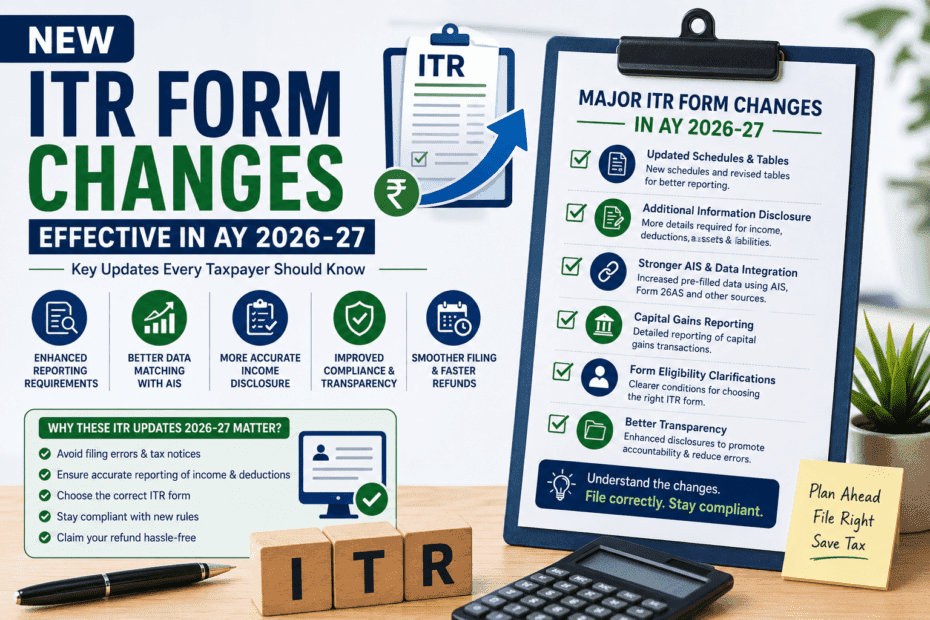
The Income Tax Department regularly updates Income Tax Return (ITR) forms to improve compliance, simplify reporting, and capture relevant financial information more accurately. For Assessment Year (AY) 2026-27, taxpayers should pay close attention to the latest changes introduced in various ITR forms before filing their returns.
Understanding these ITR Updates 2026-27 is essential for salaried employees, freelancers, business owners, investors, and pensioners. Filing the wrong form or missing new reporting requirements could result in notices, delayed refunds, or defective return notices from the Income Tax Department.
This guide explains the major ITR form changes effective in AY 2026-27 and how taxpayers can prepare for a smooth filing experience.
Why ITR Form Changes Matter
Every year, taxpayers often focus on income tax deductions and tax-saving investments but overlook updates made to ITR forms.
These changes can impact:
Eligibility to use a specific ITR form
Reporting requirements
Disclosure obligations
Refund processing
Compliance verification
The latest ITR Updates 2026-27 are designed to improve transparency and ensure better matching of taxpayer information with data already available to the Income Tax Department.
Increased Use of AIS and Data Matching
One of the most significant trends in recent years is the growing reliance on the Annual Information Statement (AIS).
The Income Tax Department now receives financial data from multiple sources, including:
Banks
Mutual funds
Stock brokers
Employers
Property registrars
GST databases
Financial institutions
Because of this, taxpayers must ensure that the information reported in their ITR matches the information available in AIS.
The latest ITR Updates 2026-27 reinforce the importance of verifying AIS before filing returns.
Changes in Reporting Requirements
Modern ITR forms require more accurate and comprehensive disclosures than before.
Taxpayers may need to report:
Salary income
Capital gains
Interest income
Dividend income
Rental income
Foreign assets (where applicable)
Business income
Incomplete reporting can increase the chances of receiving a tax notice.
As part of the new ITR Updates 2026-27, taxpayers should carefully review all schedules before submitting their returns.
Choosing the Correct ITR Form
Selecting the correct ITR form remains one of the most important steps in the filing process.
Common forms include:
ITR-1 (Sahaj)
Generally used by eligible salaried individuals and pensioners with relatively simple income structures.
ITR-2
Typically used by individuals who have capital gains, multiple properties, or other income that makes them ineligible for ITR-1.
ITR-3
Usually applicable to individuals and professionals having income from business or profession.
ITR-4 (Sugam)
Generally available for eligible taxpayers opting for presumptive taxation schemes.
The latest ITR Updates 2026-27 make it even more important to verify form eligibility before filing.
Capital Gains Reporting Becomes More Important
Capital gains reporting continues to receive significant attention from tax authorities.
Taxpayers earning income from:
Shares
Mutual funds
Property sales
Bonds
Securities
should ensure accurate reporting of transactions.
With increased data sharing between financial institutions and tax authorities, mismatches are easier to detect.
The recent ITR Updates 2026-27 emphasize accurate disclosure of investment-related income.
Importance of Form 26AS Verification
Before filing an income tax return, taxpayers should review Form 26AS carefully.
Form 26AS contains information related to:
TDS deductions
TCS collections
Advance tax payments
Refund details
Errors in reporting can lead to discrepancies during processing.
Taxpayers should reconcile Form 26AS with their own records as part of the filing process.
Impact on Salaried Employees
Salaried employees often assume that Form 16 is sufficient for filing returns.
However, many individuals now have additional income sources such as:
Bank interest
Dividend income
Freelancing income
Capital gains
Rental income
The latest ITR Updates 2026-27 encourage taxpayers to review all income sources before filing rather than relying solely on Form 16.
Impact on Freelancers and Consultants
Freelancers and consultants should pay special attention to:
Professional receipts
Expense documentation
TDS credits
Presumptive taxation eligibility
Accurate record keeping can help reduce compliance issues and support claims made in the return.
The ongoing ITR Updates 2026-27 continue to place greater emphasis on proper reporting of professional income.
Impact on Small Business Owners
Business owners must ensure consistency between:
Books of accounts
GST records
Bank transactions
Income tax returns
Differences between these records may attract scrutiny.
As authorities increasingly use technology-driven verification systems, maintaining accurate records has become essential.
Common ITR Filing Mistakes to Avoid
1. Ignoring AIS
Many taxpayers fail to review AIS before filing.
2. Choosing the Wrong ITR Form
Incorrect form selection can result in defective return notices.
3. Missing Income Sources
Interest, dividends, and small investment gains are often overlooked.
4. Incorrect Bank Details
Wrong bank account information can delay refunds.
5. Failing to Verify Returns
Returns are not considered complete until properly verified.
Avoiding these mistakes should be a key objective while implementing the latest ITR Updates 2026-27.
How to Prepare for AY 2026-27 Filing
Taxpayers should gather the following documents:
PAN card
Aadhaar card
Form 16
AIS
Form 26AS
Bank statements
Capital gains statements
Investment proofs
Home loan certificates
Business records (if applicable)
Proper preparation reduces errors and simplifies the filing process.
Benefits of Understanding ITR Form Changes
Taxpayers who stay updated can benefit from:
Faster refund processing
Reduced chances of notices
Improved compliance
Accurate reporting
Better tax planning
The latest ITR Updates 2026-27 are not merely compliance requirements; they also help taxpayers maintain clean tax records.
Technology and Future Tax Compliance
The Income Tax Department is increasingly relying on technology, automation, and data analytics.
Future tax compliance is expected to involve:
Greater data integration
Faster mismatch detection
Enhanced AIS reporting
Automated verification systems
Improved taxpayer services
These developments make it even more important for taxpayers to understand new filing requirements every year.
The direction of ITR Updates 2026-27 clearly indicates a move toward greater transparency and real-time data verification.
Practical ITR Filing Checklist for AY 2026-27
Before filing your return, ensure that you:
✔ Verify AIS
✔ Check Form 26AS
✔ Collect Form 16
✔ Reconcile all income sources
✔ Select the correct ITR form
✔ Verify capital gains reporting
✔ Confirm bank account details
✔ Review deductions and exemptions
✔ Verify return submission
✔ Keep records safely for future reference
Following this checklist can significantly reduce filing errors.
Conclusion
The new ITR form changes effective in AY 2026-27 highlight the growing importance of accurate reporting, data reconciliation, and tax compliance. Taxpayers should not treat return filing as a routine task but as an opportunity to ensure that all financial information is reported correctly.
Understanding these ITR Updates 2026-27 can help salaried employees, freelancers, investors, and business owners avoid costly mistakes, reduce the risk of notices, and improve refund processing. By reviewing AIS, verifying Form 26AS, choosing the correct ITR form, and maintaining proper records, taxpayers can confidently meet their income tax obligations and enjoy a smoother filing experience.


