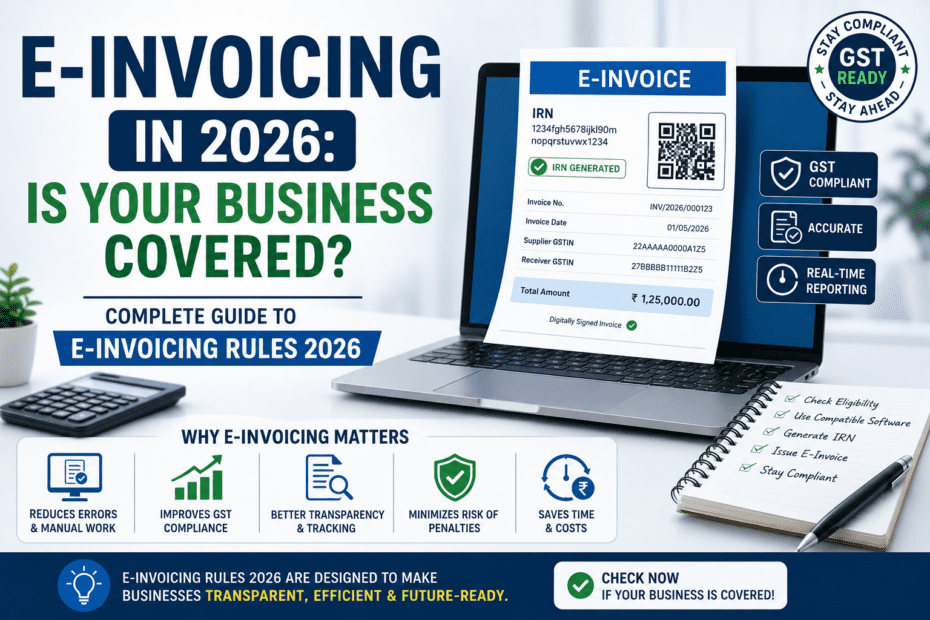
As GST compliance becomes increasingly digital, e-invoicing has become one of the most important requirements for businesses in India. The government continues to expand and strengthen the e-invoicing framework to improve tax transparency, reduce fraud, and simplify compliance.
Many businesses still assume that e-invoicing only applies to large corporations. However, the scope of e-invoicing has expanded significantly over the years, and more businesses are now required to comply with the latest regulations.
If your business issues GST invoices, understanding the E-Invoicing Rules 2026 is essential. Failure to comply can result in invalid invoices, denial of Input Tax Credit (ITC) to customers, penalties, and unnecessary compliance issues.
This article explains everything businesses need to know about e-invoicing in 2026, including eligibility, benefits, compliance requirements, and common mistakes to avoid.
What is E-Invoicing?
E-invoicing is a system where specified GST invoices are electronically authenticated through the Invoice Registration Portal (IRP) before being issued to customers.
Contrary to popular belief, e-invoicing does not mean generating invoices directly on a government website. Businesses can continue creating invoices using their existing accounting or ERP software. The invoice details are then reported to the IRP, which generates a unique Invoice Reference Number (IRN) and QR code.
The E-Invoicing Rules 2026 require eligible businesses to ensure that invoices are properly registered before being shared with customers.
Why Was E-Invoicing Introduced?
The government introduced e-invoicing to improve GST compliance and reduce tax evasion.
Key objectives include:
Reducing fake invoicing practices
Improving GST reporting accuracy
Simplifying return filing
Enhancing tax transparency
Reducing data entry errors
Facilitating faster reconciliation
As technology continues to play a larger role in tax administration, the importance of complying with E-Invoicing Rules 2026 has increased significantly.
Who Needs to Follow E-Invoicing Rules in 2026?
The applicability of e-invoicing depends on turnover thresholds and government notifications.
Businesses should regularly verify whether their aggregate turnover exceeds the prescribed limits. Even if a business’s current turnover has reduced, earlier turnover levels may still impact e-invoicing obligations.
Generally, businesses should review:
Annual turnover
GST registration status
Nature of supplies
Applicable government notifications
The E-Invoicing Rules 2026 may apply even if a business is not actively monitoring changes in GST regulations. Therefore, periodic compliance reviews are essential.
How Does the E-Invoicing Process Work?
The e-invoicing process is straightforward when implemented correctly.
Step 1: Generate Invoice
Create an invoice using accounting software, ERP software, or billing software.
Step 2: Upload Invoice Data
The invoice details are transmitted to the Invoice Registration Portal.
Step 3: IRN Generation
The system validates invoice information and generates a unique Invoice Reference Number (IRN).
Step 4: QR Code Generation
A digitally signed QR code is generated for verification purposes.
Step 5: Issue Invoice
The authenticated invoice can then be shared with customers.
Following the E-Invoicing Rules 2026 ensures that invoices remain valid and compliant with GST requirements.
Major Benefits of E-Invoicing
Many businesses initially viewed e-invoicing as an additional compliance burden. However, it offers several practical benefits.
Improved Accuracy
Automation reduces manual errors and improves data consistency.
Easier GST Compliance
Invoice data can flow automatically into GST returns, reducing repetitive work.
Faster Reconciliation
Businesses can reconcile sales records more efficiently.
Better Record Management
Digital records are easier to track, retrieve, and verify.
Reduced Risk of Tax Disputes
Properly authenticated invoices help reduce disputes related to invoice validity.
Businesses that adapt early to the E-Invoicing Rules 2026 often experience smoother compliance processes and better operational efficiency.
Common Mistakes Businesses Make
Many businesses face compliance issues because of avoidable mistakes.
1. Assuming E-Invoicing Does Not Apply
Some businesses fail to review turnover-based eligibility requirements.
2. Delayed Invoice Reporting
Waiting too long to upload invoice details can create compliance problems.
3. Incorrect GSTIN Details
Entering incorrect customer GSTIN information may lead to invoice mismatches.
4. Duplicate Invoice Reporting
Duplicate submissions can create reconciliation challenges.
5. Ignoring Software Updates
Businesses using outdated software may struggle to comply with evolving requirements.
Understanding the E-Invoicing Rules 2026 can help prevent these common issues.
What Happens If You Do Not Comply?
Non-compliance can create serious consequences.
Potential risks include:
GST penalties
Invalid tax invoices
Customer disputes
Denial of Input Tax Credit
Increased scrutiny from tax authorities
Compliance notices
A business may believe it has issued a valid invoice, but if e-invoicing requirements were applicable and not followed, the invoice may not be legally valid under GST regulations.
This is one reason why the E-Invoicing Rules 2026 deserve close attention from business owners and finance teams.
E-Invoicing and Input Tax Credit (ITC)
Input Tax Credit remains one of the most important aspects of GST compliance.
Customers rely on valid invoices to claim ITC. If invoices are not generated according to applicable e-invoicing requirements, ITC claims may be affected.
As a result, compliance is not only important for the seller but also for customers and business partners.
The E-Invoicing Rules 2026 play a significant role in ensuring accurate tax reporting throughout the supply chain.
How Businesses Can Prepare for E-Invoicing Compliance
Preparation is the key to avoiding compliance issues.
Upgrade Accounting Systems
Ensure your software supports e-invoicing functionality.
Train Staff
Employees responsible for invoicing should understand the process.
Verify Customer Information
Accurate GSTIN and invoice details reduce errors.
Conduct Regular Reviews
Periodic audits can identify compliance gaps before they become major problems.
Monitor Regulatory Changes
GST regulations evolve frequently, making ongoing compliance monitoring essential.
Businesses that proactively adapt to E-Invoicing Rules 2026 are generally better positioned to avoid disruptions.
Future of E-Invoicing in India
India’s GST ecosystem is becoming increasingly technology-driven.
Tax authorities are using advanced analytics, automation, and real-time reporting systems to improve compliance monitoring.
In the coming years, businesses can expect:
Greater automation
Improved integration between GST systems
Faster reconciliation processes
Increased digital compliance requirements
Enhanced data verification
As these changes continue, the relevance of E-Invoicing Rules 2026 will only increase.
Businesses that embrace digital compliance today will likely find future transitions easier and more cost-effective.
E-Invoicing Compliance Checklist for 2026
Before issuing invoices, businesses should verify:
Whether e-invoicing applies to them
Software compatibility
Correct GSTIN details
Invoice accuracy
IRN generation status
QR code availability
Proper record maintenance
Following this checklist can significantly reduce compliance risks.
Conclusion
E-invoicing is no longer just a compliance requirement for large businesses. As GST systems become more automated, businesses of various sizes must assess whether they fall under the applicable framework.
Understanding the E-Invoicing Rules 2026 is critical for maintaining valid invoices, protecting customer ITC claims, and avoiding penalties. Businesses that invest in proper systems, staff training, and compliance reviews can benefit from smoother operations and fewer tax-related challenges.
If your business has not yet reviewed its e-invoicing obligations, now is the right time to evaluate whether you are covered and ensure full compliance with GST requirements in 2026.


