Getting approval from Food Safety and Standards Authority of India is an important step for every food business in India. Whether you run a restaurant, cloud kitchen, home bakery, grocery shop, or packaged food business, FSSAI compliance is essential for operating legally. However, many business owners face delays or rejection because of simple but avoidable mistakes.
Understanding the Hidden FSSAI Rejection Reasons can help food businesses avoid unnecessary delays, financial loss, and compliance issues. Many applicants assume the process is straightforward and submit applications without proper verification. Even small errors can result in rejection.
In this guide, we will discuss the most common and Hidden FSSAI Rejection Reasons, how to avoid them, and what businesses should do before submitting their application.
Why FSSAI Applications Get Rejected
FSSAI authorities carefully verify the details submitted during the registration or licensing process. If the information provided is incomplete, incorrect, or inconsistent, the application may be rejected.
Most rejections happen because businesses:
Submit incorrect documents
Choose the wrong license category
Provide mismatched information
Ignore compliance requirements
Fail to respond to department queries
Understanding these Hidden FSSAI Rejection Reasons can significantly improve approval chances.
Hidden FSSAI Rejection Reasons You Should Know
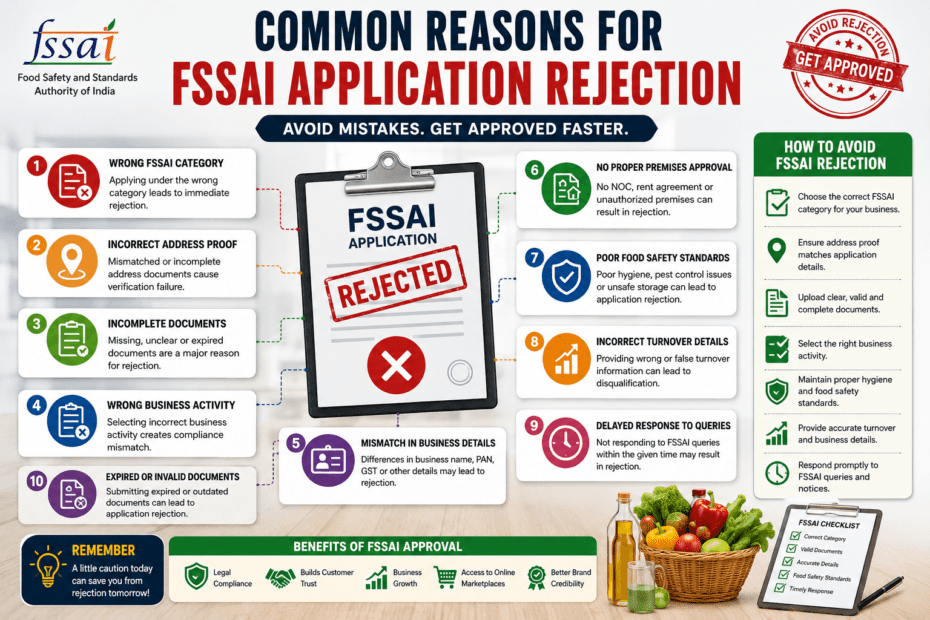
1. Choosing the Wrong FSSAI Category
One of the biggest mistakes applicants make is selecting the wrong category.
Many small businesses apply for a basic registration when they actually require a State License. Similarly, some businesses apply for a State License when they legally require a Central License.
Example:
Turnover above the permitted limit
Import-export food business
Multi-state operations
Large manufacturing units
Applying under the wrong category is one of the most common Hidden FSSAI Rejection Reasons.
2. Incorrect Business Address Proof
Address mismatches frequently cause application rejection.
The business address in the application must match the supporting documents exactly.
Common Problems:
Different spelling of address
Missing shop number
Old electricity bill
Incomplete rental agreement
Invalid NOC from owner
Even minor inconsistencies can create verification issues.
3. Incomplete Documentation
Many businesses upload partial or unclear documents.
Common Missing Documents:
PAN card
Aadhaar card
Passport-size photo
Business constitution proof
Food safety management details
Utility bills
Blurry or unreadable scans also increase rejection chances.
One of the major Hidden FSSAI Rejection Reasons is poor document quality.
4. Wrong Business Activity Selection
During application filing, applicants must select the correct business activity.
Many people incorrectly choose categories such as:
Manufacturer instead of retailer
Retailer instead of distributor
Food service instead of cloud kitchen
Incorrect activity selection creates compliance mismatches and may result in rejection.
5. Mismatch Between Business Name and Documents
The business name entered in the application should match supporting records.
Common Mismatch Issues:
Trade name differs from GST registration
Different spelling in PAN
Using unregistered brand names
Missing proprietorship declaration
Authorities may suspect inaccurate information if records do not match properly.
6. Applying Without Proper Premises Approval
Some businesses apply before securing legal permission for their premises.
Examples:
No rental agreement
No owner NOC
Unauthorized commercial use
Illegal kitchen setup
These issues become major Hidden FSSAI Rejection Reasons during verification or inspection.
7. Ignoring Food Safety Requirements
FSSAI focuses heavily on hygiene and food safety standards.
Businesses with poor preparation may face rejection after inspection.
Common Problems:
Unhygienic kitchen
Poor storage conditions
Improper waste disposal
No pest control
Unsafe water usage
Even if documentation is correct, poor food safety practices can still lead to rejection.
8. Incorrect Turnover Declaration
Applicants sometimes intentionally show lower turnover to avoid applying for a higher category license.
This is risky because authorities may verify turnover through:
GST filings
Bank statements
Business operations
Marketplace sales
Providing false turnover details is one of the serious Hidden FSSAI Rejection Reasons.
9. Delayed Response to Department Queries
FSSAI officers may request clarification or additional documents.
Many applicants:
Ignore notices
Miss deadlines
Fail to check application updates
Applications can be rejected if queries are not answered within the required timeframe.
10. Using Expired or Invalid Documents
Expired documents are another common issue.
Examples:
Expired rent agreement
Old utility bills
Invalid ID proof
Expired partnership deed
Always ensure all documents are current before submission.
Hidden FSSAI Rejection Reasons for Home Kitchens
Home-based food businesses are growing rapidly in India. However, home businesses also face unique compliance problems.
Common Issues:
Residential property restrictions
No kitchen hygiene setup
Missing owner permission
Wrong business activity selection
Many home bakers and cloud kitchens underestimate compliance requirements.
Hidden FSSAI Rejection Reasons for Restaurants
Restaurants often face stricter scrutiny because of operational scale.
Common Restaurant Mistakes:
Incomplete kitchen details
Missing fire safety approvals
Improper food storage
No pest control records
Wrong seating capacity declaration
Restaurant owners should carefully verify operational compliance before applying.
Hidden FSSAI Rejection Reasons for Online Food Sellers
Food sellers on platforms like Amazon, Flipkart, Swiggy, and Zomato must maintain proper compliance.
Common Problems:
Incorrect packaging details
No labeling compliance
Missing manufacturing information
Wrong business type selection
Online food businesses often grow quickly and outgrow their registration category without updating licenses.
How to Avoid FSSAI Application Rejection
Verify Business Category Properly
Understand whether your business requires:
Basic Registration
State License
Central License
Choosing correctly reduces rejection risk significantly.
Prepare Clear Documents
Ensure all uploaded documents:
Are readable
Match application details
Are updated
Are properly signed if required
Use Accurate Business Information
Never use estimated or false details.
Information should match:
GST records
PAN records
Address proof
Business constitution documents
Maintain Hygiene Standards
Food safety compliance is not just paperwork.
Businesses should maintain:
Clean kitchens
Proper storage
Safe water supply
Waste management systems
Respond Quickly to Queries
Track application status regularly and respond immediately if clarification is requested.
Ignoring notices is one of the easiest ways to get rejected.
What Happens After FSSAI Rejection?
If your application is rejected, you may need to:
Correct errors
Submit fresh documents
Reapply
Pay fees again in some cases
Repeated rejection can delay business operations and create unnecessary expenses.
This is why understanding the Hidden FSSAI Rejection Reasons beforehand is extremely important.
Benefits of Proper FSSAI Approval
Avoiding rejection helps businesses:
Start operations faster
Build customer trust
Sell on marketplaces easily
Avoid legal penalties
Improve business credibility
FSSAI compliance also helps attract partnerships and distributors.
Final Thoughts
Understanding the Hidden FSSAI Rejection Reasons can save food businesses from costly delays and unnecessary stress. Most FSSAI application rejections happen because of avoidable mistakes such as incorrect documents, wrong category selection, mismatched information, or poor compliance preparation.
Whether you operate a home kitchen, restaurant, cloud kitchen, packaged food business, or online food store, careful application preparation is essential. Businesses should always verify turnover limits, business activity categories, address proof, and hygiene compliance before applying.
FSSAI approval is not just a legal requirement — it also improves customer trust and business credibility. By avoiding these common and Hidden FSSAI Rejection Reasons, businesses can increase their chances of smooth and faster approval.


