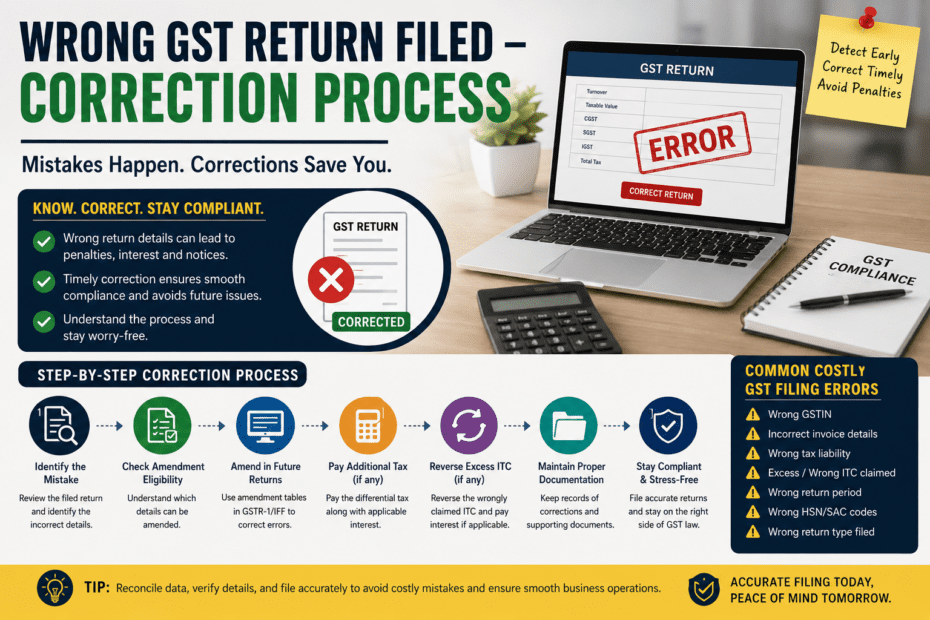
Filing GST returns correctly is extremely important for businesses in India. Even a small mistake in GST filing can lead to notices, penalties, blocked input tax credit, or unnecessary compliance issues. Many taxpayers accidentally file incorrect details due to confusion, calculation mistakes, invoice mismatches, or selecting the wrong return period.
Understanding how to correct these mistakes is essential to avoid long-term tax problems. Many businesses suffer financial losses because they ignore or delay corrections. These Costly GST Filing Errors can affect both compliance and business credibility.
In this guide, we will explain the complete correction process for wrong GST returns, common mistakes businesses make, penalties involved, and practical ways to avoid future errors.
What Happens if You File the Wrong GST Return?
Under the GST system, once a return is filed, it generally cannot be revised directly like income tax returns. This creates panic among taxpayers after discovering mistakes.
However, GST law allows certain corrections in subsequent returns. Businesses can rectify errors through adjustment mechanisms depending on the type of mistake.
Ignoring Costly GST Filing Errors can result in:
Tax notices
Interest liability
Penalty
Input tax credit mismatch
Vendor disputes
Compliance scrutiny
The earlier the correction is made, the lower the risk.
Common GST Filing Mistakes
Before understanding the correction process, it is important to identify the most common Costly GST Filing Errors businesses make.
1. Wrong GSTIN Mentioned
Entering an incorrect GST number can transfer invoice details to another taxpayer.
This may:
Block customer ITC
Create reconciliation problems
Lead to notices
2. Incorrect Invoice Details
Businesses often enter:
Wrong invoice value
Wrong tax amount
Incorrect invoice date
Wrong HSN/SAC code
Even minor invoice mismatches can affect return reconciliation.
3. Filing Return in Wrong Period
Sometimes taxpayers accidentally report invoices in the wrong month or quarter.
This is one of the most common Costly GST Filing Errors among small businesses.
4. Wrong Tax Liability Reported
Businesses may:
Under-report sales
Over-report sales
Miss taxable invoices
Report exempt supplies incorrectly
This can directly affect tax liability.
5. Incorrect Input Tax Credit Claimed
Claiming excess ITC is a serious compliance issue.
Common causes include:
Duplicate ITC claim
Ineligible credit
Missing supplier invoices
Fake invoice credits
6. Wrong Return Type Filed
Some taxpayers accidentally file:
GSTR-3B instead of NIL return
Quarterly return instead of monthly
Composition-related return incorrectly
These mistakes can create unnecessary complications.
Can GST Returns Be Revised?
Unlike income tax returns, GST returns generally cannot be revised after filing. However, corrections are possible in future returns through amendments.
This is why identifying Costly GST Filing Errors early is extremely important.
Wrong GST Return Filed – Correction Process
The correction process depends on the type of error made.
Step 1: Identify the Exact Mistake
Before making corrections, carefully review:
Filed GST return
Books of accounts
Sales register
Purchase register
GSTR-2B
E-invoices (if applicable)
Businesses should identify:
Which return contains errors
Nature of mistake
Tax impact
ITC impact
Step 2: Understand Whether Amendment is Allowed
Some details can be amended while others cannot.
Usually Amendable:
Invoice details
B2B invoices
Credit notes
Debit notes
Tax values
Usually Not Directly Revisable:
Filed GSTR-3B itself
Certain summary values
Understanding amendment limitations is essential while handling Costly GST Filing Errors.
Step 3: Correct Errors in Future GST Returns
Most GST mistakes are corrected in subsequent returns.
Example:
If incorrect tax liability was reported in April:
Adjustment can usually be made in May or later returns
Businesses should maintain proper working papers for corrections.
Step 4: Use Amendment Tables Properly
Returns like GSTR-1 contain amendment sections.
These sections allow correction of:
Invoice details
GSTIN
Invoice values
Tax amounts
Incorrect usage of amendment tables can worsen compliance issues.
Step 5: Pay Additional Tax if Required
If tax was underpaid:
Additional tax must be paid
Interest may also apply
Delaying payment increases liability.
This is why immediate action after discovering Costly GST Filing Errors is important.
Step 6: Reverse Excess ITC if Claimed Incorrectly
Wrongly claimed ITC should be reversed immediately.
Failure to reverse excess credit may lead to:
Department notices
Penalties
Interest
ITC blockage
Step 7: Maintain Proper Documentation
Whenever corrections are made:
Keep reconciliation records
Maintain calculation sheets
Preserve amended invoice records
Save communication copies
Proper documentation helps during scrutiny or audits.
Interest and Penalty on GST Errors
Not all mistakes attract penalties immediately. However, intentional suppression or repeated errors may lead to serious consequences.
Interest Liability
Interest generally applies when:
Tax is paid late
Liability is underreported
Penalty
Penalties may apply for:
Fraudulent claims
Fake invoices
Intentional tax evasion
Repeated non-compliance
Avoiding Costly GST Filing Errors helps businesses reduce unnecessary financial burden.
Common GST Return Correction Examples
Example 1: Wrong Invoice Value
Suppose:
Actual invoice = ₹1,00,000
Filed invoice = ₹10,000
Correction can usually be made through amendment in future GSTR-1.
Example 2: Excess ITC Claimed
If excess ITC was claimed:
Reverse excess amount
Pay interest if applicable
Example 3: Missing Sales Invoice
Missed invoices can usually be added in later returns within allowed timelines.
Time Limit for GST Corrections
GST law provides time limits for amendments and corrections.
Generally, corrections should be completed before:
Filing annual return, or
Prescribed deadline under GST law
Delaying corrections increases risk exposure.
How to Avoid Costly GST Filing Errors
1. Reconcile Books Regularly
Monthly reconciliation helps detect mismatches early.
Compare:
Books
GSTR-1
GSTR-3B
GSTR-2B
2. Verify Invoice Data Carefully
Before filing:
Check GSTIN
Verify tax amounts
Match invoice values
Confirm invoice dates
Small errors create major compliance problems later.
3. Use Proper Accounting Software
Automation reduces manual errors significantly.
Good accounting systems help track:
ITC
Tax liability
Invoice matching
Return preparation
4. File Returns Before Deadline
Last-minute filing increases mistakes.
Businesses rushing before deadlines often create Costly GST Filing Errors.
5. Maintain Vendor Compliance Checks
Claim ITC only from compliant suppliers.
Monitor:
Vendor filing status
Invoice uploads
GSTR-2B reflection
6. Seek Professional Review
Complex businesses should get returns reviewed periodically.
Professional review helps identify:
Tax mismatches
Compliance gaps
ITC risks
Amendment needs
Importance of Correct GST Filing
Correct GST filing provides several benefits:
Smooth compliance
Reduced notices
Better ITC management
Improved vendor relationships
Lower audit risk
Businesses with frequent GST mistakes often face operational stress and unnecessary tax scrutiny.
Final Thoughts
Filing the wrong GST return is a common issue, but ignoring it can create major compliance problems. Understanding the correction process helps businesses minimize risk and avoid penalties.
Most Costly GST Filing Errors happen because of rushed filing, poor reconciliation, incorrect invoice reporting, or lack of verification. Businesses should identify mistakes quickly and use amendment mechanisms properly to correct errors.
Regular reconciliation, proper documentation, timely corrections, and accurate filing practices are essential for smooth GST compliance. Whether the mistake involves wrong GSTIN, excess ITC, missing invoices, or incorrect tax liability, prompt correction is always better than waiting for a department notice.
Avoiding Costly GST Filing Errors not only protects businesses from penalties but also improves long-term compliance and business credibility.


