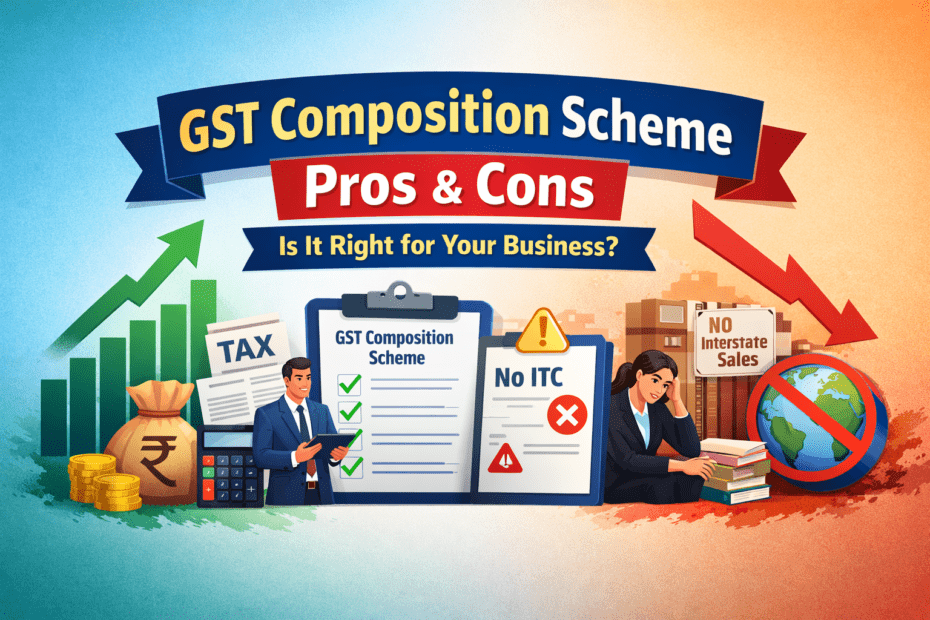
The GST Composition Scheme is a simplified tax mechanism introduced by the Government of India to reduce the compliance burden on small businesses. While it offers lower tax rates and easy filing procedures, it also comes with certain restrictions that may not suit every business.
If you’re a business owner trying to decide whether the GST Composition Scheme is right for you, this comprehensive guide will help you understand its advantages, disadvantages, eligibility, and practical implications.
📌 What is GST Composition Scheme?
The GST Composition Scheme is an optional scheme under the Goods and Services Tax (GST) system. It allows small taxpayers to pay GST at a fixed rate based on their turnover instead of the regular GST rates.
The primary objective of the GST Composition Scheme is to:
-
Simplify tax compliance
-
Reduce paperwork
-
Support small and medium enterprises (SMEs)
Under this scheme, taxpayers are not required to maintain detailed records or file multiple returns every month.
📊 GST Composition Scheme Tax Rates
The tax rates under the GST Composition Scheme are significantly lower than regular GST rates:
-
Manufacturers: 1% of turnover
-
Traders (Goods): 1% of turnover
-
Restaurants (not serving alcohol): 5% of turnover
-
Service Providers: 6% of turnover (subject to conditions)
These rates are beneficial for small businesses looking to reduce their tax burden and simplify operations.
✅ Eligibility Criteria for GST Composition Scheme
To opt for the GST Comp. Scheme, a business must meet specific conditions:
-
Annual turnover should not exceed ₹1.5 crore (₹75 lakh for special category states)
-
The business must operate within a single state (no interstate sales)
-
The taxpayer should not supply goods through e-commerce platforms
-
The business should not manufacture notified goods like tobacco or ice cream
-
Service providers are allowed only under limited conditions
Failure to meet these criteria can lead to disqualification from the scheme.
👍 Advantages of GST Composition Scheme
1. Lower Tax Liability
One of the biggest advantages of the GST Composition Schemes is the reduced tax rate. This allows small businesses to save money and improve profitability.
2. Simplified Compliance
Regular GST requires multiple monthly filings, whereas the GST Composition Scheme reduces this burden significantly.
-
Quarterly return filing (CMP-08)
-
Annual return (GSTR-4)
This simplicity is especially helpful for small business owners with limited accounting knowledge.
3. Reduced Record-Keeping
Businesses under the GST Comp. Schemes are not required to maintain extensive records, making it easier to manage accounts.
4. Better Cash Flow Management
Lower tax payments mean better liquidity and improved working capital for business operations.
5. Ideal for Small and Local Businesses
The scheme is perfect for small traders, shop owners, and local manufacturers who operate within a limited geographical area.
❌ Disadvantages of GST Composition Scheme
1. No Input Tax Credit (ITC)
One of the major drawbacks of the GST Comp. Schemes is that businesses cannot claim Input Tax Credit. This increases the cost of purchases.
2. No Interstate Sales Allowed
Businesses under this scheme cannot sell goods outside their state, which limits growth opportunities.
3. Cannot Collect GST from Customers
Unlike regular taxpayers, businesses cannot charge GST separately on invoices. The tax must be paid from their own margin.
4. Limited Business Expansion
The turnover limit restricts businesses from scaling beyond a certain point.
5. Not Suitable for E-commerce Sellers
Sellers operating on platforms like Amazon or Flipkart are not eligible for the GST Composition Scheme.
⚖️ GST Composition Scheme: Pros vs Cons
| Pros | Cons |
|---|---|
| Lower tax rates | No ITC benefit |
| Easy compliance | No interstate sales |
| Minimal paperwork | Cannot collect GST |
| Better cash flow | Limited growth potential |
📌 Who Should Opt for GST Composition Scheme?
The GST Comp. Scheme is ideal for:
-
Small traders and retailers
-
Local shop owners
-
Small manufacturers
-
Restaurants (without alcohol)
-
Businesses with limited turnover and operations
🚫 Who Should Avoid GST Composition Scheme?
This scheme may not be suitable for:
-
Businesses planning to expand across states
-
E-commerce sellers
-
Businesses that rely heavily on Input Tax Credit
-
High-growth startups
-
Service-oriented businesses with complex tax structures
🔄 How to Opt for GST Composition Scheme?
To register under the GST Composition Scheme, follow these steps:
-
Log in to the GST portal
-
Select the option to opt for composition scheme
-
File Form CMP-02
-
Submit the application before the start of the financial year
Once approved, the taxpayer must comply with the scheme’s rules and conditions.
⚠️ Compliance Requirements Under GST Composition Scheme
Even though compliance is simplified, certain rules must be followed:
-
Issue a Bill of Supply instead of a tax invoice
-
Mention “Composition Taxable Person” on all bills
-
File quarterly returns (CMP-08)
-
File annual return (GSTR-4)
-
Maintain basic records of transactions
Failure to comply may result in penalties or removal from the scheme.
📈 Latest Updates on GST Composition Scheme
The government has made several updates to the GST Composition Scheme over time:
-
Increased turnover limits for eligibility
-
Inclusion of certain service providers
-
Simplification of return filing
Business owners should stay updated with these changes to ensure compliance and avoid penalties.
💡 Practical Example
Let’s understand the GST Comp. Scheme with an example:
Suppose a small trader has an annual turnover of ₹50 lakh.
-
Under regular GST (say 18%), tax liability = ₹9 lakh
-
Under composition scheme (1%), tax liability = ₹50,000
This shows how beneficial the scheme can be for small businesses. However, the trader cannot claim ITC or expand interstate.
📊 Key Considerations Before Choosing GST Composition Scheme
Before opting for the GST Composition Scheme, consider:
-
Nature of your business
-
Growth plans
-
Customer base (local or national)
-
Input tax credit requirements
-
Profit margins
A wrong decision can impact your business profitability and expansion.
📣 Final Verdict: Should You Choose GST Composition Scheme?
The GST Comp. Scheme is a great option for small businesses that want simplicity and lower tax rates. It reduces compliance burden and improves cash flow.
However, it is not suitable for businesses that:
-
Want to expand beyond state boundaries
-
Need Input Tax Credit
-
Operate on e-commerce platforms
👉 Best for: Small, local businesses with limited turnover
👉 Not ideal for: Growing or large-scale businesses
📞 Need Professional Help?
Choosing the right tax structure is crucial for your business success. If you are unsure whether the GST Comp. Scheme is suitable for you, expert advice can make a big difference.
👉 Taxamicus offers:
-
GST Registration
-
GST Return Filing
-
Compliance Management
-
Business Tax Consultation
🔎 SEO Keywords Included
-
GST Comp. Scheme
-
GST Comp. Scheme pros and cons
-
GST Comp. Scheme benefits
-
GST Comp. Scheme eligibility
-
GST Comp. Scheme rules


