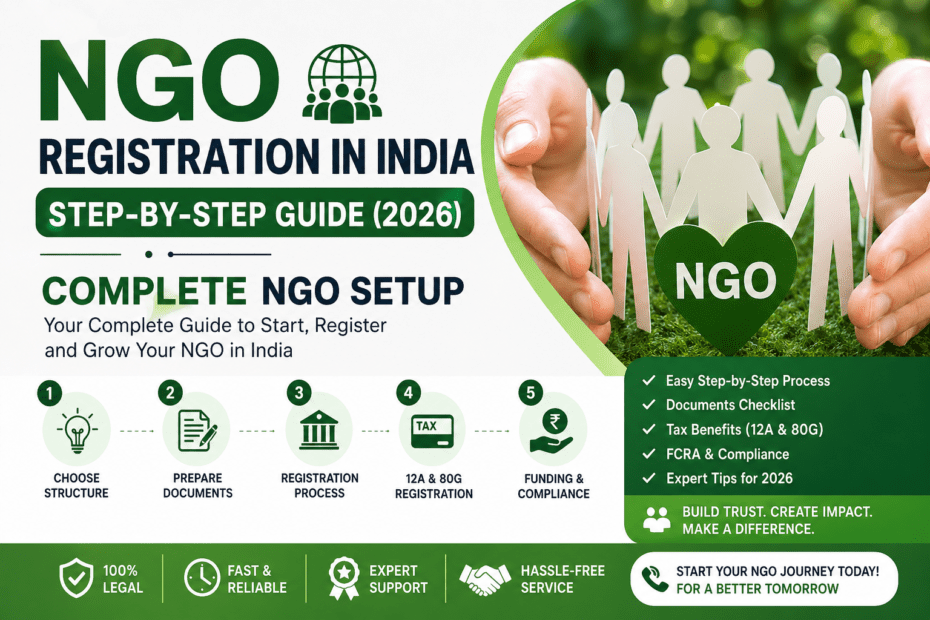
Starting an NGO in India is more than just a social initiative—it’s a structured legal process that requires proper planning, documentation, and compliance. With increasing awareness and government support, more individuals are stepping forward to contribute to society through NGOs. However, without proper guidance, the registration process can become confusing and time-consuming.
In this comprehensive guide, we will walk you through the Complete NGO Setup process in India for 2026. From choosing the right structure to understanding compliance requirements, this blog will help you build a strong foundation for your organization.
What is an NGO?
An NGO (Non-Governmental Organization) is a non-profit entity established to work for charitable, social, educational, religious, or environmental causes. Unlike private businesses, NGOs focus on public welfare rather than profit-making.
A properly registered NGO gains legal recognition, making it easier to raise funds, receive grants, and build trust among donors and stakeholders.
Why is NGO Registration Important?
Before diving into the Complete NGO Setup, it’s important to understand why registration is essential:
Provides legal identity
Enables opening of bank accounts
Helps in receiving donations and grants
Offers tax benefits under 12A and 80G
Builds credibility and transparency
Without registration, your NGO cannot operate effectively or scale its impact.
Types of NGO Registration in India
Choosing the right legal structure is the first and most crucial step in the Complete NGO Setup process. In India, NGOs can be registered in three forms:
1. Trust
A Trust is formed when property or assets are held by trustees for charitable purposes.
Key Features:
Minimum 2 trustees required
Easy and quick registration
Governed by the Indian Trusts Act, 1882
Less compliance compared to other structures
Best for: Family-run NGOs or small charitable activities
2. Society
A Society is a group of individuals working together for a common charitable goal.
Key Features:
Minimum 7 members required
Governed by the Societies Registration Act, 1860
More democratic structure
Moderate compliance requirements
Best for: Community-based organizations
3. Section 8 Company
A Section 8 Company is the most structured and professional form of NGO.
Key Features:
Minimum 2 directors required
Governed by the Companies Act, 2013
High credibility and transparency
Preferred for CSR funding
Best for: Large-scale NGOs and funding-oriented organizations
Documents Required for Complete NGO Setup
Proper documentation plays a vital role in successful NGO registration. Here’s a checklist:
PAN card of all members/directors
Aadhaar card or identity proof
Address proof of members
Passport-size photographs
Registered office address proof
Rent agreement (if applicable)
No Objection Certificate (NOC)
Trust Deed / MOA / AOA
Incomplete or incorrect documents are one of the main reasons for application rejection.
Step-by-Step NGO Registration Process (2026)
Let’s break down the Complete NGO Setup into simple and actionable steps:
Step 1: Choose a Unique Name
Your NGO name should:
Be unique and meaningful
Reflect your mission
Not match any existing organization
A good name creates a strong first impression and helps in branding.
Step 2: Select the Legal Structure
Decide whether your NGO will be a Trust, Society, or Section 8 Company. This decision affects your compliance, funding opportunities, and operational flexibility.
Step 3: Draft Legal Documents
Prepare the foundational documents:
Trust Deed (for Trust)
Memorandum of Association (MOA)
Articles of Association (AOA)
These documents define your NGO’s objectives, rules, and governance structure.
Step 4: Register the NGO
Submit your application to the appropriate authority:
Trust: Local Registrar Office
Society: Registrar of Societies
Section 8 Company: Ministry of Corporate Affairs (MCA)
Ensure all documents are properly signed and verified.
Step 5: Apply for PAN and Bank Account
After registration:
Apply for a PAN card in the NGO’s name
Open a dedicated bank account
This is essential for financial transactions and transparency.
Step 6: Obtain 12A and 80G Registration
This is a critical part of the Complete NGO Setup:
12A Registration: Provides income tax exemption
80G Registration: Allows donors to claim tax deductions
Without these, fundraising becomes difficult.
Step 7: GST Registration (If Applicable)
NGOs must register for GST if:
They provide taxable services
Their turnover exceeds the threshold
Step 8: FCRA Registration
If you plan to receive foreign donations:
Apply for FCRA registration
Maintain a separate bank account for foreign funds
Cost of NGO Registration in India (2026)
The cost of Complete NGO Setup depends on the structure:
Trust: ₹5,000 – ₹25,000
Society: ₹7,000 – ₹30,000
Section 8 Company: ₹15,000 – ₹50,000+
Professional and legal fees may vary.
Time Required for NGO Registration
Trust: 7–15 days
Society: 15–25 days
Section 8 Company: 20–30 days
Delays usually occur due to documentation errors.
Common Mistakes to Avoid
Avoid these mistakes during your Complete NGO Setup:
❌ Choosing the wrong structure
❌ Submitting incomplete documents
❌ Ignoring tax registrations (12A & 80G)
❌ Not maintaining proper records
❌ Missing compliance deadlines
These mistakes can lead to rejection, penalties, or legal complications.
Compliance Requirements for NGOs
After registration, NGOs must follow:
Filing Income Tax Returns (ITR-7)
Maintaining proper books of accounts
Conducting audits (if applicable)
Filing annual returns
FCRA compliance (if applicable)
Regular compliance ensures smooth functioning and avoids penalties.
Funding Options for NGOs
A successful Complete NGO Setup includes planning for funding. NGOs can receive funds from:
Individual donations
Corporate CSR contributions
Government grants
International funding (via FCRA)
Proper documentation and transparency increase funding chances.
Benefits of NGO Registration
A legally registered NGO enjoys:
✔ Tax exemptions
✔ Legal recognition
✔ Access to grants and funding
✔ Increased credibility
✔ Long-term sustainability
Why Professional Assistance is Recommended
While it’s possible to register an NGO independently, professional help ensures:
Correct documentation
Faster approvals
Compliance with legal requirements
Reduced risk of rejection
Conclusion
The process of NGO registration in India may seem complex, but with the right guidance, it becomes manageable and efficient. This Complete NGO Setup guide for 2026 covers everything you need to start your journey—from choosing the right structure to ensuring compliance and funding.
A well-structured NGO not only creates social impact but also builds trust, credibility, and long-term sustainability.
📞 Get Expert Help for Complete NGO Setup
If you want a hassle-free NGO registration experience, professional support can make all the difference.
Taxamicus offers:
NGO Registration Services
12A & 80G Registration
Compliance & Tax Filing
Expert Consultation
Start your NGO today with confidence and expert guidance!


