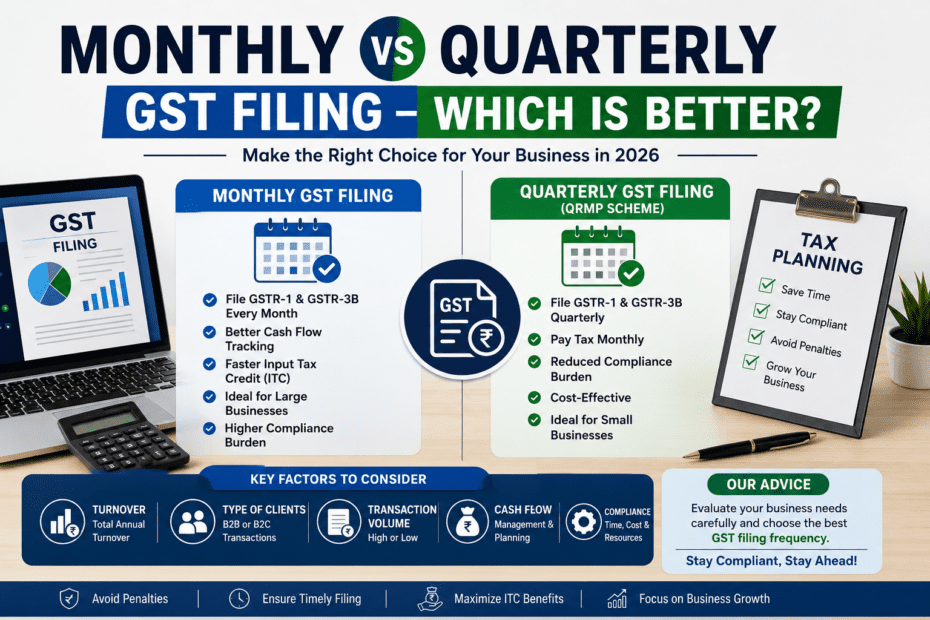
Choosing between Monthly vs Quarterly GST filing is one of the most important compliance decisions for any GST-registered business in India. While it may seem like a simple choice, the impact of this decision goes beyond just filing frequency—it directly affects your cash flow, compliance burden, client relationships, and even your risk of penalties.
Many small business owners opt for quarterly filing to reduce workload, while larger businesses prefer monthly filing for better control. But which one is truly better for your business?
In this detailed Monthly vs Quarterly GST filing guide for 2026, we will break down everything you need to know—features, eligibility, advantages, disadvantages, and practical insights—to help you make the right choice.
Understanding GST Filing Basics
Before comparing Monthly vs Quarterly, it’s important to understand what GST filing actually involves.
Under GST, businesses must regularly report their:
Sales (outward supplies)
Purchases (inward supplies)
Tax liability and payments
The most common GST returns include:
GSTR-1 – Details of sales
GSTR-3B – Summary return and tax payment
The frequency of filing these returns depends on whether you choose Monthly vs Quarterly filing.
What is Monthly GST Filing?
Monthly GST filing requires businesses to file returns every month.
Key Requirements:
GSTR-1 filed every month
GSTR-3B filed every month
Tax payment made monthly
Who Typically Chooses Monthly Filing?
Businesses with turnover above ₹5 crore
Companies dealing with B2B clients
Businesses with high transaction volume
What is Quarterly GST Filing (QRMP Scheme)?
The Quarterly Return Monthly Payment (QRMP) scheme allows eligible businesses to file returns quarterly while still paying taxes monthly.
Key Requirements:
GSTR-1 filed quarterly
GSTR-3B filed quarterly
Tax paid monthly
Eligibility:
Turnover up to ₹5 crore
Monthly vs Quarterly GST Filing – Detailed Comparison
| Feature | Monthly Filing | Quarterly Filing |
|---|---|---|
| Return Filing | Every month | Every quarter |
| Tax Payment | Monthly | Monthly |
| Compliance Effort | High | Low |
| ITC Availability | Faster | Delayed |
| Suitable For | Large businesses | Small businesses |
| Error Risk | Lower (regular updates) | Higher (bulk filing) |
Advantages of Monthly GST Filing
Choosing monthly filing under Monthly vs Quarterly comparison offers several benefits:
1. Better Financial Control
Monthly filing ensures that your financial data is updated regularly. This helps in:
Accurate tracking of tax liability
Better decision-making
Improved financial discipline
2. Faster Input Tax Credit (ITC)
One of the biggest advantages of monthly filing is quicker ITC availability.
Buyers can claim ITC sooner
Improves business relationships
Enhances working capital
3. Reduced Risk of Errors
Since data is filed monthly:
Less data accumulation
Easier error detection
Lower chances of major mistakes
4. Preferred by B2B Businesses
If your clients depend on ITC:
Monthly filing makes you more reliable
Improves credibility
Disadvantages of Monthly GST Filing
Despite its benefits, monthly filing has some drawbacks:
❌ Higher compliance workload
❌ More time-consuming
❌ Increased professional fees
❌ Frequent deadlines increase stress
Advantages of Quarterly GST Filing
Quarterly filing under QRMP is popular among small businesses. Here’s why:
1. Reduced Compliance Burden
Filing returns only four times a year instead of twelve reduces workload significantly.
2. Cost Savings
Lower accounting and professional fees
Reduced administrative costs
3. Better Time Management
Business owners can focus more on operations rather than compliance.
4. Ideal for Small Businesses
Businesses with limited transactions benefit the most from quarterly filing.
Disadvantages of Quarterly GST Filing
However, quarterly filing is not perfect:
❌ Delayed ITC for customers
❌ Monthly tax payment still required
❌ Risk of errors due to bulk data entry
❌ Not suitable for high-volume businesses
Monthly vs Quarterly – Key Decision Factors
When choosing between Monthly vs Quarterly, consider the following:
1. Turnover
Above ₹5 crore → Monthly filing
Below ₹5 crore → Option to choose
2. Type of Clients
B2B clients → Monthly filing preferred
B2C clients → Quarterly filing acceptable
3. Transaction Volume
High transactions → Monthly
Low transactions → Quarterly
4. Cash Flow Management
Monthly filing → Better tracking
Quarterly filing → Requires planning
Impact on Cash Flow
Cash flow is a major factor in the Monthly vs Quarterly decision.
Monthly Filing:
Regular tax payments
Better cash flow visibility
Quarterly Filing:
Less frequent reporting
Requires disciplined planning
Compliance and Penalty Risks
Regardless of your choice in Monthly vs Quarterly, non-compliance can lead to:
Late fees of ₹50 per day
Interest on unpaid tax
GST notices
Blocking of ITC
👉 Proper compliance is more important than filing frequency.
Switching Between Monthly and Quarterly Filing
You can switch between Monthly vs Quarterly filing through the GST portal.
Steps:
Log in to GST portal
Select QRMP option
Choose filing frequency
Confirm selection
👉 Switching is allowed at specific times, usually at the beginning of a quarter.
Practical Examples
Let’s understand with real-life scenarios:
Example 1: Small Retail Shop
Turnover: ₹20 lakh
Transactions: Low
Customers: Mostly B2C
👉 Best Option: Quarterly filing
Example 2: Service Company
Turnover: ₹2 crore
Clients: B2B
ITC dependency: High
👉 Best Option: Monthly filing
Example 3: Freelancer
Turnover: ₹15 lakh
Few invoices
👉 Best Option: Quarterly filing
Common Mistakes to Avoid
While choosing between Monthly vs Quarterly, avoid these mistakes:
❌ Choosing quarterly just to reduce workload
❌ Ignoring ITC needs of clients
❌ Missing monthly tax payments under QRMP
❌ Not reviewing turnover eligibility
❌ Filing at the last moment
Expert Tips for GST Filing
To manage Monthly vs Quarterly efficiently:
✔ Maintain proper accounting records
✔ Use GST software
✔ Track due dates regularly
✔ Reconcile invoices monthly
✔ Consult a GST expert
Due Dates for GST Filing (2026)
Monthly Filing:
GSTR-1: 11th of next month
GSTR-3B: 20th of next month
Quarterly Filing:
GSTR-1: End of quarter
GSTR-3B: 22nd/24th of next month after quarter
Monthly vs Quarterly – Final Comparison Summary
| Criteria | Best Option |
|---|---|
| Small Business | Quarterly |
| Large Business | Monthly |
| Low Transactions | Quarterly |
| High ITC Requirement | Monthly |
| Cost Saving | Quarterly |
| Better Control | Monthly |
Future Trends in GST Filing
With digitalization, GST filing is becoming more automated. Future trends include:
AI-based return filing
Real-time invoice matching
Faster ITC processing
Simplified compliance
This makes understanding Monthly vs Quarterly even more important.
Conclusion
The choice between Monthly vs Quarterly GST filing depends on your business size, transaction volume, and compliance capacity. There is no one-size-fits-all answer.
Monthly filing offers better control, faster ITC, and improved credibility
Quarterly filing reduces workload and cost but requires careful planning
Making the right decision can save you time, money, and stress while ensuring smooth compliance.
📞 Need Help with GST Filing?
Still confused about Monthly vs Quarterly filing? Let experts guide you.
Taxamicus offers:
GST Registration
GST Return Filing
Compliance Management
Expert Consultation
Get hassle-free GST services and focus on growing your business!


