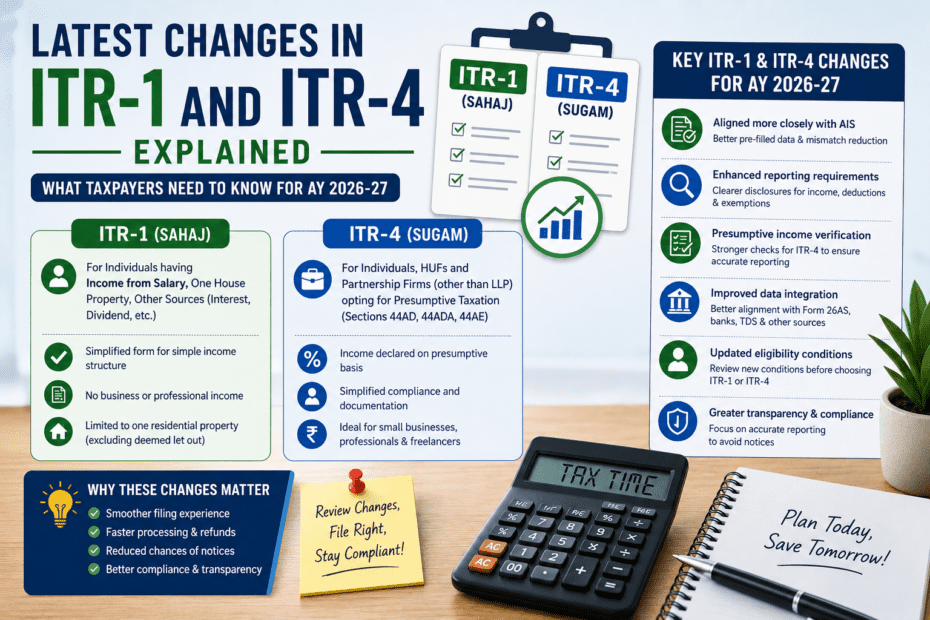
The Income Tax Department regularly updates Income Tax Return (ITR) forms to improve compliance, simplify tax filing, and ensure accurate reporting of income. For Assessment Year (AY) 2026-27, taxpayers should carefully review the latest modifications introduced in ITR-1 (Sahaj) and ITR-4 (Sugam).
These forms are among the most commonly used ITR forms in India, covering millions of salaried employees, pensioners, freelancers, professionals, and small business owners. Understanding the latest ITR-1 & ITR-4 Changes can help taxpayers avoid filing mistakes, reduce the risk of notices, and ensure smooth processing of tax returns.
This guide explains the important updates, eligibility conditions, and practical considerations taxpayers should know before filing their returns.
Why ITR Form Updates Matter
Many taxpayers focus on tax-saving investments and deductions but overlook changes in ITR forms.
However, even small modifications can impact:
Eligibility criteria
Reporting requirements
Return processing
Refund timelines
Compliance obligations
The latest ITR-1 & ITR-4 Changes are intended to make tax reporting more transparent while simplifying filing for eligible taxpayers.
Understanding these updates before filing can save both time and unnecessary complications.
What is ITR-1 (Sahaj)?
ITR-1 is generally used by resident individuals having relatively simple income structures.
It is commonly used by:
Salaried employees
Pensioners
Individuals earning interest income
Taxpayers with limited income sources
Because of its simplified structure, ITR-1 remains one of the most popular income tax return forms.
The recent ITR-1 & ITR-4 Changes seek to make this form more practical for eligible taxpayers while maintaining reporting accuracy.
What is ITR-4 (Sugam)?
ITR-4 is primarily designed for eligible taxpayers who opt for presumptive taxation schemes.
This form is generally used by:
Small business owners
Freelancers
Consultants
Professionals eligible for presumptive taxation
ITR-4 simplifies compliance by allowing taxpayers to declare income on a presumptive basis instead of maintaining detailed books of accounts in certain situations.
The latest ITR-1 & ITR-4 Changes continue to support simplified tax filing while strengthening compliance verification.
Major Changes in ITR-1 for AY 2026-27
Expanded Eligibility for Certain Taxpayers
One of the notable updates relates to eligibility conditions for taxpayers who may now qualify for simplified return filing under specific circumstances.
Taxpayers should carefully review the latest instructions before selecting ITR-1.
Using the wrong return form may result in a defective return notice.
Better Reporting Alignment with AIS
The Income Tax Department increasingly relies on data available through the Annual Information Statement (AIS).
As a result, ITR-1 reporting requirements are being aligned more closely with information already available to tax authorities.
This is one of the most important ITR-1 & ITR-4 Changes because mismatches between reported income and AIS data can attract scrutiny.
Improved Disclosure Requirements
Taxpayers should ensure accurate reporting of:
Salary income
Interest income
Dividend income
Other income sources
Accurate disclosures help avoid future compliance issues.
Major Changes in ITR-4 for AY 2026-27
Enhanced Verification of Presumptive Income
Tax authorities continue to monitor presumptive taxation claims more closely.
Taxpayers using ITR-4 should ensure consistency between:
Bank transactions
Business receipts
GST records (where applicable)
Financial statements
The latest ITR-1 & ITR-4 Changes place greater emphasis on accurate reporting of presumptive income.
Better Integration with Digital Records
As tax compliance becomes increasingly technology-driven, return forms are being aligned with information obtained from various digital sources.
This allows authorities to verify reported income more efficiently.
Improved Reporting for Professionals
Freelancers and professionals using presumptive taxation should review all reporting requirements carefully before filing.
Accurate disclosures help reduce compliance risks and improve return processing.
Importance of AIS and Form 26AS
Before filing any return, taxpayers should review:
AIS (Annual Information Statement)
AIS provides information related to:
Interest income
Dividend income
Securities transactions
Property transactions
High-value financial activities
Form 26AS
Form 26AS includes:
TDS credits
TCS details
Advance tax payments
Refund information
The latest ITR-1 & ITR-4 Changes make reconciliation with AIS and Form 26AS more important than ever.
Common Mistakes Taxpayers Should Avoid
1. Choosing the Wrong ITR Form
Using an incorrect form remains one of the most common filing mistakes.
2. Ignoring AIS
Many taxpayers fail to reconcile income information available in AIS.
3. Missing Interest Income
Savings account interest and fixed deposit interest are frequently overlooked.
4. Incorrect Presumptive Income Reporting
ITR-4 users should ensure consistency between reported income and actual business receipts.
5. Incorrect Bank Account Information
Errors in bank details can delay refunds.
Avoiding these issues should be a priority when implementing the latest ITR-1 & ITR-4 Changes.
Impact on Salaried Employees
Salaried individuals often assume that Form 16 contains everything required for filing.
However, many taxpayers also earn:
Interest income
Dividend income
Capital gains
Rental income
The latest ITR-1 & ITR-4 Changes encourage taxpayers to review all income sources before filing.
This helps reduce reporting errors and ensures accurate tax calculations.
Impact on Freelancers and Consultants
Freelancers and consultants using presumptive taxation should:
Maintain proper records
Monitor bank transactions
Track professional receipts
Verify TDS credits
Although presumptive taxation simplifies compliance, taxpayers should still maintain sufficient documentation to support their filings.
Impact on Small Businesses
Small businesses using ITR-4 should ensure consistency between:
Bank records
Business receipts
GST filings
Income tax returns
The growing use of technology and data analytics means discrepancies can be identified more easily than before.
Understanding the latest ITR-1 & ITR-4 Changes can help business owners remain compliant and avoid notices.
Practical Filing Checklist for AY 2026-27
Before filing your return, make sure you:
✔ Download AIS
✔ Review Form 26AS
✔ Collect Form 16
✔ Verify bank account details
✔ Review all income sources
✔ Select the correct ITR form
✔ Verify presumptive income calculations
✔ Check deductions and exemptions
✔ Review return carefully
✔ Complete return verification
Following this checklist can significantly reduce filing errors.
Benefits of Understanding ITR Form Changes
Taxpayers who stay updated with the latest form changes can benefit from:
Faster refund processing
Reduced risk of notices
Improved compliance
Better tax planning
Accurate reporting
The latest ITR-1 & ITR-4 Changes are designed to improve the filing experience while strengthening tax compliance.
Future of Income Tax Compliance
Income tax filing is becoming increasingly data-driven.
Authorities now receive information from:
Banks
Employers
Stock brokers
Mutual funds
Property registrars
Financial institutions
Future tax compliance is expected to involve greater automation, faster verification, and increased transparency.
Taxpayers who understand evolving filing requirements will be better prepared for future compliance expectations.
Conclusion
The latest changes in ITR-1 and ITR-4 for AY 2026-27 reflect the Income Tax Department’s continued efforts to simplify filing while improving transparency and compliance. Whether you are a salaried employee, pensioner, freelancer, consultant, or small business owner, understanding these updates is essential for accurate return filing.
By staying informed about the latest ITR-1 & ITR-4 Changes, reviewing AIS and Form 26AS carefully, selecting the correct return form, and reporting income accurately, taxpayers can avoid common mistakes, reduce compliance risks, and enjoy a smoother filing experience.


