Input Tax Credit (ITC) is one of the most valuable benefits available under the Goods and Services Tax (GST) regime. It allows businesses to reduce their tax liability by claiming credit for GST paid on purchases used for business purposes. However, claiming ITC is not as simple as collecting invoices and filing returns. Businesses must comply with various conditions to ensure that their ITC claims remain valid.
As tax authorities continue to strengthen compliance monitoring and data reconciliation processes, maintaining proper ITC records has become more important than ever. This GST ITC Checklist 2026-27 will help businesses understand the key requirements, avoid costly mistakes, and maximize eligible Input Tax Credit claims.
What is Input Tax Credit (ITC)?
Input Tax Credit refers to the GST paid by a business on purchases of goods or services that are used for business operations. This credit can generally be used to offset GST liability on sales.
For example:
A business purchases raw materials and pays GST.
The business sells finished goods and collects GST.
The GST paid on purchases can be adjusted against the GST collected on sales.
This mechanism prevents the cascading effect of taxation and helps businesses reduce overall tax costs.
A well-maintained GST ITC Checklist 2026-27 ensures that businesses do not lose eligible tax credits due to compliance errors.
Why ITC Compliance is Important in FY 2026-27
The GST ecosystem has become increasingly technology-driven. Tax authorities now use automated systems to verify return data, supplier filings, e-invoices, and reconciliation reports.
As a result, businesses may face:
ITC reversals
GST notices
Interest liabilities
Compliance scrutiny
Following a proper GST ITC Checklist 2026-27 can significantly reduce these risks and improve overall GST compliance.
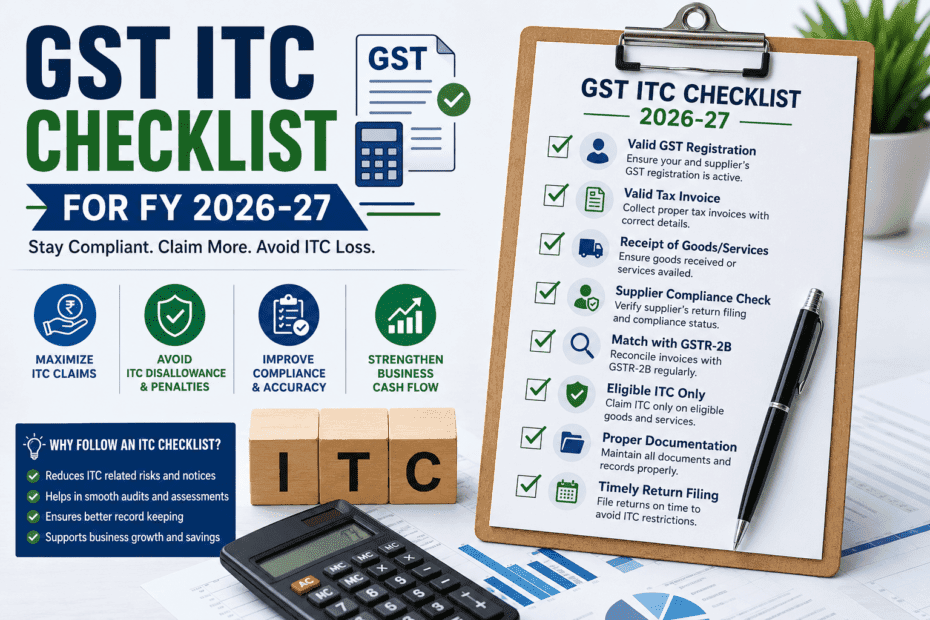
GST ITC Checklist 2026-27 for Businesses
1. Verify GST Registration Status
Before claiming ITC, ensure that:
Your GST registration is active.
Your supplier’s GST registration is valid.
Purchases from non-compliant or inactive suppliers can create complications in ITC claims.
2. Collect Valid Tax Invoices
A valid tax invoice is one of the most important requirements for claiming Input Tax Credit.
Invoices should contain:
GSTIN of supplier
GSTIN of recipient
Invoice number
Invoice date
Taxable value
GST amount
HSN/SAC details where applicable
Missing or incorrect invoices may result in ITC disputes.
3. Ensure Receipt of Goods or Services
ITC is generally available only after the goods or services have been received.
Businesses should maintain supporting documents such as:
Delivery challans
Goods receipt notes
Service completion records
Transportation documents
This is a crucial item in every GST ITC Checklist 2026-27.
4. Verify Supplier Compliance
Many businesses lose ITC because suppliers fail to comply with GST requirements.
Before claiming credit:
Verify supplier return filings.
Monitor supplier compliance history.
Reconcile supplier invoices regularly.
Strong vendor management reduces ITC-related risks.
5. Match Purchase Records with GSTR-2B
GSTR-2B serves as an important reference document for ITC verification.
Businesses should:
Download GSTR-2B monthly.
Compare purchase records with GSTR-2B.
Identify missing invoices.
Follow up with suppliers for corrections.
Regular reconciliation should be a permanent part of your GST ITC Checklist 2026-27.
Common ITC Mistakes Businesses Must Avoid
Claiming ITC Without Proper Documentation
Many businesses claim ITC without maintaining complete records. This can create issues during assessments or audits.
Ignoring Reconciliation
Failure to reconcile purchase records with GSTR-2B often leads to mismatches and notices.
Delayed Vendor Follow-Up
Businesses sometimes discover missing invoices too late to take corrective action.
Claiming Ineligible Credits
Certain expenses may not qualify for Input Tax Credit under GST provisions. Businesses should verify eligibility before claiming ITC.
Poor Record Management
Missing invoices and incomplete documentation remain common causes of ITC disputes.
Avoiding these errors is one of the primary objectives of the GST ITC Checklist 2026-27.
Documents Required for ITC Compliance
Businesses should maintain the following documents:
Tax invoices
Debit notes
Credit notes
Purchase orders
Payment records
Delivery challans
Goods receipt records
Vendor communications
Reconciliation reports
Proper documentation provides evidence to support ITC claims if questioned by authorities.
Importance of Monthly Reconciliation
Many businesses perform reconciliation only at the end of the financial year.
This approach can be risky because discrepancies become harder to resolve over time.
Monthly reconciliation allows businesses to:
Detect missing invoices quickly
Correct reporting errors
Follow up with suppliers promptly
Improve GST accuracy
A strong GST ITC Checklist 2026-27 should always include monthly reconciliation procedures.
Vendor Management and ITC Protection
Suppliers play a critical role in ITC eligibility.
Businesses should evaluate suppliers based on:
Filing consistency
GST compliance history
Invoice accuracy
Responsiveness to discrepancies
Working with compliant vendors can significantly reduce ITC-related challenges.
Many GST notices originate from supplier-side non-compliance rather than errors made by the recipient business.
ITC Checklist for E-Commerce Sellers
Online sellers face additional compliance challenges because of high transaction volumes.
E-commerce businesses should:
Reconcile marketplace reports
Verify purchase invoices regularly
Track GST on advertising expenses
Monitor logistics-related GST entries
Maintain accurate inventory records
Following a dedicated GST ITC Checklist 2026-27 helps online sellers maximize eligible tax credits while remaining compliant.
How Technology Can Improve ITC Compliance
Modern accounting tools can simplify GST compliance.
Businesses increasingly use:
GST software
Automated reconciliation tools
Accounting platforms
Compliance dashboards
Vendor monitoring systems
Technology reduces manual errors and improves visibility into potential ITC risks.
As GST compliance becomes more automated, businesses that adopt technology are better positioned to manage their tax obligations efficiently.
Practical Monthly GST ITC Checklist
Use this quick checklist every month:
✔ Download GSTR-2B
✔ Verify supplier compliance
✔ Match invoices with purchase records
✔ Review missing credits
✔ Follow up with suppliers
✔ Verify invoice accuracy
✔ Maintain supporting documents
✔ Reconcile books of accounts
✔ Monitor GST portal communications
✔ Correct discrepancies promptly
This simple routine can prevent many ITC-related issues before they become serious compliance problems.
Future of ITC Compliance in India
The future of GST compliance is moving toward greater automation and real-time verification.
Businesses can expect:
Faster mismatch detection
Increased data analytics
Automated notices
Improved reconciliation systems
Greater compliance transparency
These developments make the GST ITC Checklist 2026-27 more important than ever for businesses seeking to protect their Input Tax Credit claims.
Conclusion
Input Tax Credit remains one of the most valuable benefits available under GST, but claiming and retaining ITC requires careful planning and compliance. Businesses must maintain proper documentation, verify supplier compliance, reconcile records regularly, and monitor GST filings to avoid unnecessary disputes.
By following this GST ITC Checklist 2026-27, businesses can reduce compliance risks, avoid costly ITC reversals, and maximize eligible tax credits. Whether you are a small business owner, startup, freelancer, manufacturer, or e-commerce seller, a proactive approach to ITC compliance will help strengthen your financial position and support long-term business growth.


