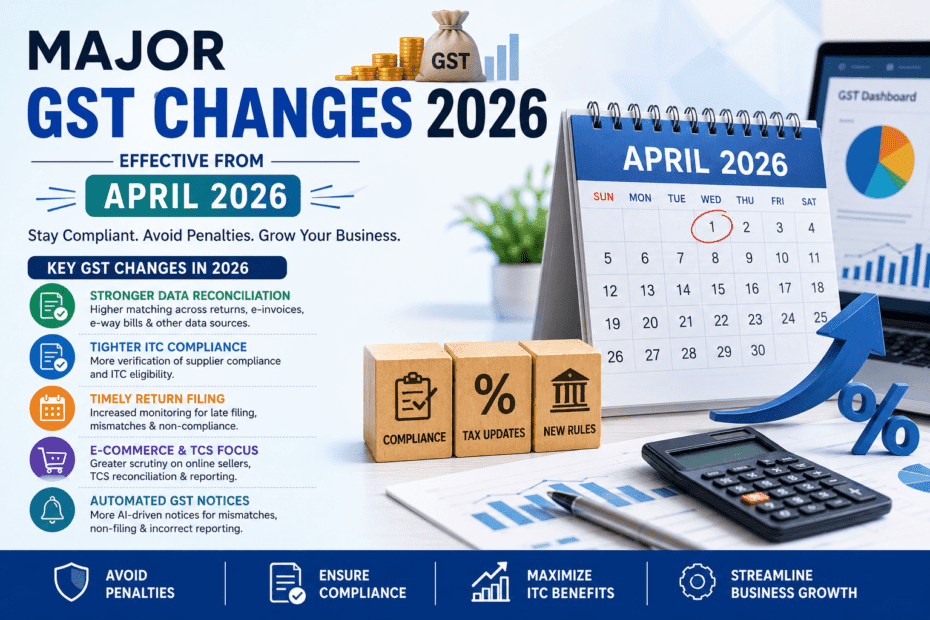
India’s GST system continues to evolve, and businesses must stay updated with the latest compliance requirements. The year 2026 brings several important developments that may impact GST registration, return filing, Input Tax Credit (ITC), reconciliation processes, and overall compliance management.
Understanding these GST Changes 2026 is essential for business owners, accountants, startups, freelancers, and e-commerce sellers. Ignoring new rules can lead to penalties, notices, and unnecessary compliance burdens, while understanding them can help businesses remain compliant and operate more efficiently.
This article explains the major GST developments that businesses should pay attention to from April 2026 onwards.
Why Businesses Must Track GST Changes
GST compliance has become increasingly technology-driven. Tax authorities now use data analytics, automation, and cross-verification systems to identify mismatches and compliance gaps.
As a result, businesses that fail to maintain proper records or file accurate returns may face increased scrutiny.
The latest GST Changes 2026 emphasize greater transparency, better reporting, and stronger reconciliation requirements.
Businesses that adapt early will find compliance easier and reduce the risk of receiving GST notices.
Increased Focus on Data Reconciliation
One of the most significant developments under the latest GST framework is the growing importance of reconciliation.
Authorities can compare information from multiple sources, including:
GST returns
E-way bills
E-invoices
TDS and TCS data
E-commerce platform reports
Banking records
Any mismatch between reported figures may trigger verification requests or notices.
Because of this, businesses should regularly reconcile their records instead of waiting until the end of the financial year.
The recent GST Changes 2026 highlight the importance of maintaining accurate books and matching data across various compliance systems.
Input Tax Credit (ITC) Compliance Becomes More Important
Input Tax Credit remains one of the most valuable benefits available under GST.
However, claiming ITC has become increasingly dependent on accurate supplier compliance.
Businesses should:
Verify supplier GST filings
Reconcile purchase records regularly
Review GSTR-2B reports
Maintain proper tax invoices
Monitor vendor compliance
Many businesses lose eligible ITC due to supplier defaults or reconciliation errors.
Under the latest GST Changes 2026, businesses are expected to pay closer attention to vendor management and ITC verification processes.
Stronger Monitoring of Return Filing
Timely GST return filing continues to be one of the most critical compliance requirements.
Authorities are increasingly using automated systems to identify:
Non-filers
Late filers
Inconsistent reporting
Tax payment mismatches
Businesses should ensure timely filing of:
GSTR-1
Used for reporting outward supplies and sales transactions.
GSTR-3B
Used for summarizing liabilities and paying GST.
Annual Returns
Required for eligible taxpayers based on applicable regulations.
The latest GST Changes 2026 indicate that delayed filing may attract quicker compliance actions than in previous years.
E-Commerce Sellers Face Greater Compliance Expectations
Online selling through marketplaces such as Amazon, Flipkart, and Meesho continues to grow rapidly.
At the same time, GST compliance for e-commerce businesses has become more detailed.
Marketplace operators provide extensive transaction data that can be matched against GST returns.
Online sellers should regularly reconcile:
Sales reports
Settlement reports
TCS statements
GST returns
Failure to reconcile data properly may create compliance issues.
The ongoing GST Changes 2026 make accurate reporting increasingly important for online businesses.
Rise of Automated GST Notices
Many GST notices today are generated through automated systems rather than manual reviews.
These notices may be issued due to:
Return mismatches
ITC discrepancies
Non-filing of returns
Incorrect tax payments
Reconciliation failures
Businesses should not panic if they receive a notice.
Instead, they should:
Review the notice carefully.
Verify the reported discrepancy.
Gather supporting documents.
Respond within the prescribed timeline.
The automation trend is expected to accelerate further under GST Changes 2026.
Greater Importance of Record Keeping
Proper documentation remains the foundation of GST compliance.
Businesses should maintain:
Tax invoices
Purchase invoices
Debit notes
Credit notes
E-way bill records
E-invoice records
Vendor documentation
Digital record management is becoming increasingly important as authorities rely more on technology-based verification.
The latest GST Changes 2026 reinforce the importance of maintaining complete and accurate documentation.
Technology and GST Compliance
Technology is transforming the GST ecosystem.
Businesses are increasingly using:
GST software
Accounting platforms
Automated reconciliation tools
Compliance dashboards
AI-powered reporting systems
These tools help reduce human errors and improve compliance efficiency.
As compliance requirements become more complex, businesses that invest in technology may gain a significant advantage.
Many experts believe future GST Changes 2026 and beyond will continue moving toward real-time compliance monitoring.
Common Mistakes Businesses Should Avoid
Even compliant businesses sometimes face GST issues due to avoidable errors.
1. Ignoring Reconciliation
Waiting until year-end often leads to missed discrepancies.
2. Claiming Incorrect ITC
Improper ITC claims remain a major source of notices.
3. Delayed Return Filing
Late returns may trigger penalties and compliance actions.
4. Poor Vendor Management
Non-compliant vendors can affect your ITC eligibility.
5. Incomplete Documentation
Missing invoices and records create challenges during audits and assessments.
Avoiding these mistakes can significantly reduce compliance risks under the latest GST framework.
Practical GST Compliance Checklist for 2026
Businesses should consider the following checklist:
✔ Reconcile books monthly
✔ Verify GSTR-2B regularly
✔ Review vendor compliance
✔ File GST returns on time
✔ Maintain proper documentation
✔ Monitor GST portal communications
✔ Reconcile e-commerce reports
✔ Verify tax payments
✔ Address notices promptly
Following these practices can help businesses stay ahead of compliance challenges.
How Small Businesses Can Prepare
Small businesses often have limited accounting resources.
To remain compliant under GST Changes 2026, they should:
Maintain organized records
Use accounting software
Review GST returns before filing
Monitor ITC eligibility
Seek professional guidance when required
Proactive compliance is generally less expensive than resolving notices and disputes later.
The Future of GST Compliance
The GST ecosystem is becoming increasingly data-driven.
Authorities now have access to multiple data sources that can be cross-verified automatically.
This means businesses should expect:
Faster detection of mismatches
Increased automation
More digital compliance systems
Greater transparency requirements
Stronger reconciliation expectations
The direction of GST Changes 2026 suggests that accurate reporting and proactive compliance will become even more important in the coming years.
Conclusion
The major GST developments effective from April 2026 reinforce a clear message: businesses must prioritize compliance, reconciliation, and accurate reporting. While the GST framework continues to become more technology-driven, businesses that maintain proper records and file accurate returns can adapt successfully.
Understanding these GST Changes 2026 will help businesses reduce risks, avoid penalties, protect Input Tax Credit claims, and maintain smooth operations. Whether you are a small business owner, freelancer, startup founder, or e-commerce seller, staying informed about GST developments is one of the best investments you can make for your business’s future.


