FSSAI Registration vs FSSAI License: What’s the Difference?
Starting a food business in India involves more than just preparing good food. Whether you run a home kitchen, restaurant, cloud kitchen, grocery shop, bakery, or food manufacturing business, compliance with Food Safety and Standards Authority of India rules is essential. One of the most common confusions among food business owners is understanding FSSAI Registration vs FSSAI License.
Many people assume both are the same, but they are different. Choosing the wrong category can lead to rejection, penalties, or compliance issues later. In this guide, we will explain the complete difference between FSSAI Registration vs FSSAI License, who needs which type, eligibility criteria, documents required, and how to choose the correct option for your business.
What is FSSAI?
FSSAI stands for Food Safety and Standards Authority of India. It regulates food businesses in India and ensures food products meet safety and hygiene standards.
Any person or business involved in manufacturing, storing, distributing, transporting, or selling food products usually requires either FSSAI Registration or an FSSAI License.
FSSAI Registration vs FSSAI License
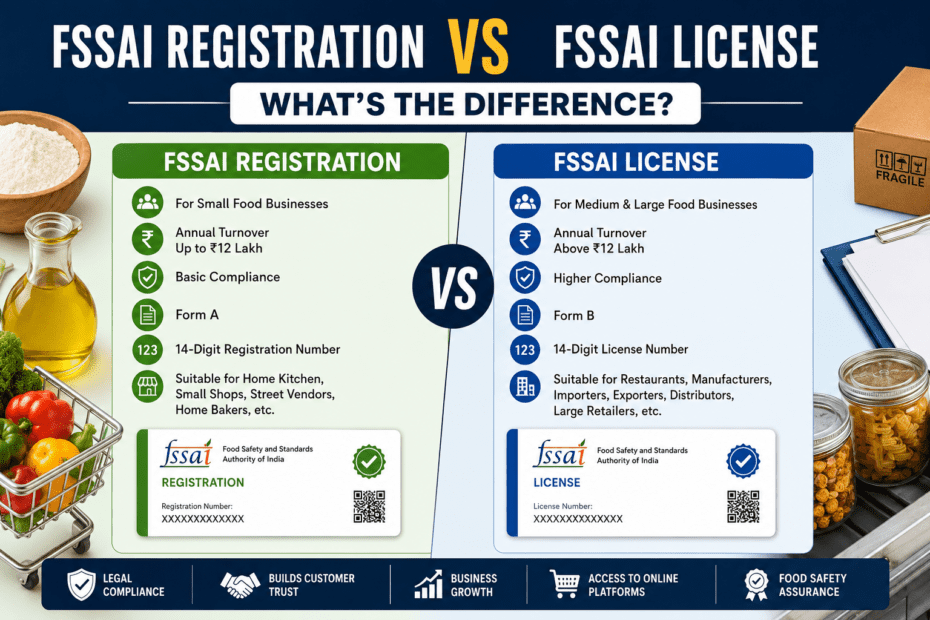
The main difference between FSSAI Registration vs FSSAI License is based on the size and turnover of the food business.
Small food businesses usually need FSSAI Registration
Medium and large businesses require an FSSAI License
Many businesses mistakenly apply for registration when they actually require a state or central license. This can create problems during inspections or while selling through platforms like Swiggy, Zomato, Amazon, or Flipkart.
What is FSSAI Registration?
FSSAI Registration is the basic level approval for small food businesses. It is generally issued to businesses with low turnover and limited operations.
Who Needs FSSAI Registration?
Small businesses such as:
Home kitchen businesses
Home bakers
Small grocery stores
Tea stalls
Street food vendors
Small snack makers
Temporary food stalls
Turnover Limit for FSSAI Registration
Businesses with annual turnover up to ₹12 lakh generally require basic FSSAI Registration.
Features of FSSAI Registration
Basic compliance certificate
14-digit registration number
Suitable for small food operators
Lower compliance burden
Simple documentation process
What is FSSAI License?
An FSSAI License is required for medium and large food businesses. It has stricter compliance requirements compared to basic registration.
There are mainly two types of FSSAI Licenses:
1. State FSSAI License
Required for businesses with turnover above ₹12 lakh and up to ₹20 crore in most cases.
2. Central FSSAI License
Required for large businesses, import-export businesses, large manufacturers, or businesses operating in multiple states.
FSSAI Registration vs FSSAI License: Major Differences
| Basis | FSSAI Registration | FSSAI License |
|---|---|---|
| Suitable For | Small businesses | Medium & large businesses |
| Turnover Limit | Up to ₹12 lakh | Above ₹12 lakh |
| Application Form | Form A | Form B |
| Compliance Level | Basic | Higher |
| Inspection Requirement | Usually minimal | More detailed |
| Business Scale | Local/small | Large/multi-location |
| Validity | 1-5 years | 1-5 years |
| Government Scrutiny | Lower | Higher |
This comparison clearly shows why understanding FSSAI Registration vs FSSAI License is important before applying.
How to Decide Between FSSAI Registration vs FSSAI License?
Choosing the right category depends on several factors.
1. Annual Turnover
This is one of the biggest deciding factors.
Up to ₹12 lakh → Registration
Above ₹12 lakh → License
2. Nature of Business
Manufacturing, importing, exporting, or large-scale food processing usually requires a license even if turnover is lower in some situations.
3. Business Expansion Plans
If you plan to scale your business quickly, it may be better to apply for a license instead of basic registration.
4. Selling on Online Platforms
Many online food marketplaces prefer businesses to have proper FSSAI licensing.
Documents Required for FSSAI Registration
The documentation for basic registration is simpler.
Common documents include:
Aadhaar card
PAN card
Passport-size photo
Business address proof
Food business details
Documents Required for FSSAI License
License applications usually require additional documentation.
These may include:
PAN card of business
Address proof
Constitution certificate
Food safety management plan
Machinery details
NOC
Import-export code (if applicable)
Common Mistakes Businesses Make
While understanding FSSAI Registration vs FSSAI License, many businesses make avoidable mistakes.
Applying Under Wrong Category
Some businesses intentionally choose basic registration to save money even when they legally require a license.
Ignoring Turnover Limits
Once turnover crosses the registration limit, upgrading becomes necessary.
Using Expired Certificate
Operating with an expired registration or license can attract penalties.
Wrong Business Activity Selection
Incorrect activity selection during application can create compliance issues later.
Penalty for Operating Without FSSAI
Running a food business without proper FSSAI approval can lead to penalties and legal action.
Possible consequences include:
Monetary penalties
Business closure notices
Product seizure
Marketplace restrictions
Loss of customer trust
This is why understanding FSSAI Registration vs FSSAI License is critical for every food entrepreneur.
Benefits of FSSAI Compliance
Builds Customer Trust
Customers prefer food businesses with legal compliance and hygiene standards.
Helps Business Growth
FSSAI approval improves credibility with customers, marketplaces, and distributors.
Easier Online Selling
Platforms like Swiggy and Zomato usually require FSSAI details.
Legal Protection
It reduces the risk of penalties and compliance disputes.
FSSAI Registration vs FSSAI License for Home Businesses
Many people starting from home often ask whether they need registration or a license.
Home Bakers
Small-scale home bakers with low turnover usually require registration.
Home Kitchens
Cloud kitchens or growing food delivery businesses may eventually require a state license.
Homemade Snacks Sellers
Small local sellers can often start with registration.
However, once business expands, upgrading becomes necessary.
Can You Upgrade from Registration to License?
Yes. Businesses can upgrade from FSSAI Registration to an FSSAI License when turnover increases or operations expand.
This is common for:
Growing cloud kitchens
Expanding restaurants
Fast-growing packaged food brands
E-commerce food sellers
Businesses should upgrade before becoming non-compliant.
Validity of FSSAI Registration and License
Both registration and licenses can generally be obtained for 1 to 5 years depending on the application.
Renewal should be done before expiry to avoid penalties.
How to Apply for FSSAI Registration or License?
The general process includes:
Determine correct category
Prepare documents
Submit application
Pay government fees
Respond to clarification if required
Receive certificate
Businesses should ensure all details are accurate to avoid rejection.
Which is Better: FSSAI Registration or FSSAI License?
Neither is “better” universally. The correct choice depends on your business size and operations.
Small businesses should choose registration
Growing and larger businesses should choose licensing
The goal is proper compliance, not simply choosing the cheaper option.
Conclusion
Understanding FSSAI Registration vs FSSAI License is extremely important for every food business owner in India. While both are related to food safety compliance, they apply to different business categories and turnover levels.
Choosing the wrong type can create unnecessary compliance problems, penalties, and business restrictions. Small businesses usually require FSSAI Registration, while medium and large businesses need a State or Central FSSAI License.
Before applying, always evaluate your turnover, business activities, future expansion plans, and compliance requirements carefully. Proper FSSAI compliance not only protects your business legally but also helps build customer trust and long-term growth.
If you are planning to start a food business, understanding the difference between FSSAI Registration vs FSSAI License is one of the first and most important steps.


