Starting an NGO in India is a meaningful decision that allows individuals and groups to contribute toward social welfare, education, healthcare, and community development. However, before beginning this journey, one of the most important questions you must answer is: What is the actual cost of NGO registration in India?
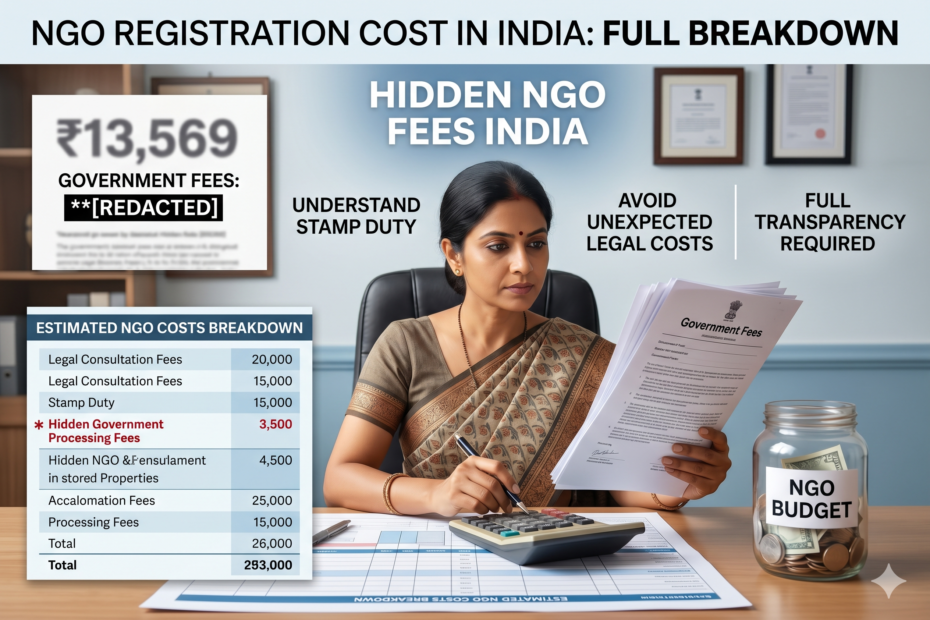
Most online guides only provide basic estimates, but they often ignore the Hidden NGO Fees India that can significantly increase your total expenses. If you are not aware of these hidden costs, you may end up exceeding your budget or facing delays in the registration process.
In this detailed guide, we will break down every aspect of NGO registration cost in India for 2026, including official fees, professional charges, and all hidden expenses you must consider for proper financial planning.
Why Understanding NGO Registration Cost is Crucial
Proper cost planning is not just about saving money—it’s about ensuring a smooth and legally compliant setup. Understanding Hidden NGO Fees India helps you:
Avoid unexpected financial stress
Choose the right NGO structure
Prevent delays due to incomplete processes
Plan long-term sustainability
Build transparency from the beginning
A well-planned NGO setup ensures that your focus remains on your mission rather than financial complications.
Types of NGO Structures and Their Cost Differences
In India, NGOs can be registered under three main legal structures. Each structure has different cost implications.
1. Trust Registration Cost
A Trust is one of the simplest forms of NGO registration and is commonly used for charitable activities managed by families or small groups.
Cost Breakdown:
Government Fees: ₹500 – ₹2,000
Trust Deed Drafting: ₹3,000 – ₹10,000
Stamp Duty: ₹1,000 – ₹10,000 (varies by state)
Estimated Total Cost: ₹5,000 – ₹25,000
👉 Hidden NGO Fees India Insight: Stamp duty is often underestimated and can significantly increase the total cost depending on your state.
2. Society Registration Cost
Societies are ideal for group initiatives and community-based work.
Cost Breakdown:
Government Fees: ₹1,000 – ₹5,000
Documentation Charges: ₹5,000 – ₹15,000
Miscellaneous Expenses: ₹2,000 – ₹5,000
Estimated Total Cost: ₹7,000 – ₹30,000
👉 Hidden costs include notarization, affidavit preparation, and document corrections.
3. Section 8 Company Registration Cost
A Section 8 Company is the most professional and structured NGO format, offering higher credibility and better funding opportunities.
Cost Breakdown:
Government Fees: ₹2,000 – ₹7,000
DSC & DIN Charges: ₹2,000 – ₹5,000
Professional Fees: ₹10,000 – ₹40,000
Estimated Total Cost: ₹15,000 – ₹50,000+
👉 Though costly, it is preferred by organizations seeking CSR funding and large-scale operations.
Hidden NGO Fees India – Detailed Breakdown
Now let’s focus on the most important part—the Hidden NGO Fees India that many people overlook.
1. Name Approval and Reservation Fees
Some registration types require name approval
Rejection may lead to additional charges
👉 Choosing the wrong name can increase cost and delay the process.
2. Notary and Affidavit Charges
Required for legal verification
Cost: ₹500 – ₹2,000
Though small individually, these costs add up.
3. Registered Office Expenses
Every NGO must have a registered office.
Costs include:
Rent agreement preparation
Address proof documentation
No Objection Certificate (NOC)
👉 Even if you use a home address, documentation costs still apply.
4. Professional Consultation Fees
Charges for CA, CS, or legal advisors
Often not included in basic service packages
👉 Many low-cost service providers exclude these, increasing Hidden NGO Fees India later.
5. PAN and Bank Account Setup
After registration:
PAN application fees
Bank account setup requirements
These are essential for financial transactions and compliance.
6. 12A and 80G Registration Costs
These registrations are critical for tax benefits:
12A: Income tax exemption
80G: Tax benefits for donors
Cost:
Government Fees: Minimal
Professional Fees: ₹5,000 – ₹20,000
👉 A major part of Hidden NGO Fees India that many beginners ignore.
7. FCRA Registration Costs
If your NGO plans to receive foreign funding:
Government Fees: ₹10,000+
Professional Fees: ₹10,000 – ₹50,000
👉 This is one of the highest hidden expenses in NGO setup.
8. Annual Compliance Costs
After registration, NGOs must maintain compliance every year.
Costs include:
Audit Fees: ₹5,000 – ₹25,000
Income Tax Filing: ₹2,000 – ₹10,000
Annual Returns
👉 These recurring costs are often ignored but are essential for legal operation.
Real Total Cost of NGO Setup in India (2026)
Including all Hidden NGO Fees India, here’s the realistic cost:
| NGO Type | Basic Cost | Actual Cost (Including Hidden Fees) |
|---|---|---|
| Trust | ₹5,000 | ₹10,000 – ₹30,000 |
| Society | ₹7,000 | ₹15,000 – ₹40,000 |
| Section 8 | ₹15,000 | ₹25,000 – ₹70,000+ |
Factors That Affect NGO Registration Cost
Several factors influence the total cost:
State-specific stamp duty rates
Number of members or directors
Complexity of documentation
Professional service provider fees
Additional registrations (12A, 80G, FCRA)
Understanding these factors helps in better cost estimation.
How to Reduce Hidden NGO Fees India
You can minimize costs by following these smart tips:
✔ Choose the right NGO structure from the beginning
✔ Prepare documents accurately to avoid rejection
✔ Compare multiple service providers
✔ Avoid unnecessary add-ons
✔ Plan compliance requirements in advance
Common Mistakes That Increase NGO Costs
Avoid these mistakes to prevent unnecessary expenses:
❌ Submitting incorrect documents
❌ Choosing the wrong structure
❌ Ignoring tax registrations
❌ Delaying compliance filings
❌ Falling for cheap but incomplete service packages
👉 These mistakes often lead to higher Hidden NGO Fees India in the long run.
DIY vs Professional NGO Registration
Many people try to register NGOs themselves to save money. While DIY may reduce initial expenses, it often leads to:
Errors in documentation
Application rejection
Legal complications
Increased long-term cost
👉 Professional assistance ensures accuracy, saves time, and reduces risks.
Importance of Financial Planning for NGOs
Proper financial planning is crucial for long-term success. It helps NGOs:
Maintain transparency
Build donor trust
Ensure compliance
Plan future growth
Understanding Hidden NGO Fees India is the first step toward effective financial management.
Benefits of Knowing the True Cost
When you understand the full cost, you can:
Avoid surprises
Register smoothly
Maintain compliance easily
Build a strong financial foundation
Conclusion
NGO registration in India involves more than just basic government fees. There are several hidden expenses that can significantly increase your overall cost. Understanding Hidden NGO Fees India is essential for accurate budgeting and a smooth registration process.
By choosing the right structure, preparing documents carefully, and planning for compliance, you can avoid unnecessary expenses and successfully establish your NGO in 2026.
📞 Need Help with NGO Registration?
Avoid hidden costs and get expert support for your NGO setup.
Taxamicus offers:
Transparent pricing
Complete NGO registration services
12A & 80G registration
Ongoing compliance support
Start your NGO journey with clarity, confidence, and professional guidance today!


