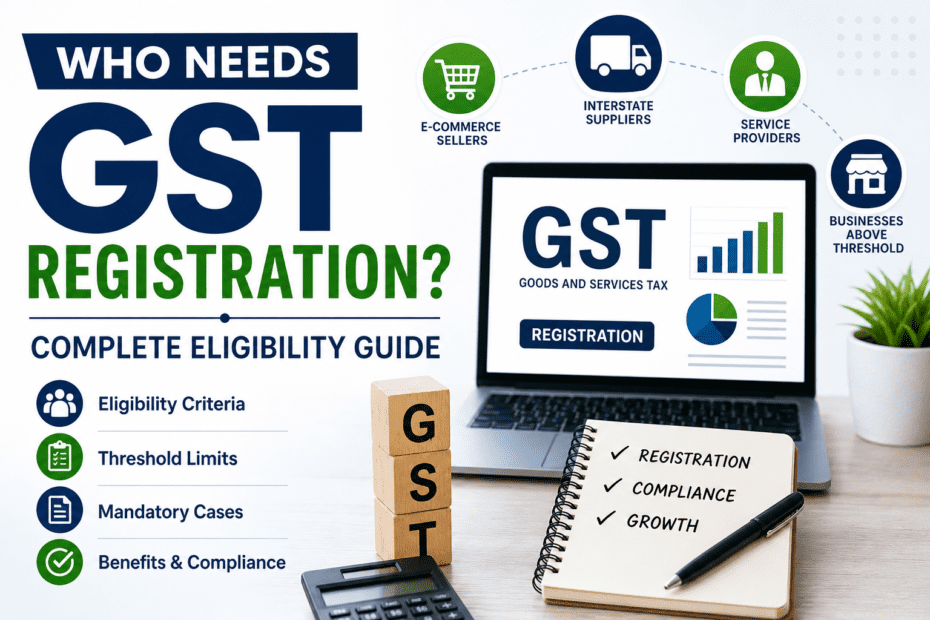
Since its implementation, Goods and Services Tax (GST) has become a crucial part of India’s taxation system. It simplified multiple indirect taxes into a single framework, making compliance more transparent and streamlined. However, despite these improvements, many business owners, freelancers, and startups still ask one important question: Who actually needs GST Registration?
Understanding whether your business requires GST Registration is essential. Registering unnecessarily can increase your compliance burden, while failing to register when required can lead to heavy penalties. This guide will help you clearly understand GST registration eligibility, mandatory cases, exemptions, and practical examples to ensure you make the right decision.
What is GST Registration?
GST Reg is the process of enrolling your business under the GST law. Once registered, you receive a GSTIN (Goods and Services Tax Identification Number), which acts as your unique tax identity.
With GST Registration, a business can:
Collect GST from customers
Claim input tax credit (ITC)
Legally operate across India
Build credibility in the market
Without GST Registration (where required), collecting GST is illegal, and you won’t be able to claim tax benefits.
GST Registration Threshold Limits
The primary factor for determining GST Registration eligibility is annual turnover.
1. For Goods Suppliers
₹40 lakh annual turnover (₹20 lakh in special category states)
2. For Service Providers
₹20 lakh annual turnover (₹10 lakh in special category states)
3. For Mixed Supply (Goods + Services)
₹20 lakh threshold usually applies
👉 Once your turnover crosses these limits, GST Registration becomes mandatory.
Who Needs GST Registration? (Mandatory Categories)
Even if your turnover is below the threshold, certain businesses must register under GST.
1. Inter-State Suppliers
If you supply goods or services from one state to another, GST Reg is compulsory.
Example:
A seller based in West Bengal supplying goods to Maharashtra must register under GST, even if turnover is low.
2. E-commerce Sellers
If you sell products through online platforms such as:
Amazon
Flipkart
Meesho
You must obtain GST Registration.
👉 This rule applies even to small sellers with minimal turnover.
3. Casual Taxable Persons
If you occasionally supply goods/services in a state where you don’t have a fixed business location, you need GST Registration.
4. Non-Resident Taxable Persons
Foreign individuals or businesses supplying goods/services in India must register under GST.
5. Reverse Charge Mechanism (RCM)
Businesses required to pay tax under reverse charge must register, regardless of turnover.
6. Input Service Distributors (ISD)
Organizations distributing input tax credit among branches must obtain GST Registration.
7. Agents and Brokers
If you supply goods/services on behalf of others (as an agent), GST Registration is mandatory.
8. TDS/TCS Deductors
Entities required to deduct or collect tax at source under GST must also register.
Who Does NOT Need GST Registration?
GST law also provides exemptions for certain categories.
1. Small Businesses Below Threshold
If your turnover is below:
₹40 lakh (goods)
₹20 lakh (services)
GST Regi is not required.
2. Agriculturists
Farmers supplying produce from cultivation are exempt from GST Reg.
3. Suppliers of Exempt Goods/Services
Businesses dealing exclusively in exempt categories such as:
Fresh fruits and vegetables
Unprocessed food items
Healthcare services
Educational services
do not require GST Reg.
Voluntary GST Registration
Even if your business is not required to register, you can opt for voluntary GST Reg.
Benefits
Claim input tax credit
Work with larger clients
Sell on e-commerce platforms
Improve business credibility
Drawbacks
Regular GST return filing
Increased compliance costs
Need for proper accounting
👉 Voluntary registration is ideal for businesses planning to grow or expand interstate.
Special Category States and Lower Limits
Certain states have lower GST thresholds:
Arunachal Pradesh
Mizoram
Nagaland
Manipur
Meghalaya
Sikkim
Tripura
Threshold Limits
₹20 lakh for goods
₹10 lakh for services
Businesses operating in these states must register earlier than others.
Composition Scheme vs Regular GST Registration
After deciding to register, you must choose the appropriate GST scheme.
Composition Scheme
Available for small taxpayers
Turnover up to ₹1.5 crore
Lower tax rates
Minimal compliance
Limitation:
Cannot claim input tax credit
Cannot make interstate supplies
Regular Scheme
Standard GST rates apply
Eligible for input tax credit
Suitable for growing businesses
👉 Choosing the right scheme depends on your business model and growth plans.
Documents Required for GST Registration
To apply for GST Reg, you will need:
PAN Card
Aadhaar Card
Business registration proof
Address proof
Bank account details
Photograph of owner
Digital signature (for companies)
Step-by-Step GST Registration Process
The GST Reg process is completely online:
Visit the GST portal
Fill in basic details (Part A)
Verify with OTP
Complete business details (Part B)
Upload required documents
Submit application
Receive GSTIN
👉 Approval usually takes 3–7 working days.
Penalty for Not Registering Under GST
Failing to register when required can result in serious penalties:
10% of tax due (minimum ₹10,000)
100% penalty in case of fraud
👉 This makes timely GST Reg extremely important.
Practical Examples for Better Understanding
Example 1: Freelancer
A freelance content writer earning ₹18 lakh annually:
👉 No GST Reg required (below threshold)
Example 2: Online Seller
A small seller on Meesho earning ₹4 lakh annually:
👉 GST Reg required (e-commerce rule)
Example 3: Local Business
A clothing store with ₹35 lakh turnover operating within one state:
👉 No GST Reg required (below ₹40 lakh limit)
Example 4: Interstate Consultant
A consultant earning ₹12 lakh but serving clients across states:
👉 GST Reg required (interstate supply)
Example 5: Growing Startup
A startup expecting rapid growth:
👉 Voluntary GST Registration recommended
Common Mistakes to Avoid
Many businesses make errors while dealing with GST:
Ignoring interstate transactions
Not tracking turnover regularly
Delaying registration after crossing threshold
Choosing the wrong GST scheme
Filing incorrect GST returns
👉 Avoiding these mistakes can save you from penalties and compliance issues.
Important Tips for GST Compliance
To stay compliant after GST Registration:
Maintain proper invoices
File returns on time
Track input tax credit carefully
Use GST software for accuracy
Consult professionals when needed
Why GST Registration is Important for Business Growth
Beyond legal compliance, GST Reg offers strategic benefits:
Enhances business credibility
Helps in scaling operations
Enables seamless interstate trade
Allows tax savings through ITC
Improves transparency in transactions
👉 In today’s competitive market, GST reg is often seen as a sign of a professional and trustworthy business.
Conclusion
Determining whether you need GST Reg depends on your turnover, business type, and nature of operations. While small businesses below threshold limits can remain unregistered, many categories must register regardless of turnover.
Key Takeaways
Register if your turnover exceeds limits
Register if you sell interstate or online
Consider voluntary registration for growth
Stay compliant to avoid penalties
If you’re unsure about your eligibility, it’s always better to analyze your business activities carefully or consult a professional. Proper GST Registration not only keeps you legally safe but also opens doors to long-term growth and expansion.
SEO Tags (Keywords)
GST Registration, GST eligibility India, who needs GST registration, GST threshold limit India, GST rules India, GST registration guide, GST for small business, GST compliance India, GST registration online, GST applicability India, GST for freelancers, GST for e-commerce sellers, GST turnover limit, GST law India, GST registration benefits.


