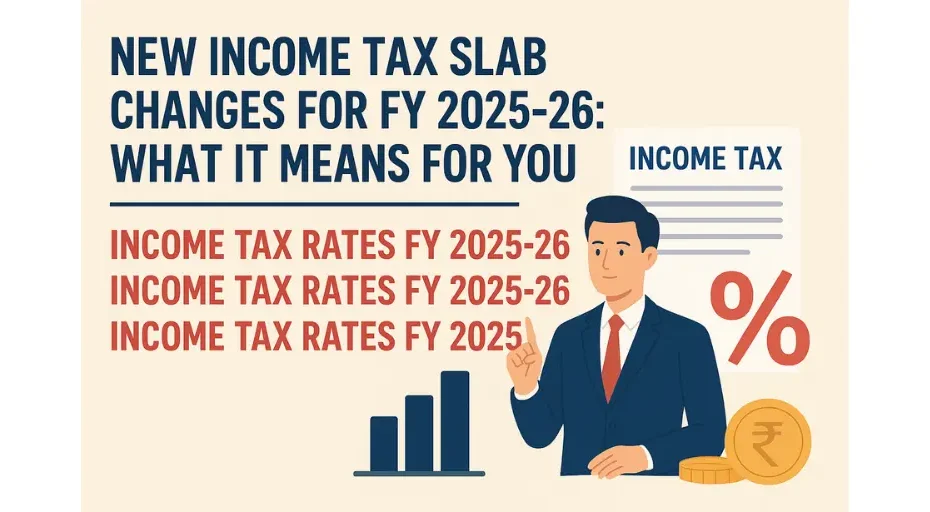
New Income Tax Slab Changes for FY 2025-26: What It Means for You
The announcement of the income tax rates FY 2025-26 in the Union Budget has created a buzz among taxpayers, financial planners, and businesses alike. Every year, tax slabs and exemptions are reviewed to balance government revenue with taxpayer relief. For the financial year 2025-26, significant updates have been made that could affect salaried employees, professionals, business owners, and retirees. Understanding these changes is crucial because even small modifications in tax slabs can impact your take-home income, investment strategy, and overall financial planning.
In this blog, we will break down the income tax rates FY 2025-26, compare them with previous years, highlight the differences between the old and new regimes, and explain what these changes mean for different categories of taxpayers.
Why Tax Slab Changes Matter
Income tax is one of the primary sources of government revenue. By tweaking tax slabs, the government influences consumer spending, investment behavior, and even business growth. When tax rates are reduced, individuals often have more disposable income to spend or save. On the other hand, higher taxes can restrict consumption but may strengthen fiscal stability.
The income tax rates FY 2025-26 have been designed keeping in mind inflationary pressures, demands for middle-class relief, and the push towards wider adoption of the simplified new tax regime. For individuals, these changes could mean either more savings or higher contributions to government revenue, depending on their income bracket.
Overview of Income Tax Slabs
India currently follows two systems for personal income taxation:
Old Regime – with higher rates but multiple exemptions and deductions (such as HRA, LTA, Section 80C, 80D, etc.).
New Regime – with lower rates but minimal exemptions, introduced to simplify tax compliance.
For FY 2025-26, the government has made changes primarily to encourage more people to adopt the new regime. The revised income tax rates FY 2025-26 under the new system provide relief to low and middle-income earners while attempting to reduce complexity.
Income Tax Rates FY 2025-26: New Regime
Here’s the updated slab structure under the new regime for individuals below 60 years of age:
Income up to ₹3,00,000 – Nil tax
Income between ₹3,00,001 – ₹7,00,000 – 5%
Income between ₹7,00,001 – ₹10,00,000 – 10%
Income between ₹10,00,001 – ₹12,00,000 – 15%
Income between ₹12,00,001 – ₹15,00,000 – 20%
Income above ₹15,00,000 – 30%
Additionally, a standard deduction of ₹75,000 for salaried employees and pensioners has been retained, making the regime slightly more attractive. The rebate under Section 87A is also available for income up to ₹7 lakh, effectively making the first slab tax-free for many.
Income Tax Rates FY 2025-26: Old Regime
For taxpayers who prefer to stick with the old system due to deductions and exemptions, the slabs remain largely unchanged:
Income up to ₹2,50,000 – Nil
Income between ₹2,50,001 – ₹5,00,000 – 5%
Income between ₹5,00,001 – ₹10,00,000 – 20%
Income above ₹10,00,000 – 30%
However, deductions such as Section 80C (up to ₹1.5 lakh), 80D (medical insurance), and housing loan benefits can significantly reduce taxable income here. Despite this, the government’s clear intention is to gradually phase out the old regime by making the income tax rates FY 2025-26 under the new regime more appealing.
Key Highlights of FY 2025-26 Tax Changes
Wider Zero-Tax Bracket: The exemption limit in the new regime has been raised to ₹3 lakh, offering relief to entry-level earners.
Lower Middle-Class Benefit: Individuals earning between ₹7–12 lakh stand to save the most due to reduced slab rates.
Standard Deduction Hike: The increase in standard deduction puts more money in the hands of salaried taxpayers.
Simplification Drive: By incentivizing the new regime, the government is aiming for a uniform, simplified structure that reduces litigation and compliance burden.
Incentives to Adopt New Regime: The cumulative effect of revised income tax rates FY 2025-26 strongly nudges taxpayers towards the new system.
What Do These Changes Mean for You?
For Salaried Employees
The revised income tax rates FY 2025-26 under the new regime can reduce tax outgo for many middle-income employees. For instance, someone earning ₹10 lakh annually may find the new regime more beneficial due to the lower tax rate, even without deductions. However, employees with significant deductions (HRA, 80C, NPS) might still prefer the old regime.
For Business Owners and Professionals
Since many business owners invest heavily in tax-saving instruments, the old regime may still remain attractive for them. However, professionals with simpler income structures could benefit more from the new rates.
For Retirees and Senior Citizens
Retirees who don’t have large deductions might benefit from the reduced slab rates in the new system. Senior citizens also enjoy slightly higher exemption thresholds under the old regime, which must be considered before making a choice.
For High-Income Earners
For those earning above ₹15 lakh, the maximum rate remains 30% under both regimes. The decision for this group hinges largely on available deductions versus the simplicity of the new structure.
Old Regime vs. New Regime: Which Should You Choose?
The big question for most taxpayers remains: which regime is better? The answer is not universal and depends on your income, investments, and eligible deductions.
If you are someone who invests in 80C instruments (like PPF, ELSS, life insurance), pays housing loan EMIs, or claims HRA, the old regime might still save you more.
If you prefer fewer compliances and don’t utilize many deductions, the new regime with its revised income tax rates FY 2025-26 will be the better choice.
Taxpayers are advised to calculate tax liability under both systems before filing returns to determine the most beneficial option.
The Bigger Picture
The changes in income tax rates FY 2025-26 reflect the government’s ongoing attempt to simplify India’s tax system. Over the last few years, there has been a steady shift towards the new regime, with attractive rate cuts and rebates. By reducing reliance on exemptions, the government aims to make the system transparent, predictable, and less prone to misuse.
In the long run, these moves could increase compliance, reduce litigation, and help taxpayers make informed decisions without the pressure of complicated deductions.
Conclusion
The updated income tax rates FY 2025-26 have introduced notable relief for low and middle-income earners while keeping the tax system straightforward under the new regime. While the old regime still holds value for those who maximize deductions, the government’s push is clear: the future lies in a simplified tax structure.
As a taxpayer, the smartest approach is to analyze both regimes carefully, evaluate your deductions, and calculate the final liability before choosing. Whether you are a salaried professional, business owner, or retiree, these changes will impact your financial planning for the year ahead.
Staying informed and proactive can help you not just comply with the law but also optimize your savings. The income tax rates FY 2025-26 may be a turning point in India’s journey towards a more transparent and efficient tax system.
Our GST Services

All E-commerce Tax services
E-commerce tax services help online sellers navigate GST registration, compliance, return filing, TCS management, tax planning, and audits, ensuring efficient tax management and legal compliance.
GST Filing
GST filing is the process of submitting tax returns to the government, detailing sales, purchases, and taxes paid or collected, ensuring compliance with GST laws.

GST Registration
GST registration is the process where businesses obtain a GSTIN from the government, allowing them to collect taxes, claim input tax credits, and comply with GST laws.


