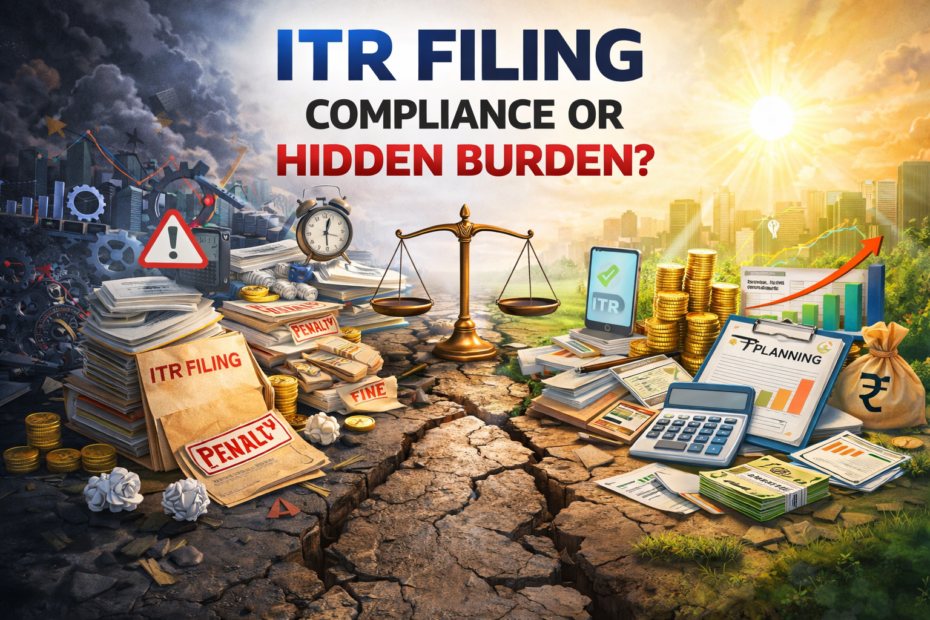
ITR Filing: Compliance or Hidden Burden?
Every year, as the Income Tax Return (ITR) filing season approaches, millions of taxpayers across India rush to meet deadlines, gather documents, and ensure compliance. While filing ITR is a legal responsibility, an important question arises:
Is ITR filing just compliance, or has it become a Hidden ITR Burden on taxpayers?
For many salaried individuals, freelancers, and small business owners, the process is no longer just about paying tax—it involves navigating complexities, managing documentation, and avoiding costly errors. This growing gap between expectation and experience has turned ITR filing into more than just a routine obligation.
In this blog, we explore the reality behind the Hidden ITR Burden, why taxpayers feel stressed, and how you can manage it effectively.
Understanding ITR Filing: The Basics
An Income Tax Return (ITR) is a declaration of:
Income earned during the financial year
Taxes paid
Deductions claimed
Refunds (if any)
The objective is simple: maintain transparency and ensure tax compliance. However, the process surrounding it has become increasingly complex over time.
What Is the Hidden ITR Burden?
The Hidden ITR Burden refers to the unseen pressure associated with ITR filing, including:
Time spent collecting and verifying documents
Understanding changing tax rules
Risk of errors and penalties
Stress of compliance and deadlines
Dependency on professionals or software
While the tax amount is visible, these indirect costs are often ignored—but they significantly impact taxpayers.
Why ITR Filing Feels Like a Burden Today
1. Increasing Complexity in Tax Rules
Over the years, tax laws have become more detailed and technical. From multiple ITR forms to frequent updates, taxpayers must constantly stay informed.
Even a simple salaried individual now needs to understand:
Old vs new tax regime
Deductions and exemptions
Capital gains rules
Reporting requirements
This complexity adds to the Hidden ITR Burden.
2. Too Many Data Sources to Track
Modern ITR filing requires cross-checking multiple sources:
Form 16
Form 26AS
AIS (Annual Information Statement)
Bank statements
Investment proofs
If any mismatch occurs, it may lead to notices or corrections. Managing this data is time-consuming and stressful.
3. Fear of Notices and Penalties
One of the biggest contributors to the Hidden ITR Burden is fear.
Taxpayers worry about:
Incorrect filing
Missing income details
Mismatch with AIS
Receiving notices
Even honest taxpayers often feel anxious, which makes the process mentally exhausting.
4. Limited Awareness Among Taxpayers
Many individuals:
Do not fully understand tax rules
Depend on last-minute filing
Rely on incomplete information
This lack of awareness leads to mistakes, increasing both financial and emotional burden.
Common Mistakes That Increase Hidden ITR Burden
Let’s look at some frequent errors:
🚨 Not Reporting All Income
Many taxpayers forget to include:
Bank interest
Freelance income
Dividend income
This leads to mismatches and possible scrutiny.
🚨 Choosing the Wrong Tax Regime
Selecting between old and new regimes without calculation can result in higher tax liability.
🚨 Incorrect Deduction Claims
Claiming deductions without proper proof or eligibility can cause problems later.
🚨 Ignoring AIS and Form 26AS
These statements reflect what the government already knows about your income. Ignoring them increases risk.
🚨 Last-Minute Filing
Rushing at the last moment often leads to errors.
Financial Impact of Hidden ITR Burden
The burden is not just about stress—it has real financial consequences:
Penalties for late filing
Interest on unpaid taxes
Loss of eligible deductions
Higher tax liability due to poor planning
Professional fees for corrections
In many cases, taxpayers end up paying more than necessary.
Is the New Tax Regime Reducing the Burden?
The government introduced the new tax regime to simplify taxation. However:
Pros:
Lower tax rates
No need for multiple deductions
Cons:
Loss of tax-saving benefits
Not suitable for individuals with investments
Limited flexibility
For many taxpayers, the new regime does not fully eliminate the Hidden ITR Burden—it only changes its nature.
ITR Filing: Compliance vs Reality
Compliance Perspective
Legal requirement
Ensures transparency
Supports government revenue
Reality for Taxpayers
Complex procedures
Time-consuming process
Risk of errors
Continuous stress
This gap between theory and practice defines the Hidden ITR Burden.
How to Reduce Hidden ITR Burden
✔ Start Early
Avoid last-minute rush. Begin tax planning at the start of the financial year.
✔ Maintain Proper Records
Keep:
Salary slips
Investment proofs
Bank statements
Expense records
Organized data reduces errors.
✔ Understand Your Tax Profile
Know:
Your income sources
Applicable deductions
Suitable tax regime
Awareness reduces dependency.
✔ Use Technology Carefully
Online platforms and apps can help, but:
Do not rely blindly
Always verify details
✔ Take Professional Help
A tax expert can:
Optimize tax liability
Ensure correct filing
Reduce risk of notices
This is one of the most effective ways to minimize the Hidden ITR Burden.
Why Professional Support Matters More Than Ever
Many taxpayers believe:
“I can file ITR myself and save money.”
However, mistakes can cost far more than professional fees.
A professional ensures:
Accuracy
Compliance
Tax efficiency
Peace of mind
For growing incomes and complex financial situations, expert support becomes essential.
How Taxamicus Helps Reduce Hidden ITR Burden
At taxamicus.in, we focus on simplifying taxation for individuals and businesses.
Our services include:
Accurate ITR filing
Tax planning strategies
Error checking and reconciliation
Notice handling support
Personalized financial guidance
Our goal is simple:
➡️ Make ITR filing stress-free and cost-effective.
Future of ITR Filing in India
With increasing digitization, the future of ITR filing will include:
AI-based verification
Real-time data matching
Faster notice generation
More transparency
While this may improve efficiency, it may also increase scrutiny—making accuracy even more important.
Final Thoughts
So, is ITR filing just compliance, or is it a Hidden ITR Burden?
The answer lies somewhere in between.
While filing ITR is essential for a transparent and structured economy, the growing complexity, risks, and indirect costs make it feel like a burden for many taxpayers.
However, with the right approach—early planning, proper knowledge, and expert guidance—you can turn this burden into a manageable process.
Need Help with ITR Filing?
If you want to:
✔ Avoid costly mistakes
✔ Reduce tax liability legally
✔ File your ITR without stress
Taxamicus is here to help.


