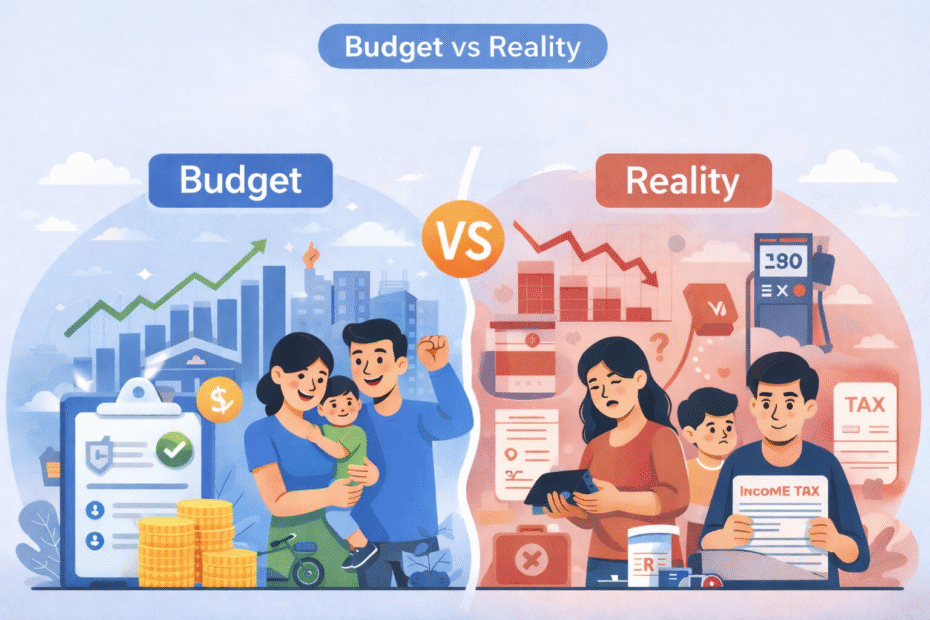
Every year, when the Union Budget is announced, middle-class families sit with hope. News headlines promise relief, growth, benefits, and support. Finance experts debate numbers, social media celebrates or criticizes, and governments highlight achievements.
But once the excitement settles, a crucial question remains unanswered for most households:
What do middle-class families actually get?
This gap between promises and lived experience is best explained by one phrase—Budget vs Reality.
In this blog, we break down the real impact of budgets on middle-class families, uncover hidden truths, and explain what taxpayers should realistically expect instead of what is advertised.
Who Are Middle-Class Families in India?
Before understanding Budget vs Reality, we must define the middle class.
Typically, middle-class families:
Earn between ₹3 lakh and ₹25 lakh annually
Rely mainly on salary or small business income
Pay income tax regularly
Have home loans, education expenses, medical costs
Aim for savings, insurance, and basic investments
Ironically, this group contributes the most consistent tax revenue but often receives the least visible benefit.
Budget Announcements: What Is Promised? (Budget vs Reality)
Every budget highlights:
Increased standard deduction
Changes in tax slabs
New schemes and incentives
Infrastructure development
Digital growth and ease of living
On paper, everything looks positive. This is where the Budget side of Budget vs Reality dominates the narrative.
Reality Check: What Middle-Class Families Experience
After budgets are implemented, families usually face:
Rising cost of living
Higher education and healthcare expenses
Increased indirect taxes
Reduced or removed deductions
Complex compliance rules
The real struggle begins when numbers on paper meet real household expenses.
Budget vs Reality: Income Tax Relief
Budget Claim
Tax slabs are revised. New tax regime is promoted as “simpler and beneficial”.
Reality
Most middle-class families lose deductions under the new tax regime
Tax savings are often offset by loss of exemptions
Inflation neutralizes tax relief
Higher income still means higher tax burden
In the Budget vs Reality comparison, tax relief often looks bigger than it actually is.
Standard Deduction: Relief or Illusion?
Budget Perspective
Standard deduction increases are projected as major relief.
Reality
Increase rarely matches inflation
Medical, education, and housing costs grow faster
Net disposable income barely improves
For most salaried families, this is symbolic relief, not financial comfort.
Indirect Taxes: The Silent Burden
One major reason Budget vs Reality feels unfair is indirect taxation.
Even if income tax remains stable:
GST on daily essentials affects everyone
Fuel prices impact transport and goods
Hidden taxes increase living costs
Middle-class families end up paying more without realizing it.
Education & Healthcare: The Biggest Reality Gap
Budget Announcements
Increased allocation for education and healthcare
New schemes and digital initiatives
Ground Reality
Private education costs continue rising
Healthcare expenses remain largely out-of-pocket
Insurance premiums increase every year
The Budget vs Reality gap is widest in these two essential areas.
Home Loans & Housing: Expectations vs Experience
Budget Side
Housing incentives
Affordable housing push
Interest deduction under Section 24
Reality Side
Property prices remain high
Interest deduction limits unchanged
EMI burden increases with interest rate changes
For middle-class families, owning a home still feels stressful rather than secure.
Savings & Investments: Are They Really Encouraged?
Budget Claims
Encouragement for long-term investments
Focus on financial discipline
Reality
Many tax-saving instruments offer low real returns
Inflation eats into savings
Middle-class families save less, not more
In the Budget vs Reality debate, savings are encouraged in theory but discouraged by economic pressure.
Why Middle-Class Families Feel Ignored
The middle class often feels:
Too rich for subsidies
Too poor for luxury benefits
Heavily taxed but lightly supported
This emotional disconnect fuels the Budget vs Reality discussion every year.
Is the New Tax Regime Really Better?
The new tax regime is a classic Budget vs Reality example.
Budget Narrative
Lower tax rates
Simpler structure
Reality
Loss of deductions
Less flexibility
Not suitable for families with loans, insurance, or dependents
For many middle-class taxpayers, the old regime still works better—but only with careful planning.
Compliance Burden: The Hidden Cost
Budgets promise simplification, but reality shows:
Frequent rule changes
Confusing tax updates
Increased reporting requirements
Time, stress, and professional fees add to the middle class’s financial burden.
Budget vs Reality for Small Family Businesses
Middle-class families running small businesses face:
Higher compliance costs
GST complexity
Limited real incentives
While budgets talk about MSME support, ground reality often says otherwise.
What Middle-Class Families Can Do Instead of Complaining
Understanding Budget vs Reality is important—but action matters more.
Smart Steps to Take
Choose tax regime after proper calculation
Plan deductions early in the year
Integrate tax planning with budgeting
Avoid relying only on budget announcements
Seek professional advice
A smart tax strategy matters more than budget headlines.
Role of Professional Tax Planning
Budgets are generic. Families are not.
Professional tax planning helps:
Optimize tax liability legally
Choose the right regime
Plan investments smartly
Avoid compliance errors
This bridges the gap between Budget vs Reality.
How Taxamicus.in Helps Middle-Class Families
At taxamicus.in, the focus is on:
Practical tax planning, not theory
Real savings, not headline relief
Personalized advice for families
Budget impact analysis
ITR and compliance support
We help families understand what the budget says vs what actually benefits them.
The Truth About Budget vs Reality
Budgets are not designed to solve individual problems. They create frameworks.
Reality depends on:
Your income structure
Family responsibilities
Loans and investments
Tax planning approach
Understanding this difference helps families make smarter financial decisions.
Conclusion
The debate of Budget vs Reality will continue every year. While budgets may promise relief, middle-class families must look beyond headlines and focus on personal financial planning.
Instead of waiting for budget miracles:
Plan smartly
Save strategically
Invest wisely
Seek expert guidance
That is how middle-class families can truly benefit—regardless of what the budget announces.Bud