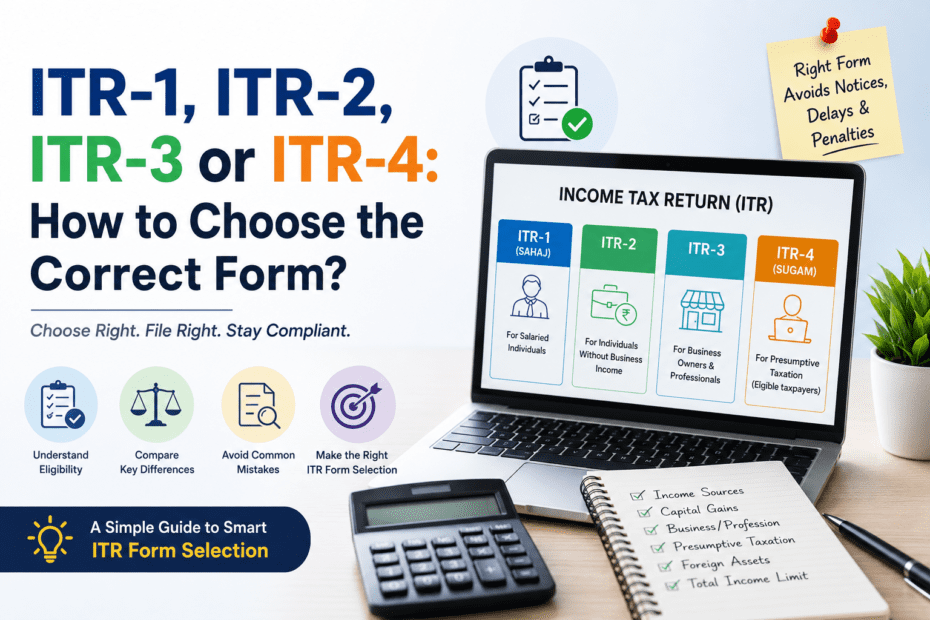
Filing your Income Tax Return (ITR) is an important responsibility for every taxpayer. However, one of the most common mistakes taxpayers make is selecting the wrong ITR form. An incorrect form can lead to a defective return notice, processing delays, or even the need to file a revised return.
If you are wondering whether you should file ITR-1, ITR-2, ITR-3, or ITR-4, this guide will help you make the right choice. Proper ITR Form Selection ensures that your return is filed accurately and complies with Income Tax Department requirements.
Why Is ITR Form Selection Important?
The Income Tax Department provides different ITR Form Selection based on the type of income earned by a taxpayer. Each form is designed for specific categories of taxpayers and income sources.
Choosing the wrong form may result in:
Defective return notices from the Income Tax Department
Delays in refund processing
Additional compliance requirements
Possible penalties if errors are not corrected
Therefore, understanding the correct ITR Form Selection process is essential before filing your return.
Overview of ITR Forms
For most individual taxpayers, the commonly used forms are:
ITR-1 (Sahaj)
ITR-2
ITR-3
ITR-4 (Sugam)
Let’s understand who should use each form.
ITR-1 (Sahaj): For Salaried Individuals
ITR-1 is the simplest return form and is suitable for resident individuals having:
Income from salary or pension
Income from one house property
Income from other sources such as interest
Total income up to ₹50 lakh
Who Can File ITR-1?
You can generally file ITR-1 if:
You are a salaried employee
You receive pension income
You earn interest from savings accounts or fixed deposits
Your total income does not exceed ₹50 lakh
Who Cannot File ITR-1?
You cannot use ITR-1 if:
You have business or professional income
You are a company director
You hold unlisted equity shares
You have significant foreign assets or foreign income
Your income exceeds ₹50 lakh
Example
Ravi works in a private company and earns ₹12 lakh per year. He also earns bank interest of ₹15,000. He does not have business income.
Correct Form: ITR-1
ITR-2: For Individuals Without Business Income
ITR-2 is designed for individuals and Hindu Undivided Families (HUFs) who do not have income from business or profession.
Who Should File ITR-2?
ITR-2 is generally suitable if you have:
Salary or pension income
Multiple house properties
Capital gains from shares, mutual funds, or property
Foreign assets or foreign income
Income exceeding ₹50 lakh
Example
Priya earns salary income of ₹18 lakh and has earned capital gains from selling mutual funds.
Correct Form: ITR-2
Common Mistake ITR Form Selection
Many taxpayers wrongly choose ITR-1 despite having capital gains from stocks or mutual funds. In such cases, ITR-2 is usually the appropriate form.
ITR-3: For Business Owners and Professionals
ITR-3 is meant for individuals and HUFs having income from business or profession.
Who Should File ITR-3?
You should generally file ITR-3 if you have:
Proprietorship business income
Freelancing income
Consultancy income
Professional income such as doctors, lawyers, architects, or chartered accountants
Trading income from futures and options
Example
Amit runs an online business and maintains proper books of accounts.
Correct Form: ITR-3
When Is ITR-3 Better Than ITR-4?
If you are not opting for presumptive taxation under Sections 44AD, 44ADA, or 44AE, you will generally need to file ITR-3.
ITR-4 (Sugam): For Presumptive Taxation
ITR-4 is designed for taxpayers opting for the presumptive taxation scheme.
Who Can File ITR-4?
Generally, individuals, HUFs, and firms (other than LLPs) can file ITR-4 if:
Total income does not exceed ₹50 lakh
They opt for presumptive taxation under Sections 44AD, 44ADA, or 44AE
Suitable for:
Small business owners
Freelancers
Consultants
Professionals eligible under presumptive taxation provisions
Example
Neha is a freelance graphic designer earning ₹20 lakh annually. She opts for presumptive taxation under Section 44ADA.
Correct Form: ITR-4
Quick Comparison of ITR Forms
ITR-1
Suitable for:
Salary income
One house property
Interest income
Income up to ₹50 lakh
ITR-2
Suitable for:
Salary income
Capital gains
Multiple properties
Foreign income or assets
ITR-3
Suitable for:
Business income
Professional income
Proprietorship businesses
F&O traders
ITR-4
Suitable for:
Presumptive taxation scheme
Small businesses
Freelancers
Professionals under Sections 44AD or 44ADA
How to Make the Correct ITR Form Selection
Ask yourself the following questions:
1. Do You Have Business or Professional Income?
If yes:
Presumptive taxation → ITR-4
Regular books of accounts → ITR-3
If no:
Move to the next question.
2. Do You Have Capital Gains?
If yes:
Generally choose ITR-2.
If no:
Continue further.
3. Is Your Income Only Salary, One House Property, and Interest?
If yes:
ITR-1 may be suitable.
4. Do You Own Foreign Assets or Have Foreign Income?
If yes:
ITR-2 is generally required.
Common ITR Form Selection Mistakes
Filing ITR-1 Despite Capital Gains
Many taxpayers sell shares or mutual funds and still choose ITR-1. This is one of the most common filing errors.
Choosing ITR-4 Without Eligibility
Some taxpayers opt for ITR-4 even when they do not qualify for presumptive taxation.
Ignoring Freelancing Income
Freelancers often assume they can file ITR-1 because they receive payments in their bank account. However, freelance earnings are professional income and may require ITR-3 or ITR-4.
Not Reporting Foreign Assets
Taxpayers with foreign assets often select the wrong return form, leading to compliance issues.
Documents Required Before Filing
Regardless of your ITR form selection, keep the following ready:
PAN card
Aadhaar card
Form 16
Bank statements
Interest certificates
Capital gains statements (if applicable)
Business records (if applicable)
Investment proofs
Having these documents available makes the ITR Form Selection process easier and more accurate.
Conclusion
Selecting the correct ITR form selection is the first step toward successful tax filing. While ITR-1 is suitable for many salaried individuals, taxpayers with capital gains, business income, professional income, or presumptive taxation requirements may need ITR-2, ITR-3, or ITR-4.
Understanding your income sources is the key to proper ITR Form Selection. Filing the correct form helps avoid notices, delays, and unnecessary complications.
If you are still unsure about which ITR form applies to your situation, professional guidance can help ensure your return is filed accurately and in compliance with tax laws.


