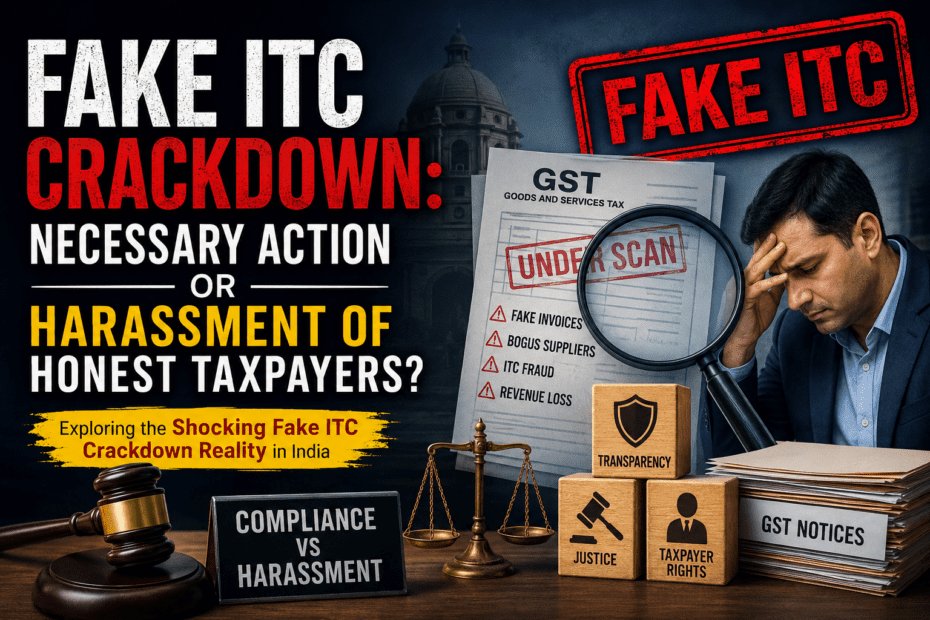
India’s GST system was introduced with the promise of transparency, simplified taxation, and better compliance. However, in recent years, one issue has created fear and confusion among businesses across the country — the aggressive crackdown on Fake Input Tax Credit (ITC). While the government argues that strict action is necessary to stop tax fraud, many honest taxpayers believe they are becoming unintended victims of the process.
The Shocking Fake ITC Crackdown Reality is now a major concern for MSMEs, startups, traders, and even compliant businesses that unknowingly deal with suspicious suppliers. GST notices, ITC reversals, account freezes, and investigations are increasing rapidly, raising an important question: Is this crackdown protecting the economy, or is it creating unnecessary pressure on genuine taxpayers?
In this blog “Shocking Fake ITC Crackdown Reality”, we will explore the complete reality behind fake ITC crackdowns, the government’s perspective, the problems faced by honest businesses, and what taxpayers should do to stay safe.
What is Fake ITC Under GST?
Input Tax Credit (ITC) allows businesses to reduce their tax liability by claiming credit for GST paid on purchases. However, fake ITC fraud happens when businesses claim tax credits using fake invoices, non-existent transactions, or shell companies.
Some common examples include:
Fake invoices without actual supply of goods or services
Bogus GST registrations
Circular trading
Fraudulent supplier networks
Claiming ITC from non-compliant vendors
The government loses thousands of crores every year due to such frauds. Because of this, GST authorities have intensified investigations and compliance checks.
The Shocking Fake ITC Crackdown Reality in India
The Shocking Fake ITC Crackdown Reality is that the government’s aggressive anti-fraud actions are not only targeting fraudsters but are also affecting genuine businesses.
Today, even honest taxpayers can receive notices if:
Their supplier fails to file GST returns
Vendor registration gets cancelled
GST payments are not deposited by suppliers
Invoice mismatches occur in GST returns
Businesses unknowingly deal with fake firms
This has created panic among MSMEs and small businesses that lack strong compliance teams.
Many businesses claim they are being punished for mistakes made by suppliers over whom they have limited control.
Why the Government is Taking Strict Action
From the government’s point of view, strict crackdowns are necessary to protect tax revenue and maintain GST system integrity.
Authorities believe fake ITC fraud:
Damages the economy
Reduces government revenue
Encourages black money circulation
Creates unfair competition
Weakens GST compliance culture
GST intelligence departments have uncovered several fake invoice rackets involving huge amounts. As a result, authorities now use:
AI-based risk analysis
Data matching tools
E-invoicing systems
GST return analytics
Bank account verification
The government argues that stronger enforcement improves transparency and discourages tax fraud.
The Biggest Concern for Honest Taxpayers
The real controversy begins when genuine businesses face consequences for supplier defaults.
Imagine this situation:
A business purchases goods legally, pays GST properly, receives invoices, and completes payment through banking channels. Later, the supplier disappears or fails to deposit GST with the government.
Now the buyer receives a notice demanding ITC reversal.
This is where the Shocking Fake ITC Crackdown Reality becomes alarming for honest taxpayers.
Many businesses ask:
“Why should the buyer suffer if the supplier commits fraud?”
This legal and ethical debate is growing rapidly across India.
How MSMEs Are Suffering Due to GST Crackdowns
Large corporations often have dedicated tax teams and compliance systems. But MSMEs face several challenges:
1. Vendor Verification Burden
Businesses now need to constantly verify suppliers, GST filings, registrations, and compliance status.
2. Increased Compliance Costs
Many small businesses are hiring GST consultants, accountants, and legal experts to avoid notices.
3. Fear of Department Notices
Even compliant businesses fear sudden GST investigations and ITC disputes.
4. Working Capital Pressure
If ITC gets blocked or reversed, businesses face cash flow problems.
5. Business Reputation Risks
GST investigations can create panic among customers, banks, and vendors.
For small businesses already struggling with inflation and market competition, this pressure becomes overwhelming.
Are GST Authorities Becoming Too Aggressive?
This is the most controversial part of the debate.
Critics argue that some GST investigations have become excessively aggressive. Reports of:
Bank account freezes
Immediate ITC blocking
Repeated notices
Sudden raids
Long investigations
have increased concerns among taxpayers.
Many business owners believe authorities sometimes treat procedural errors as intentional fraud.
Tax experts argue that there should be a clear distinction between:
Deliberate tax evasion
Genuine compliance mistakes
Without this distinction, honest businesses may lose confidence in the GST system.
Legal Position on Shocking Fake ITC Crackdown Reality Cases
Indian courts have also dealt with multiple disputes related to fake ITC.
Several judgments indicate that:
Buyers cannot always be punished for supplier fraud
Authorities must prove taxpayer involvement
Genuine transactions deserve protection
Natural justice principles must apply
However, legal interpretations still vary depending on facts and circumstances.
This uncertainty adds to the fear surrounding the Shocking Fake ITC Crackdown Reality.
How Businesses Can Protect Themselves
Businesses must now adopt stronger GST compliance practices to reduce risk.
Verify Vendors Regularly
Before dealing with suppliers:
Check GST registration validity
Verify return filing history
Confirm business existence
Monitor GST compliance ratings
Maintain Proper Documentation
Keep records of:
Tax invoices
E-way bills
Transport proof
Payment records
Purchase orders
Reconcile GST Returns Frequently
Regular reconciliation between:
GSTR-2B
Purchase register
Vendor filings
can help identify mismatches early.
Avoid Unrealistic Deals
Extremely cheap pricing or suspicious vendors may indicate fake invoice networks.
Seek Professional GST Guidance
Expert compliance support can reduce risk exposure significantly.
Technology Is Changing GST Enforcement
The government is increasingly relying on technology-driven monitoring systems.
Modern GST enforcement includes:
AI-powered fraud detection
E-invoice validation
Data analytics
PAN linkage checks
Banking transaction monitoring
While this improves fraud detection, it also increases compliance pressure on businesses.
The future of GST compliance may become even stricter as automation expands.
The Need for Balance in GST Enforcement
No one supports fake invoice scams or tax fraud. Strict action against organized fraud networks is necessary for economic stability.
However, the real issue is balance.
The GST system should:
Punish intentional fraudsters
Protect honest taxpayers
Reduce unnecessary litigation
Improve procedural clarity
Offer fair hearing opportunities
If fear becomes greater than trust, businesses may view GST as a burden instead of a reform.
That is why policymakers must ensure that enforcement remains fair, transparent, and practical.
Final Thoughts
The Shocking Fake ITC Crackdown Reality reveals a growing conflict between tax enforcement and taxpayer confidence in India.
On one side, the government must stop fake invoice fraud and revenue leakage. On the other side, honest businesses should not become collateral damage in the process.
The future success of GST depends on creating a balanced system where:
Fraudsters face strict punishment
Genuine taxpayers receive protection
Compliance becomes easier
Investigations remain fair and transparent
For businesses, the safest approach today is proactive GST compliance, regular vendor verification, and strong documentation practices.
As GST regulations continue evolving, staying informed and compliant is no longer optional — it is essential for business survival in modern India.
For professional GST advisory, compliance support, and legal guidance, connect with Taxamicus to safeguard your business against growing GST risks.


