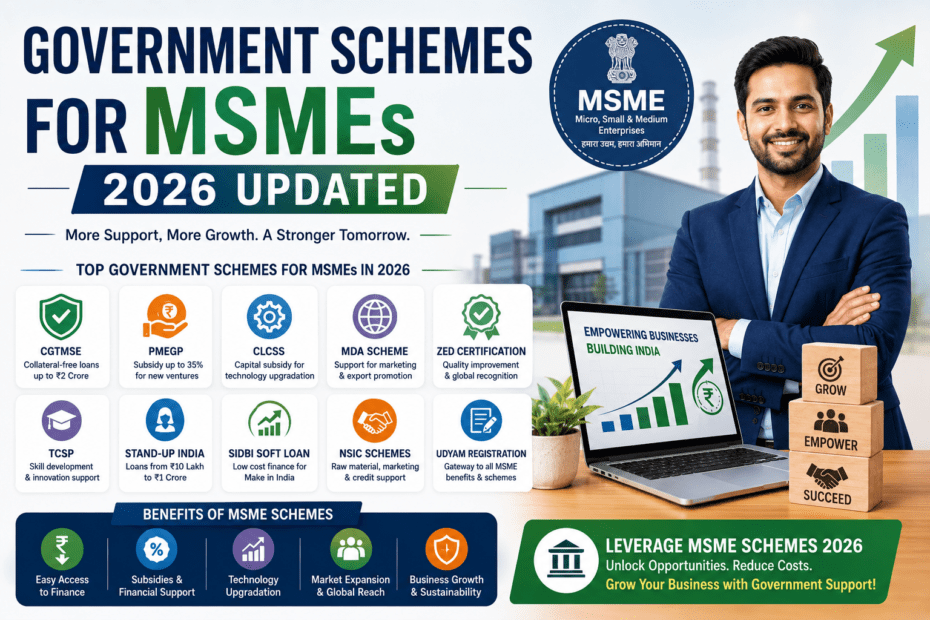
Micro, Small, and Medium Enterprises (MSMEs) are the backbone of India’s economic growth. They contribute significantly to employment generation, industrial production, and exports. However, despite their importance, many MSMEs struggle with challenges such as lack of funding, outdated technology, and limited market access.
To address these issues, the Government of India has introduced a wide range of schemes designed to support MSMEs financially, technically, and strategically. This detailed MSME Schemes 2026 guide will help you understand the most important schemes, their benefits, eligibility criteria, and how you can take advantage of them.
If you are a business owner or planning to start one, this guide will ensure you don’t miss out on valuable opportunities while also avoiding costly mistakes.
Why MSME Schemes Are Important in 2026
Government schemes are not just financial aids—they are growth accelerators. These schemes aim to:
Provide easy access to credit
Reduce financial burden through subsidies
Encourage innovation and modernization
Promote exports and global competitiveness
Support entrepreneurship across sectors
This MSME Schemes 2026 guide is essential because many businesses fail to utilize these benefits simply due to lack of awareness.
Overview of MSME Classification
Before applying for any scheme, you must understand whether your business qualifies as an MSME:
Micro Enterprise: Investment up to ₹1 crore, turnover up to ₹5 crore
Small Enterprise: Investment up to ₹10 crore, turnover up to ₹50 crore
Medium Enterprise: Investment up to ₹50 crore, turnover up to ₹250 crore
👉 Udyam Registration is mandatory to avail benefits under most MSME schemes.
Top Government Schemes for MSMEs in 2026
Let’s explore the most beneficial schemes included in this MSME Schemes 2026 guide:
1. Credit Guarantee Fund Trust for MSMEs (CGTMSE)
This scheme is designed to provide collateral-free loans to MSMEs.
Key Features:
Loans up to ₹2 crore without collateral
Government-backed guarantee for lenders
Reduced risk for banks
Why It Matters:
It enables startups and small businesses to access funding without pledging assets.
2. Prime Minister’s Employment Generation Programme (PMEGP)
PMEGP is a credit-linked subsidy scheme aimed at promoting self-employment.
Benefits:
Subsidy up to 35%
Financial support for new ventures
Focus on rural and urban employment
Ideal For:
Entrepreneurs starting new manufacturing or service businesses.
3. Credit Linked Capital Subsidy Scheme (CLCSS)
This scheme focuses on upgrading technology in MSMEs.
Benefits:
Capital subsidy for machinery purchase
Encourages modernization
Improves efficiency and productivity
Impact:
Helps MSMEs stay competitive in evolving markets.
4. Udyam Registration Benefits
Though not a scheme itself, Udyam registration unlocks access to all MSME benefits.
Advantages:
Eligibility for government schemes
Priority sector lending
Easier compliance
👉 Without Udyam registration, you cannot fully utilize MSME Schemes 2026.
5. Zero Defect Zero Effect (ZED) Certification Scheme
This scheme promotes quality manufacturing with minimal environmental impact.
Benefits:
Financial assistance for certification
Improved product quality
Better export opportunities
6. MSME Market Development Assistance (MDA)
This scheme supports marketing and export promotion.
Benefits:
Assistance for trade fairs and exhibitions
International exposure
Branding support
Why It’s Important:
Helps MSMEs expand beyond local markets.
7. Technology Centre Systems Programme (TCSP)
Focused on skill development and innovation.
Benefits:
Access to advanced tools and machinery
Training programs
Support for product development
8. Stand-Up India Scheme
Encourages entrepreneurship among women and SC/ST communities.
Benefits:
Loans from ₹10 lakh to ₹1 crore
Support for new enterprises
Promotes inclusive growth
9. SIDBI Make in India Soft Loan Fund
Supports manufacturing MSMEs.
Benefits:
Soft loans for expansion
Lower interest rates
Support for Make in India initiative
10. National Small Industries Corporation (NSIC) Schemes
NSIC provides multiple support services.
Benefits:
Raw material assistance
Marketing support
Credit facilitation
Hidden Risks of Not Using MSME Schemes
This MSME Schemes 2026 guide also highlights what happens if you ignore these opportunities:
❌ Higher cost of borrowing
❌ No access to subsidies
❌ Limited growth potential
❌ Reduced competitiveness
❌ Missed government support
👉 Not using these schemes can slow down your business growth significantly.
Eligibility Criteria for MSME Schemes
To benefit from MSME Schemes 2026, you must:
Be registered under Udyam
Meet MSME classification criteria
Maintain proper financial records
Comply with government regulations
Documents Required
While requirements vary by scheme, common documents include:
Aadhaar card
PAN card
Business registration proof
Bank account details
Project report (for loans/subsidies)
Step-by-Step Process to Apply
Here’s how you can apply for MSME schemes:
Register your business under Udyam
Identify the suitable scheme
Prepare necessary documents
Apply through official portals or banks
Track application status
Tips to Maximize MSME Scheme Benefits
To get the most out of this MSME Schemes 2026 guide:
✔ Stay updated with latest schemes
✔ Maintain accurate financial records
✔ Choose schemes relevant to your business
✔ Seek professional advice
✔ Apply early
Common Mistakes to Avoid
Avoid these mistakes while applying:
❌ Applying for irrelevant schemes
❌ Incomplete documentation
❌ Ignoring eligibility criteria
❌ Missing deadlines
❌ Not following up on applications
How MSME Schemes Drive Business Growth
MSME schemes play a crucial role in:
Reducing financial burden
Increasing profitability
Enhancing market reach
Improving operational efficiency
Encouraging innovation
MSME Schemes vs No Government Support
| Feature | With MSME Schemes | Without MSME Schemes |
|---|---|---|
| Loan Access | Easy | Difficult |
| Subsidies | Available | Not Available |
| Growth Rate | Faster | Slower |
| Risk Level | Lower | Higher |
Future of MSME Schemes in India
With digitalization and economic reforms, MSME schemes are expected to:
Become more accessible online
Offer faster approvals
Provide targeted industry support
Encourage startups and innovation
This makes MSME Schemes 2026 even more relevant for businesses.
Conclusion
Government schemes are a powerful tool for MSME growth and sustainability. This MSME Schemes 2026 guide shows how these initiatives can help businesses reduce costs, access funding, and expand operations.
At the same time, ignoring these schemes means missing out on valuable opportunities that can significantly impact your business success. Whether you are starting a new venture or scaling an existing one, leveraging MSME schemes is a smart and strategic move in 2026.
📞 Need Help with MSME Schemes?
If you want to take full advantage of government schemes without confusion or delays, expert guidance can make the process easier.
Taxamicus offers:
MSME (Udyam) Registration
Scheme consultation
Loan and subsidy assistance
Compliance support
Start leveraging MSME Schemes 2026 today and grow your business with confidence!


