Introduction
Input Tax Credit (ITC) is the backbone of the GST system. It allows businesses to reduce their tax liability by claiming credit for the tax paid on purchases. However, claiming ITC is not as simple as it sounds. With increasing scrutiny from tax authorities, even a small mismatch can lead to notices, penalties, and financial losses.
This is where understanding GSTR-2B vs GSTR-3B ITC becomes extremely important. Proper reconciliation between these two returns ensures that your ITC claims are accurate, compliant, and risk-free.
In this comprehensive guide, we will explore everything you need to know about GSTR-2B vs GSTR-3B ITC, including differences, matching process, common issues, solutions, and expert tips.
What is GSTR-2B?
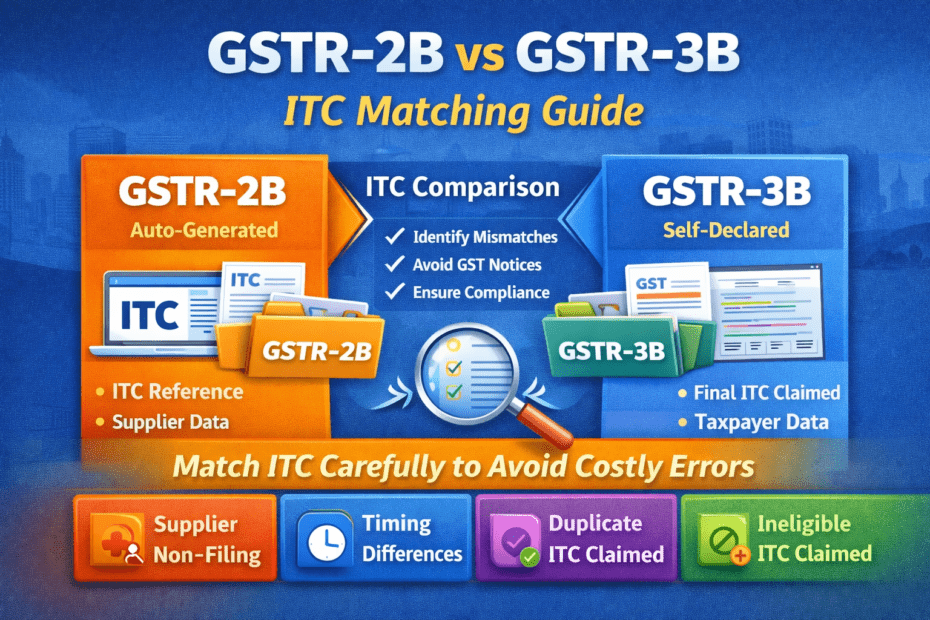
GSTR-2B is an auto-generated, static statement that provides details of Input Tax Credit available to a taxpayer for a specific period.
Key Features of GSTR-2B
Generated monthly by the GST portal
Based on supplier filings (GSTR-1, GSTR-5, GSTR-6)
Remains unchanged once generated
Shows eligible and ineligible ITC separately
Why is GSTR-2B Important?
GSTR-2B acts as a reliable reference for ITC claims. It helps businesses ensure that they are claiming only valid and eligible ITC.
What is GSTR-3B?
GSTR-3B is a summary return filed by taxpayers on a monthly or quarterly basis.
Key Features of GSTR-3B
Self-declared return
Includes outward supplies, tax liability, and ITC claimed
Determines actual tax payment
Can be revised only through future returns
Why is GSTR-3B Important?
GSTR-3B reflects the final ITC claimed by the taxpayer and is directly linked to tax payment.
GSTR-2B vs GSTR-3B ITC: Core Differences
| Aspect | GSTR-2B | GSTR-3B |
|---|---|---|
| Nature | Static | Dynamic |
| Type | Auto-generated | Self-declared |
| Purpose | ITC reference | Tax payment |
| Source | Supplier data | Taxpayer data |
| Revision | Not possible | Adjusted in future returns |
Understanding these differences is the foundation of accurate GSTR-2B vs GSTR-3B ITC matching.
Why ITC Matching is Crucial
1. Avoid GST Notices
Mismatch in ITC is one of the most common reasons for GST notices.
2. Prevent ITC Reversal
Incorrect ITC claims must be reversed with interest.
3. Maintain Compliance
Accurate matching ensures smooth GST compliance.
4. Protect Cash Flow
Incorrect ITC claims can block working capital.
Step-by-Step Process for ITC Matching
Here is a practical approach to GSTR-2B vs GSTR-3B ITC reconciliation:
Step 1: Download GSTR-2B
Access the statement from the GST portal.
Step 2: Categorize ITC
Separate:
Eligible ITC
Ineligible ITC
Step 3: Extract GSTR-3B Data
Identify ITC claimed in GSTR-3B.
Step 4: Compare Both Returns
Match:
Invoice values
GST amounts
Supplier details
Step 5: Identify Differences
Look for:
Missing invoices
Excess ITC claims
Timing differences
Step 6: Take Corrective Action
Adjust in next return
Reverse excess ITC
Follow up with suppliers
Common Reasons for ITC Mismatch
Understanding the root causes helps in better management of GSTR-2B vs GSTR-3B ITC.
1. Supplier Non-Compliance
If the supplier fails to file GSTR-1, ITC will not appear in GSTR-2B.
2. Incorrect Invoice Details
Errors in GSTIN, invoice number, or value.
3. Timing Differences
Invoices uploaded in a different period.
4. Duplicate ITC Claims
Same invoice claimed multiple times.
5. Ineligible ITC Claims
Blocked credits claimed mistakenly.
Impact of ITC Mismatch
1. GST Notices
Authorities issue automated notices for mismatches.
2. ITC Reversal
Excess ITC must be reversed with interest.
3. Financial Loss
Incorrect claims affect cash flow.
4. Increased Scrutiny
Repeated mismatches attract audits.
Real-Life Example
Case: ITC Over-Claim
ITC in GSTR-2B: ₹2,20,000
ITC claimed in GSTR-3B: ₹2,60,000
Issue:
₹40,000 excess ITC claimed.
Outcome:
GST notice issued
ITC reversal required
Interest penalty applied
👉 This clearly shows why GSTR-2B vs GSTR-3B ITC matching is essential.
Best Practices for ITC Matching
1. Monthly Reconciliation
Do not delay reconciliation.
2. Vendor Management
Track supplier compliance regularly.
3. Accurate Record-Keeping
Maintain proper invoice records.
4. Use Technology
Automate reconciliation processes.
5. Claim ITC Carefully
Only claim ITC reflected in GSTR-2B.
Advanced Strategies for Businesses
Create a vendor compliance rating system
Implement internal audit checks
Use reconciliation software
Train accounting staff regularly
These strategies strengthen your GSTR-2B vs GSTR-3B ITC process.
Common Mistakes to Avoid
Claiming ITC without verification
Ignoring GSTR-2B data
Not reconciling regularly
Delaying corrections
Avoiding these mistakes is key to compliance.
Handling GST Notices for ITC Mismatch
Steps to Follow
Review the notice carefully
Identify mismatch reasons
Gather supporting documents
Respond within deadline
Correct errors if required
Role of Technology in ITC Matching
Technology simplifies GSTR-2B vs GSTR-3B ITC reconciliation.
Benefits
Automated data matching
Real-time error detection
Faster processing
Reduced manual effort
Challenges in ITC Matching
Frequent GST updates
Complex reconciliation process
Supplier dependency
Technical issues
Future of ITC Matching in GST
The GST system is evolving towards:
Real-time ITC validation
AI-driven compliance checks
Automated reconciliation
This will make GSTR-2B vs GSTR-3B ITC even more critical.
When to Seek Professional Help
You should consult experts when:
ITC mismatch is significant
GST notices are received
Data reconciliation is complex
Professional assistance ensures accurate compliance.
Conclusion
Understanding GSTR-2B vs GSTR-3B ITC is essential for every GST-registered business. Proper ITC matching not only ensures compliance but also protects your business from financial risks and penalties.
The key takeaway:
👉 Always reconcile before filing
👉 Never claim unverified ITC
👉 Maintain proper documentation
By following these practices, businesses can avoid notices, improve compliance, and maximize GST benefits.
SEO Keywords (For Ranking Boost)
GSTR-2B vs GSTR-3B ITC, ITC matching guide, GST ITC reconciliation, GSTR-2B vs 3B difference, ITC mismatch solution, GST compliance India, ITC rules GST, GST reconciliation process.


