Introduction
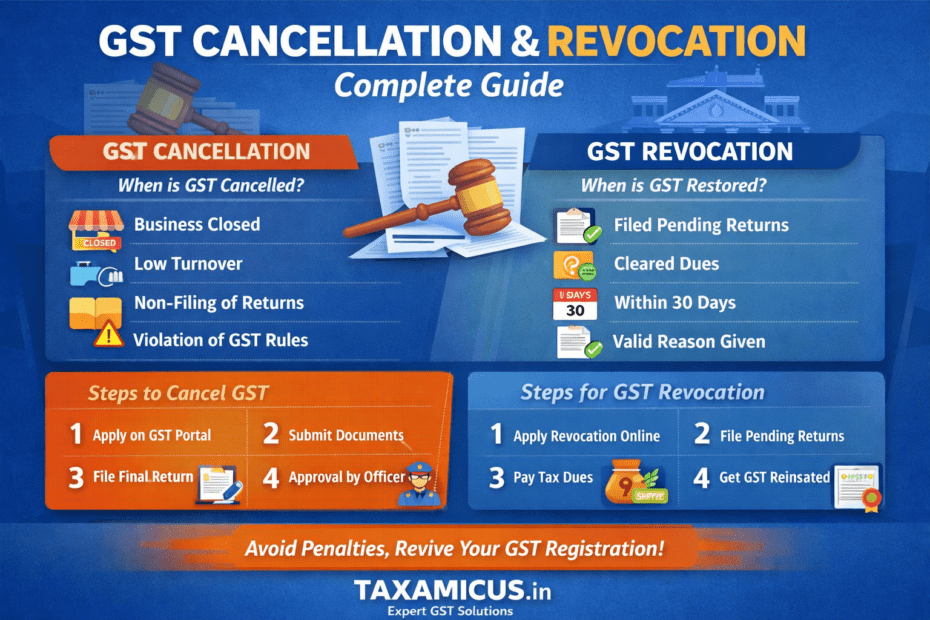
The Goods and Services Tax (GST) system has simplified indirect taxation in India, but it has also introduced strict compliance requirements. While GST registration is mandatory for many businesses, there are situations where cancellation becomes necessary. On the other hand, sometimes GST registration is cancelled by authorities due to non-compliance, and businesses need to restore it.
This is where understanding GST Cancellation & Revocation becomes crucial. Whether you are shutting down your business, restructuring, or trying to reactivate a cancelled GST number, having complete clarity on the process can save you from penalties, legal complications, and operational disruptions.
This GST Cancellation & Revocation guide will walk you through every aspect—from eligibility and procedures to common mistakes and expert tips.
What is GST Cancellation?
GST cancellation means the termination of a GST registration. Once cancelled, the taxpayer is no longer recognized as a GST-registered entity.
Effects of GST Cancellation
After cancellation:
You cannot collect GST from customers
You cannot claim Input Tax Credit (ITC)
You are not required to file GST returns (except final return)
This makes it important to carefully evaluate before proceeding with GST Cancellation & Revocation.
When Can GST Registration Be Cancelled?
A taxpayer can apply for GST cancellation under the following situations:
1. Business Closure
If the business is permanently shut down.
2. Business Transfer or Merger
When the business is sold, transferred, or merged with another entity.
3. Change in Business Structure
For example:
Proprietorship converted to company
Partnership changed into LLP
4. Turnover Below Threshold
If your turnover falls below the GST registration limit and you no longer wish to continue registration.
5. Voluntary Cancellation
You may choose to cancel GST if it is no longer beneficial.
Cancellation by GST Authorities
GST authorities may cancel your registration if:
You fail to file GST returns for a continuous period
You obtained registration through fraud
You violate GST rules
You do not conduct business from the declared place
This type of cancellation makes GST Cancellation & Revocation more complex, as revocation becomes necessary to continue operations.
What is GST Revocation?
GST revocation is the process of restoring a cancelled GST registration. It applies only when the cancellation is initiated by the tax department.
Purpose of Revocation
Resume business operations
Restore GST compliance
Continue claiming ITC
Understanding revocation is a key part of this GST Cancellation & Revocation guide.
Difference Between GST Cancellation and Revocation
| Aspect | GST Cancellation | GST Revocation |
|---|---|---|
| Meaning | Ending GST registration | Restoring cancelled GST |
| Initiated By | Taxpayer or authority | Taxpayer |
| Purpose | Stop compliance | Restart compliance |
GST Cancellation Process (Step-by-Step)
Step 1: Login to GST Portal
Access your GST account using credentials.
Step 2: Navigate to Cancellation Section
Go to:
Services → Registration → Application for Cancellation.
Step 3: Fill Cancellation Form
Provide:
Reason for cancellation
Date of cancellation
Details of stock and liabilities
Step 4: Verification
Submit using:
OTP
Digital Signature Certificate (DSC)
Step 5: ARN Generation
Application Reference Number is generated for tracking.
Step 6: Approval by Officer
GST officer reviews and approves the application.
Documents Required for GST Cancellation
GSTIN details
PAN card
Final return (GSTR-10)
Stock details
Proof of business closure (if applicable)
Final Return Requirement (Very Important)
After cancellation, you must file a final return (GSTR-10) within 3 months.
Failure to do so may result in penalties.
GST Revocation Process (Step-by-Step)
Step 1: Login to GST Portal
Access your account.
Step 2: Apply for Revocation
Go to:
Services → Registration → Apply for Revocation.
Step 3: Provide Reason
Explain why cancellation should be reversed.
Step 4: File Pending Returns
All pending GST returns must be filed.
Step 5: Pay Outstanding Dues
Clear:
Tax
Interest
Penalties
Step 6: Officer Review
Authorities verify and approve revocation.
Time Limit for GST Revocation
Application must be filed within 30 days from cancellation order
Extension may be allowed by authorities in special cases
Delays can make GST Cancellation & Revocation more complicated.
Common Mistakes in GST Cancellation & Revocation
Many businesses face issues due to:
1. Ignoring Pending Returns
Unfiled returns block revocation.
2. Incorrect Information
Wrong details lead to rejection.
3. Delay in Application
Missing deadlines reduces chances of approval.
4. Not Clearing Dues
Outstanding liabilities must be paid.
Consequences of GST Cancellation
1. Loss of Business Opportunities
Cannot work with GST-registered clients.
2. ITC Loss
Input Tax Credit cannot be claimed.
3. Legal Risks
Operating without GST when required leads to penalties.
4. Operational Disruption
Business activities may be affected.
Benefits of GST Revocation
1. Business Continuity
Resume operations smoothly.
2. Restore Compliance
Avoid legal complications.
3. ITC Recovery
Regain eligibility for tax credit.
4. Maintain Market Reputation
Remain compliant and trustworthy.
Real-Life Scenarios
Case 1: Non-Filing of Returns
A business fails to file returns → GST cancelled → files returns → applies for revocation → registration restored.
Case 2: Voluntary Cancellation
Small business shuts down → applies for cancellation → no further compliance required.
Case 3: Mistaken Cancellation
Business cancels GST unintentionally → applies for revocation within time limit.
Best Practices for Businesses
1. Think Before Cancelling
Consider future business plans.
2. Maintain Compliance
File returns regularly.
3. Act Quickly for Revocation
Do not delay application.
4. Keep Documents Ready
Ensure smooth processing.
Challenges in GST Cancellation & Revocation
Complex procedures
Strict timelines
Portal-related issues
Documentation errors
When to Seek Professional Help
You should consult experts if:
GST is cancelled by authorities
Revocation is rejected
High-value transactions are involved
Compliance is complex
Professional guidance ensures smooth handling of GST Cancellation & Revocation.
Future of GST Compliance
The GST system is improving with:
Faster processing
Simplified procedures
Better portal performance
Increased automation
These improvements will make GST Cancellation & Revocation easier in the future.
Conclusion
Understanding GST Cancellation & Revocation is essential for every business operating under GST. While cancellation may seem simple, it has long-term implications. Similarly, revocation requires timely action and proper compliance.
The key takeaway is:
Cancel only when necessary
Act quickly if revocation is needed
Maintain proper records and compliance
With the right approach, businesses can handle GST Cancellation & Revocation smoothly and avoid unnecessary complications.
SEO Keywords (For Ranking Boost)
GST Cancellation & Revocation, GST cancellation process India, GST revocation rules, GST registration cancellation, GST revocation application, GST compliance India, GST cancellation guide, GST revocation process.


