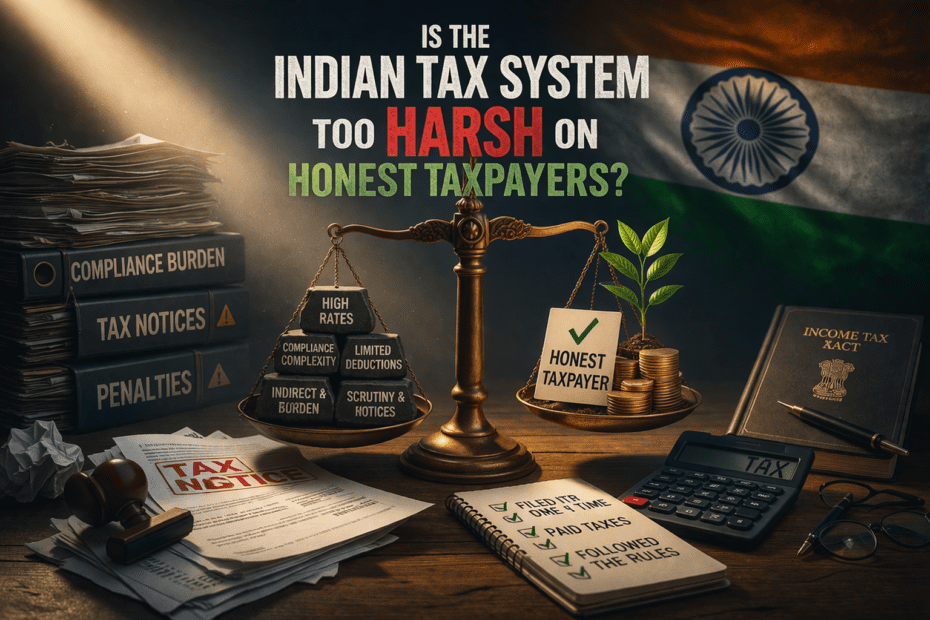
In India, paying taxes is not just a legal obligation—it is often seen as a moral responsibility. Honest taxpayers, especially salaried individuals and small business owners, consistently comply with regulations, file their Income Tax Returns (ITR), and contribute to the nation’s growth.
However, a growing concern continues to surface every year:
Is the system becoming unfairly tough on those who are the most compliant?
The phrase Harsh Indian Tax System has gained attention because many taxpayers feel that the burden of taxation is not equally distributed. While the system aims to ensure transparency and accountability, its real-world impact often tells a more complicated story.
In this blog, we dive deep into why the tax system feels harsh, how it impacts honest taxpayers, and what can be done to manage it effectively.
Understanding the Indian Tax Framework
India’s tax system consists of two primary components:
1. Direct Taxes
Income Tax
Corporate Tax
These are based on earnings and profits.
2. Indirect Taxes
Goods and Services Tax (GST)
Customs duties
These are applied to consumption and services.
The idea behind this structure is to balance economic growth with revenue generation. However, for the average taxpayer, especially the middle class, the burden often feels heavier than expected.
Why the System Feels Like a Harsh Indian Tax System
1. The Middle Class Bears the Maximum Load
The middle class is the most compliant segment of the economy. Salaried individuals:
Have taxes deducted directly (TDS)
Cannot easily manipulate income records
Have limited options for aggressive tax planning
This creates a scenario where:
Taxes are paid without delay
Financial flexibility is reduced
Savings potential is limited
As a result, the middle class often feels like the backbone—and the most burdened group—within the Harsh Indian Tax System.
2. Limited Growth in Deductions vs Rising Costs
Tax-saving provisions like Section 80C have remained largely unchanged for years. Meanwhile:
Education costs have increased significantly
Healthcare expenses have surged
Housing EMIs have become heavier
This mismatch means:
Real savings are declining
Tax benefits feel outdated
Even when taxpayers follow all rules, they don’t experience meaningful financial relief.
3. Increasing Complexity in Compliance
Modern tax filing is no longer simple. Taxpayers must deal with:
Multiple ITR forms
AIS (Annual Information Statement)
Form 26AS
TDS reconciliation
Capital gains reporting
Even a minor mismatch can result in notices. This complexity is a major reason why the system is perceived as harsh.
4. Double Burden of Direct and Indirect Taxes
The burden does not stop at income tax. Individuals also pay:
GST on goods and services
High fuel taxes
Service charges on utilities
So even after paying income tax, daily expenses are taxed again. This layered system increases the overall financial pressure.
Are Honest Taxpayers at a Disadvantage?
One of the strongest arguments against the Harsh Indian Tax System is that it appears stricter on those who follow it.
Why this perception exists:
Honest taxpayers disclose all income
Their financial records are transparent
Automated systems easily track their data
Meanwhile:
Informal sector income often goes unreported
Cash transactions remain harder to monitor
This creates an imbalance where compliance leads to higher visibility—and sometimes, higher scrutiny.
Automation and Technology: A Double-Edged Sword
The government has introduced advanced tools to improve transparency:
AIS (Annual Information Statement)
Data analytics systems
AI-based scrutiny
While these systems aim to reduce tax evasion, they also:
Flag even small mismatches
Trigger automated notices
Increase compliance pressure
For example:
If your bank interest differs slightly from AIS data, you may receive a notice—even if the difference is unintentional.
This contributes to the feeling of a Harsh Indian Tax System.
Old vs New Tax Regime: A Confusing Choice
The introduction of the new tax regime was meant to simplify taxation.
Benefits:
Lower tax rates
Fewer deductions to track
Drawbacks:
Loss of traditional tax-saving options
Not suitable for families with investments
Requires careful comparison
Many taxpayers find themselves confused rather than relieved. Instead of simplifying, it has added another layer of decision-making.
Impact on Small Businesses and Professionals
The burden is even higher for small business owners and freelancers.
They must:
Maintain detailed records
Manage GST compliance
Calculate taxes manually
Handle audits and notices
Unlike salaried individuals, they do not have automated deductions, making compliance more complex.
The combination of GST and income tax creates a heavy compliance load, reinforcing the idea of a Harsh Indian Tax System.
Psychological and Emotional Impact
The effects of taxation are not just financial—they are emotional.
Taxpayers often experience:
Stress during filing season
Fear of notices
Confusion over changing rules
Frustration with limited benefits
Over time, this leads to:
Reduced confidence in financial planning
Avoidance of investments due to tax implications
Increased dependency on professionals
Common Mistakes That Increase Tax Burden
Many taxpayers unintentionally increase their burden by:
🚨 Not Reporting All Income
Ignoring interest, dividends, or side income leads to mismatches.
🚨 Choosing the Wrong Tax Regime
Without proper calculation, taxpayers may pay more than necessary.
🚨 Incorrect Deduction Claims
Claiming ineligible deductions can lead to penalties.
🚨 Last-Minute Filing
Rushing increases the chances of errors.
Is the System Truly Harsh or Just Evolving?
To be fair, the system also has its strengths:
Positives:
Increased transparency
Reduced large-scale tax evasion
Digital convenience
Faster processing of returns
However, the challenge lies in balancing efficiency with simplicity. While the system evolves, taxpayers struggle to keep up.
How to Navigate the Harsh Indian Tax System Smartly
Instead of feeling overwhelmed, taxpayers can take proactive steps.
✔ Plan Your Taxes Early
Start planning at the beginning of the financial year.
✔ Maintain Proper Documentation
Keep all financial records organized and updated.
✔ Understand Your Financial Profile
Know your income sources, deductions, and liabilities.
✔ Use Technology Wisely
Use tools for assistance—but always verify data manually.
✔ Consult Experts
Professional advice helps:
Optimize tax liability
Avoid mistakes
Reduce stress
Why Professional Tax Planning Is Essential
In today’s environment, tax planning is no longer optional.
A professional can:
Identify savings opportunities
Ensure compliance
Handle notices efficiently
Provide long-term financial guidance
This helps reduce both financial and emotional burden.
How Taxamicus Simplifies Taxation
At taxamicus.in, we focus on making taxation simple and stress-free.
Our services include:
ITR filing and review
Tax planning strategies
Compliance support
Notice handling
We aim to help taxpayers navigate the Harsh Indian Tax System with confidence.
Future of Taxation in India
The future will likely involve:
More automation
Real-time data tracking
AI-driven compliance checks
Faster scrutiny processes
While this improves efficiency, it also increases the importance of accuracy.
Final Conclusion
So, is the Harsh Indian Tax System too tough on honest taxpayers?
For many, the answer is yes—especially when compliance is complex, benefits are limited, and indirect taxes continue to rise.
However, the solution is not to avoid the system but to understand and manage it better.
With proper planning, awareness, and expert support, taxpayers can:
Reduce unnecessary tax burden
Avoid penalties
Gain financial clarity
Need Help Managing Your Taxes?
If you want to:
✔ Save tax legally
✔ Avoid costly mistakes
✔ File returns without stress
Taxamicus is here to guide you.


