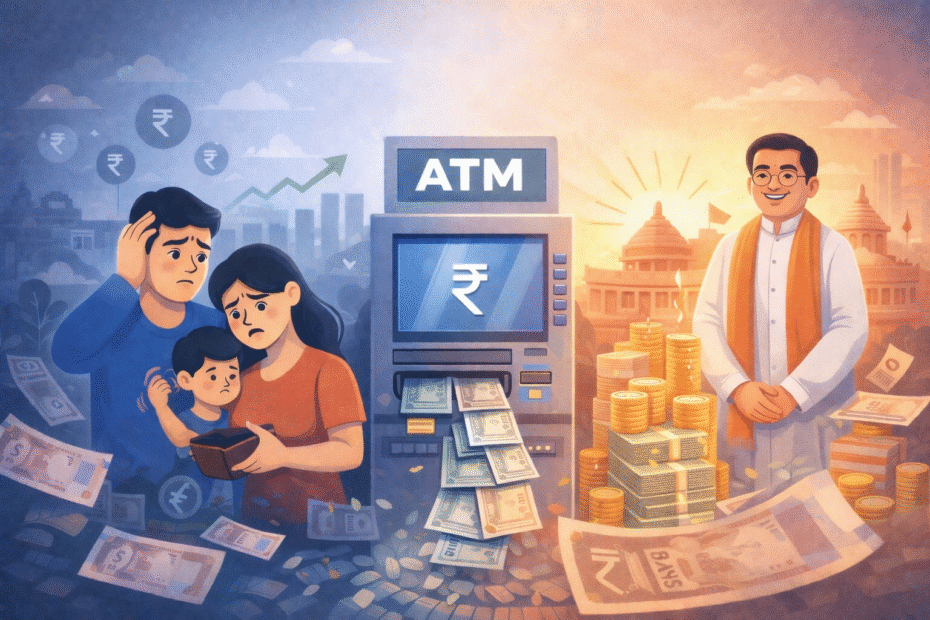
For decades, the Indian middle class has been called the backbone of the nation. They work hard, follow rules, pay taxes honestly, and dream of a stable future for their families. Yet, year after year, a growing question refuses to go away: Is the Indian middle class becoming the government’s Silent ATM?
The phrase Silent ATM Tax Burden perfectly captures the frustration many salaried and small business families feel today. Taxes are deducted automatically, compliance costs are rising, benefits seem limited, and relief often feels symbolic rather than meaningful.
This blog explores why the middle class feels financially squeezed, how the Silent ATM Tax Burden operates, and what taxpayers can do to protect themselves legally and strategically.
Understanding the Silent ATM Tax Burden
The Silent ATM Tax Burden refers to a situation where a specific group—primarily the middle class—consistently contributes a large share of tax revenue without proportional benefits, representation, or relief.
Unlike large corporations that have structured tax planning or informal sectors that often remain outside the tax net, the middle class is:
Highly visible to the tax system
Easy to tax through TDS and GST
Less able to evade or delay payments
Expected to comply fully and silently
This makes the middle class a reliable and predictable source of revenue—much like an ATM that never complains.
Why the Middle Class Feels Targeted
1. Automatic Tax Collection Through TDS
For salaried individuals, income tax is deducted before the salary even reaches their bank account. There is no flexibility, no negotiation, and no delay.
While compliance is important, the lack of choice reinforces the Silent ATM Tax Burden. Taxes are paid first; expenses come later.
2. Limited Tax-Saving Opportunities
Most middle-class taxpayers rely on basic deductions like:
Section 80C (PF, LIC, ELSS)
Section 80D (Health Insurance)
Standard deduction
These limits have not kept pace with inflation, rising education costs, or healthcare expenses. Meanwhile, compliance complexity has increased.
3. High Indirect Taxes on Daily Life
Even after paying income tax, middle-class families face heavy GST on essentials, including:
Fuel (outside GST but heavily taxed)
Insurance premiums
Mobile bills and internet
Home maintenance and appliances
This creates a double burden—direct tax + indirect tax, strengthening the Silent ATM Tax Burden.
Budget Announcements vs Ground Reality
Every Union Budget raises hopes for tax relief. However, middle-class expectations often clash with reality.
Common Budget Promises:
“Tax relief for the common man”
“Boosting disposable income”
“Supporting middle-class aspirations”
Common Outcomes:
Minor slab tweaks
Optional tax regimes with fewer deductions
Compliance-heavy changes without real savings
This growing gap between expectation and outcome fuels the belief that the middle class exists mainly to fund government spending.
Who Actually Benefits More?
1. Corporate Tax Cuts
In recent years, corporate tax rates have been reduced significantly to promote investment and growth. While economically justified, middle-class taxpayers often ask:
“Why are companies getting relief while individuals pay more?”
2. Subsidy-Focused Welfare Programs
Most welfare schemes are targeted at:
Below Poverty Line (BPL) groups
Rural households
Specific voter segments
The middle class usually falls outside eligibility limits—earning “too much” for subsidies but “too little” for financial comfort.
3. Informal Economy Escaping the Net
A large section of the economy still operates in cash or semi-formal systems. The result?
Honest taxpayers pay more
Non-compliant segments contribute less
This imbalance deepens the Silent ATM Tax Burden on compliant citizens.
Psychological Impact on Middle-Class Families
The Silent ATM Tax Burden is not just financial—it is emotional.
Many families feel:
Financially stuck despite rising incomes
Afraid to grow income due to higher tax slabs
Discouraged from entrepreneurship
Constantly audited, tracked, and monitored
Instead of feeling empowered, taxpayers often feel punished for honesty.
Is the New Tax Regime a Solution?
The government introduced optional tax regimes promising simplicity and lower rates. However, for many middle-class taxpayers:
Deductions are lost
Savings discipline weakens
Real tax savings are minimal
For families with home loans, insurance, children’s education, and medical expenses, the old regime often still makes more sense.
This again raises the question—is simplification masking the Silent ATM Tax Burden rather than solving it?
How the Middle Class Can Fight Back—Legally
While the system may feel unfair, smart planning can reduce the impact of the Silent ATM Tax Burden.
1. Strategic Tax Planning (Not Last-Minute Saving)
Tax planning should be done at the beginning of the financial year—not in March panic mode.
Professional planning can help:
Optimize deductions
Choose the right tax regime
Structure salary efficiently
Avoid unnecessary taxes
2. Use Family-Based Planning
Many families overpay tax by ignoring:
Income splitting opportunities
HUF benefits
Clubbing provisions
Senior citizen exemptions
Legal structuring can significantly reduce tax liability.
3. Don’t Ignore Compliance Benefits
Proper filing and compliance help in:
Faster refunds
Avoiding penalties
Clean financial records
Easier loans and visas
The goal is not to evade tax—but to pay only what is legally required, nothing more.
The Role of Tax Professionals
Navigating the Silent ATM Tax Burden alone is risky. Laws change frequently, interpretations evolve, and mistakes are costly.
A professional tax advisor:
Understands budget implications
Interprets new tax rules correctly
Protects you during scrutiny or notices
Aligns tax planning with long-term goals
For middle-class families, expert guidance is no longer optional—it is essential.
Final Thoughts: Silent, But Not Powerless
The Indian middle class may feel like the government’s Silent ATM—but silence does not mean helplessness.
Awareness, planning, and professional support can:
Reduce unnecessary tax outflow
Improve financial stability
Restore confidence in the system
The Silent ATM Tax Burden is real, but with the right approach, middle-class taxpayers can regain control over their money—legally, ethically, and smartly.
About Taxamicus
At taxamicus.in, we help individuals and families navigate India’s complex tax system with clarity, strategy, and confidence. Our goal is simple:
You should pay taxes—but never more than what the law requires.
Our GST Services

All E-commerce Tax services
E-commerce tax services help online sellers navigate GST registration, compliance, return filing, TCS management, tax planning, and audits, ensuring efficient tax management and legal compliance.
GST Filing
GST filing is the process of submitting tax returns to the government, detailing sales, purchases, and taxes paid or collected, ensuring compliance with GST laws.

GST Registration
GST registration is the process where businesses obtain a GSTIN from the government, allowing them to collect taxes, claim input tax credits, and comply with GST laws.


